University of Melbourne Brand Guidelines
A winged Victory, a colony’s stars and a line of Horace.
Aa
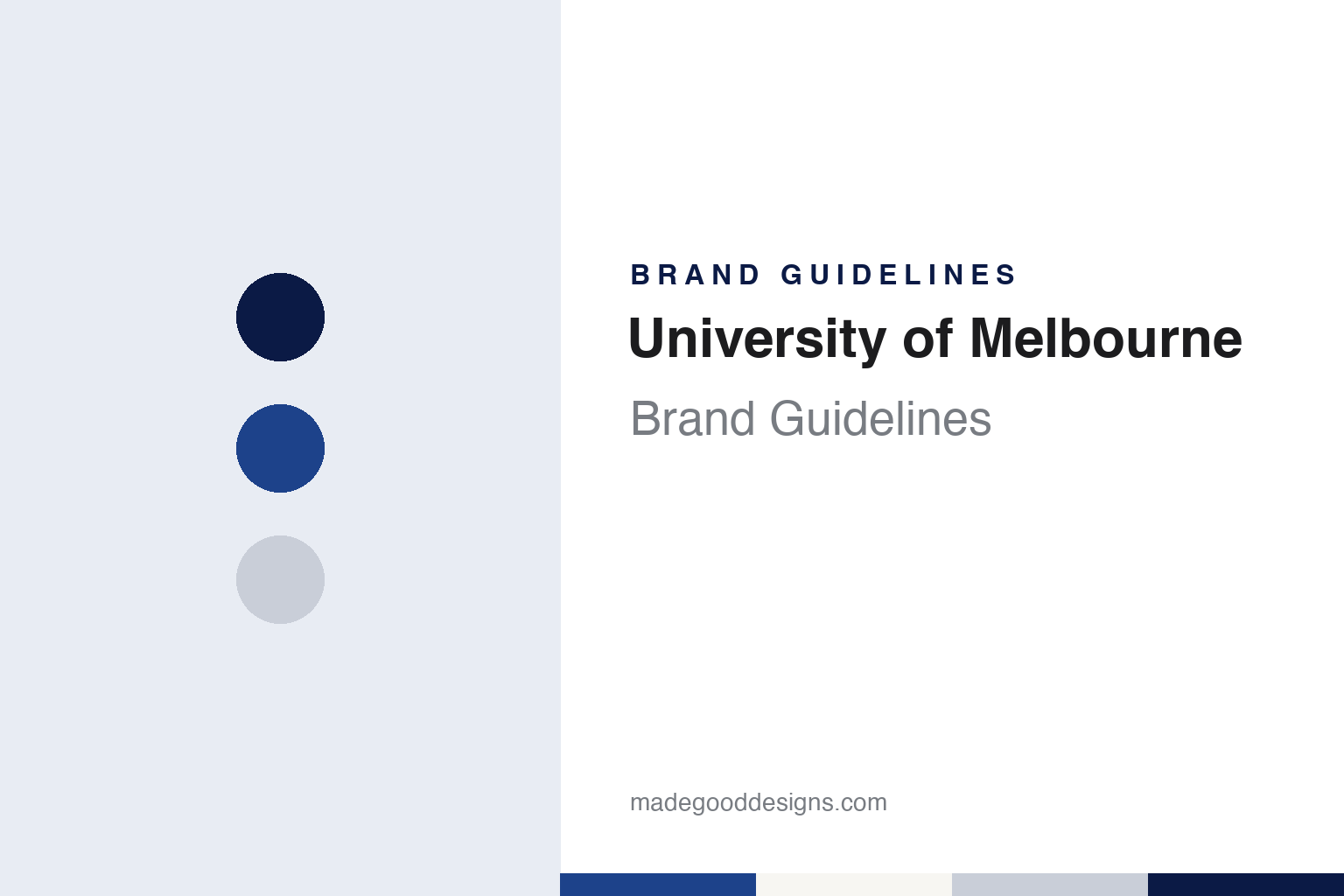
Two constants: a heritage blue, star silver and laurel gold palette and a colonial book serif register. Abstract homage — not a University of Melbourne mark; no figure, star, shield or logo is reproduced.
Parkville, 1853
An act of parliament, a judge and a Gothic quadrangle.
The University of Melbourne was established by an act of the Parliament of Victoria on 22 January 1853, with power to confer degrees in arts, medicine, laws and music, English Wikipedia says. Its foundation stone was laid on 3 July 1854, the same day as that of the public library in the city, and teaching began in 1855 with three professors, all from Ireland. The original buildings on the Parkville site, north of the city centre, were officially opened by the lieutenant-governor of the colony, Sir Charles Hotham, on 3 October 1855.
A central figure in the founding was Redmond Barry, a judge of the colony. Writing in the Australian Dictionary of Biography in 1969, Peter Ryan called Barry the “indubitable prime founder” of the university, despite beliefs that the credit belonged largely to the politician Hugh Childers, and noted that Barry served as its chancellor from 1853 until 1880 while also presiding over the trustees of what is now the State Library of Victoria. Ryan describes a chancellor who would pace out the dimensions of a new building on the muddy ground before going in to chair a meeting. Childers, for his part, pursued Letters Patent in England, granted in 1859, which recognised the university’s degrees across the British Empire, according to the university’s archives.
Architecture gave the young institution its early look. Several of the earliest buildings, including the Old Quadrangle, were built in a Gothic revival style, Wikipedia says, and the Old Quad was restored in 2019 to return elements of its original design, including a space for temporary exhibitions in the Treasury Gallery.
Colour
A seal by Ludwig Becker, a grant of arms and a line from Horace.
The university council was quick to want an official seal. Its archives say that in 1854 it reluctantly adopted an isometric view of the proposed buildings, drawn by the university architect, Mr White, which appeared on the earliest diplomas and was blocked onto official book covers. In 1855 the artist Ludwig Becker submitted a new design much more to the council’s liking, and that became the seal.
The coat of arms followed. Arms could then be granted only by the heralds in London, and the archives record that on 15 January 1863 the council received the painted parchment. In the heralds’ language it was intended to represent Victory robed, her right hand extended and holding a wreath of laurel in gold, between four eight-pointed silver stars on a blue field. The archives note that the drawing has varied over time, including the addition and regrouping of the stars as the Southern Cross, and that the winged figure — borrowed from the Greek Victory of peace and virtue — can also be read, as the Latin Victoria, as a reference both to the colony and to the queen it was named after. Some have taken the similarity between the arms and Becker’s seal as a sign that the seal was the model.
The motto came earlier still. The founders adopted Postera crescam laude in 1854, usually translated as “I shall grow in the esteem of future generations.” In a 2014 essay in the university’s magazine 3010, the then vice-chancellor Glyn Davis explained that the phrase is taken from an ode by the Latin poet Horace, written around 23 BC, in which the poet predicts that his work will outlast bronze and the pyramids. The motto has also lent its words to strategy: the university’s planning papers of 2005, 2010 and 2014 were titled Growing Esteem.
Typography
Stars, Latin and cloisters.
Many university marks borrow their imagery from the natural world. A leaf, a flower or a tree stands in for growth and continuity, and a cluster of stars can tie an institution to the sky above its home country. These motifs suit identity work because they reduce well: a single leaf or a handful of points can be drawn as a crisp outline that survives on a lanyard, a web favicon or an embroidered scarf, while the fuller heraldic version stays on degree certificates and ceremonial banners.
Latin mottos play a similar role in text form. A short phrase set in capitals beneath a shield signals continuity with older academic traditions, and designers often keep it on formal documents while dropping it from everyday digital layouts where space is tight.
Buildings and gateways also become symbols. A gate, a tower or a quadrangle that appears in photographs year after year can turn into a shorthand for the whole institution, sometimes appearing in merchandise, alumni publications and social media long before it enters any official logo. Colour completes the system: a named school colour gives teams, gowns and printed matter a shared thread even when the emblem itself changes.
Aa
Colonial book serif — the register of a bound diploma and a foundation-stone inscription. (Specimen set in Libre Caslon Text, a serif STAND-IN; NOT the University of Melbourne trademark.)
University of Melbourne
A crest inside the logo, a single blue and a licensing desk.
The everyday identity grows directly out of the 1863 grant. English Wikipedia says the university’s brand logo is based on the current version of the coat of arms used on degree parchments, so the figure of Victory and her stars sit inside the trade mark rather than being kept apart from it. The university’s Brand Hub, as archived in October 2023, says the name, crest and logo together support the university brand, and that the logo’s elements, combined with the university’s blue — named Traditional Heritage Blue — make up the University of Melbourne “marks”.
The Brand Hub treats those marks as fixed. It says they should never be adapted, adjusted, separated or edited, and that anyone wishing to use the logo, from students and alumni to suppliers and partners, must ask the Brand Management team, which issues licences with end dates. Students representing the university in competitions need a faculty endorsement before asking, and those who want bespoke merchandise are told to check with their faculty and the brand team beforehand; logo-bearing goods may not be sold for profit. Doctoral students are directed to approved poster templates for presenting research, and business cards for conference travel are ordered through the university’s design team.
Ceremony keeps its own objects. The university did not acquire a ceremonial mace until 1966, its archives say; designed in 1965 by the silversmith Stuart Devlin, it was presented by Aubrey Gibson. Alongside the formal marks, English Wikipedia lists a mascot, Barry the Bear, used in orientation activities for new students.
For a design guide, the University of Melbourne shows how a colonial grant of arms can be carried into a modern trade mark, with the Southern Cross quietly redrawn and a single named blue doing the rest; compare the University of Oxford and UCL for other systems that keep heraldry and a house colour in step. For this guide we use heritage blue, star silver and laurel gold with a serif, an unofficial interpretation; no product or logo is reproduced.
Explore & save
Keep University of Melbourne’s identity on hand — save it to a board in the Made Good inspiration library.
University of Melbourne identity set
Pin the University of Melbourne heritage blue, star silver and laurel gold palette and the colonial book serif register to your own board.