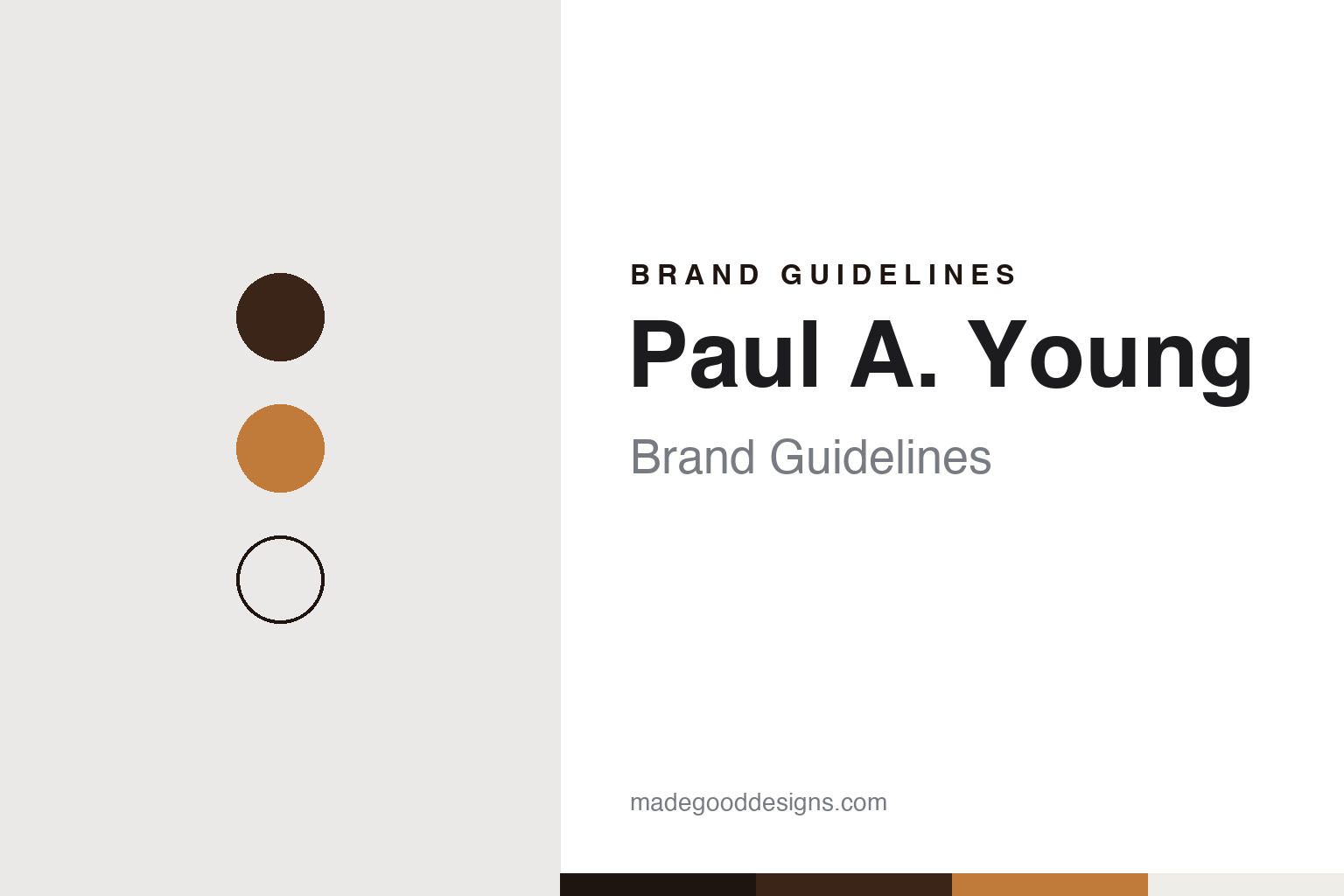
Paul A. Young Brand Guidelines
The London chocolatier of the Marmite truffle.
Aa
Two constants: a ganache, caramel and sea-salt palette and a Geometric sans register. Abstract homage — not a Paul A. Young product or mark; no box, shopfront, logo or nameplate is reproduced.
Camden Passage
A pastry chef turns chocolatier.
Paul A. Young came to chocolate from restaurant kitchens. After studying hotel catering in Durham and at Leeds Metropolitan University, he worked as head pastry chef for Marco Pierre White at the Criterion and Quo Vadis in London, the guide Chocolatier.co.uk and English Wikipedia say, and then, according to the Daily Express in 2014, as a product developer for Marks & Spencer and Sainsbury’s.
Young was born in Barnsley, in South Yorkshire, and grew up in County Durham, English Wikipedia says; the Daily Express called him “the UK’s own Willy Wonka” in a 2014 profile. Chocolatier.co.uk adds that he has taught cookery classes on P&O cruise ships.
His business partner was James Cronin. Companies House records show that the company behind the shops was incorporated in 2001 under another name, with Cronin as a director, and took the name Paul A Young Fine Chocolates in August 2004, when Young joined the board; English Wikipedia dates the founding of the company to 2004 for that reason.
The first shop opened in 2006 in Camden Passage, the antiques lane in Islington, north London. Chocolatier.co.uk says the opening range was led by the sea-salted caramels that stayed a customer favourite for the next 17 years; Young told the Daily Express in 2014 that “some people thought salted caramel was really odd but it’s very mainstream now.”
Colour
Islington, the City and Soho.
The business grew to several London shops. English Wikipedia says a second opened in 2007 in the Royal Exchange, in the City, and a flagship on Wardour Street in Soho in June 2011, citing Londonist; the Daily Express wrote in 2014 of shops in Islington, the City, Soho and near Euston station. The Royal Exchange shop closed around August 2019, which Young attributed to rent rises, Wikipedia says.
Young’s name was built on flavour. The Daily Express credited his reputation to combinations such as sea-salted caramel, sweet fennel with lemon, and beer with black pudding, and above all to the Marmite truffle, a ganache made with the yeast spread. Chocolatier.co.uk also singles out a two-ingredient champagne truffle and the shops’ brownies. The approach was a chef’s one, with the chocolatier himself as the brand.
He became a familiar face on British food television. English Wikipedia lists appearances on Saturday Kitchen and This Morning, a series of The Sweet Makers on BBC Two in 2017, Snackmasters on Channel 4 in 2020 and an episode of Top Chef: World All-Stars in 2023. He published two books: Adventures with Chocolate in 2012, and Sensational Chocolate in 2016, a collection of recipes from well-known contributors whose profits went to the Children’s Air Ambulance, according to English Wikipedia, citing the Yorkshire Post.
Typography
Heritage chocolate in Britain and Ireland.
The seven brands in this group all make or sell chocolate, and they come from two countries: Fry’s, Rowntree’s, Terry’s, Paul A. Young and Willie’s Cacao from England, and Lily O’Brien’s and Butlers from Ireland. Together they span most of the history of chocolate on these islands, from names that were household words long before the modern supermarket to makers who started within living memory.
Some of the oldest names in British chocolate grew out of Quaker family firms, and several of them now belong to multinational groups, so the name on the wrapper and the company behind it can tell two different stories. Ireland has its own tradition of chocolatiers, whose boxes and bars carry an Irish identity to shoppers at home and abroad. And a newer generation of makers has grown up in London shops and Devon workshops, where the founder’s own name and story often do the work a corporate logo would do elsewhere.
Each guide separates what independent sources record from what the company says about itself — who founded it, who owns it now, where its cocoa comes from and where its chocolate is made today — and marks plainly what rests only on the company’s own word.
Aa
A geometric sans — a clean, chef-like register. (Specimen set in Jost, a sans STAND-IN; NOT the Paul A. Young logo.)
Paul A. Young
The end of the shops, and of the company.
The business moved online late. Chocolatier.co.uk says it had long offered mail order but launched an online shop only in 2020, as the pandemic began. By 2023 the Soho and Royal Exchange shops had closed, leaving Camden Passage, and on 31 July 2023 that shop shut too, ending 17 years of trading on the street. Young thanked customers and suppliers on Instagram, calling it “an incredible journey,” Chocolatier.co.uk reported in August 2023; no reason for the closure was given. The site’s writer, while stressing that the reasons were unknown, set the closure against a hard period for small chocolate shops in Britain: the pandemic, high overheads for bricks-and-mortar businesses, changing shopping habits and rising costs for cocoa and sugar.
The company itself has since ended. The Companies House record shows that its last filed accounts were made up to the end of 2022, that notices of compulsory strike-off were published from December 2024, and that Paul A Young Fine Chocolates Ltd was dissolved on 29 September 2026 by compulsory strike-off — the process by which the registrar removes a company, rather than an administration or liquidation. The register classifies the company’s business as including the manufacture of cocoa and chocolate confectionery as well as specialist confectionery retail, which fits the shops’ model of making and selling under one name. When we checked the register in October 2026, it listed no insolvency proceedings. A related company, Paul A Young Fine Chocolates UK Ltd, had already been dissolved in November 2021.
Paul A. Young is therefore a closed brand, not a trading one: the name survives in Young’s books and television work rather than in shops. Its short history still shows a pattern common among London chocolatiers — a chef’s name over the door, one signature flavour that becomes mainstream, and a small number of shops that are expensive to keep.
For a design guide, Paul A. Young shows how a brand built on one person’s name and flavour ideas can be strong and still short-lived. Compare Rococo Chocolates, another founder-led London chocolatier, and Prestat. For this guide we use dark ganache, salted caramel and sea-salt white with a sans, an unofficial interpretation; no product or logo is reproduced.
Explore & save
Keep Paul A. Young’s identity on hand — save it to a board in the Made Good inspiration library.
Paul A. Young identity set
Pin the Paul A. Young ganache, caramel & sea-salt palette and the Geometric sans register to your own board.