French Broad Chocolate Brand Guidelines
The Asheville chocolate maker that came home from Costa Rica.
Aa
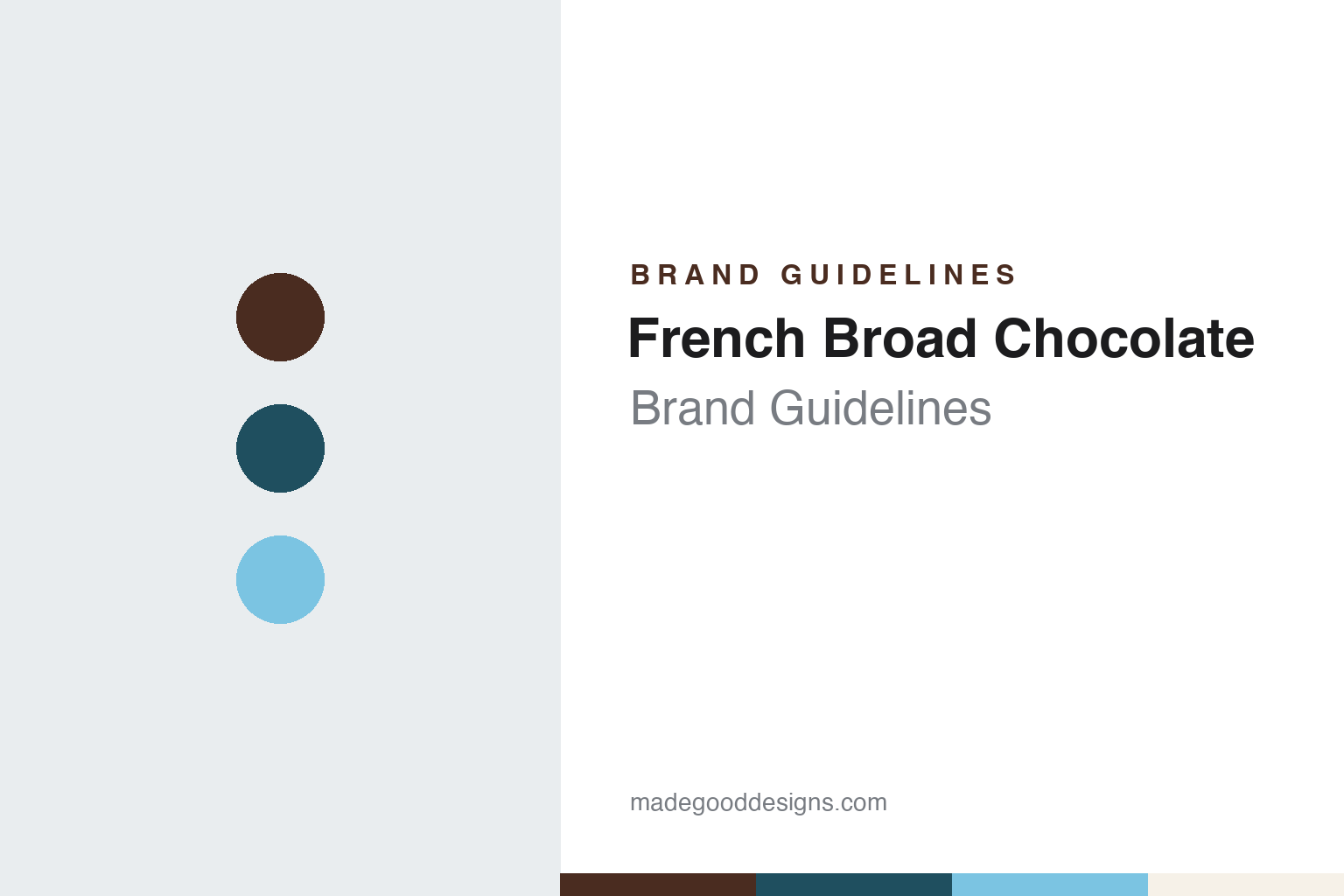
Two constants: a river teal, lounge blue and cacao palette and a slab serif register. Abstract homage — not a French Broad Chocolate product or mark; no chocolate, wrapper or logo is reproduced.
From a bus to a lounge
Costa Rica first, then Asheville.
French Broad Chocolate is a bean-to-bar chocolate maker and dessert business in Asheville, North Carolina, founded by Dan Rattigan and Jael Skeffington. The company’s own account begins in 2003, when the two met at a wedding. After a trip to Costa Rica, it says, they left graduate school, packed their lives into a 40-foot school bus that Dan had converted to run on vegetable oil, and drove south. In Costa Rica they bought an abandoned cacao plantation and opened a café and dessert shop, Bread & Chocolate, in the Caribbean village of Puerto Viejo de Limón. After about a year they sold it to one of their cooks and headed north again.
They settled in Asheville and started over from a home kitchen, selling chocolates online and at farmers markets. An archived 2007 version of their website introduces the business as French Broad Luscious Chocolates, “a small, family-run company” of two that made organic truffles by hand. The name came from the French Broad River, which runs through the city; a 2009 page on the company’s website said the river helped it “establish our local identity,” and admitted to enjoying the double meaning as well. The company now calls itself French Broad Chocolate, though its web address still uses the plural.
Demand soon outgrew the kitchen, the company says, and in 2008 it opened the French Broad Chocolate Lounge on South Lexington Avenue. Mountain Xpress, the Asheville weekly, dated the opening to February 2008 in its Best of Asheville coverage for 2010, which the company’s press page quoted; it reported that the lounge had tripled its seating within about 18 months. The lounge expanded to upper floors in 2009 and in 2014 moved to Pack Square in the centre of downtown, where the company now describes its “signature blue building.”
Colour
A factory by the river.
The step from chocolatier to chocolate maker came in 2012, when the company opened the French Broad Chocolate Factory & Tasting Room on Buxton Avenue in Asheville’s South Slope. It began buying cacao beans rather than finished chocolate, and it now says that all of the chocolate used in its products, from bars to bonbons and desserts, is made in its own Asheville factory.
In August 2017 the company announced on its blog that the factory would move to a 12,000-square-foot space in the River Arts Makers Place, or RAMP Studios, beside its namesake river, raising production from 18 to 50 tons a year; it said it then employed more than 80 people. Its history page says the move took place in November 2018 and gives the space as 14,000 square feet, with the capacity for “nearly 50 tons of chocolate each year,” so we note both figures. The building on Riverside Drive is now the company’s Chocolate Factory & Cafe, with a shop and daily factory tours.
The company describes its process step by step: cleaning and roasting the beans, winnowing off the husks, pre-refining the nibs on a two-roll granite mill, grinding in a ball mill, conching, sieving and tempering. It also presses some of its own cocoa butter, which it says goes into its single-origin bars.
The Costa Rica connection runs through the company’s story more than through its current bar range. In 2017 it listed farmers in Nicaragua, Peru, Brazil, Guatemala and Costa Rica among those it sourced from directly, and its website shows Dan Rattigan planting a cacao tree in Costa Rica. The single-origin dark bars it lists in October 2026 come from Nicaragua (Cacao Bisiesto), the Dominican Republic (Zorzal Cacao) and Uganda (Semuliki Forest).
Typography
American chocolate, old and new.
The seven brands in this group are all American: Ethel M, See’s Candies, Russell Stover, Fannie May, Lake Champlain Chocolates, French Broad Chocolates and Endangered Species Chocolate. Together they cover much of the range of American chocolate and candy, from the gift box bought for a holiday to the single bar picked up at a grocery checkout.
American boxed chocolate grew up around the shop front. Many of the country’s candy companies began as a single kitchen or store selling to local customers, and some built chains of their own shops, while others moved into drugstores, supermarkets and seasonal aisles. The assorted box, with its printed lid and its paper map of fillings, became a familiar gift, and regional makers came to be known as much for a place as for a product. More recently, small makers have added bean-to-bar chocolate, cafés and factory tours, and bar brands have used the wrapper itself to carry a story or a cause.
Each guide separates what independent sources record from what the company says about itself — who founded it, who owns it now, where its cocoa comes from and where its chocolate is made — and marks plainly what rests only on the company’s own word.
Aa
A slab serif — sturdy, local and handmade in feel. (Specimen set in Bitter, a serif STAND-IN; NOT the French Broad Chocolate logo.)
French Broad Chocolate
Asheville’s “cultural terroir.”
The company frames its brand around place. Its website describes a “cultural terroir” drawn from Asheville: it says it shares cacao imports with other regional chocolate makers, buys from local farms — strawberries from Sandy Mush each spring, for example — and gives its cacao shells to local farmers and gardeners as mulch. In September 2017 it announced that it had become a certified B Corporation, and its careers page still describes it as a “values-driven, Certified B-Corp.” Today the company names Jael Skeffington as co-founder and chief executive and Dan Rattigan as co-founder with the title CIO; we found no sale of the business in the sources we checked.
Its bar range mixes origin chocolate with flavoured bars such as Brown Butter Milk Chocolate, Scorpion Pepper Dark Chocolate and a Whiskey Barrel dark bar with smoked salt, alongside bonbons, caramels and drinking chocolate. In 2017 the company reported winning four International Chocolate Awards in that year’s Americas and Asia-Pacific competition, including a silver for its hazelnut dragée and a bronze for its strawberry balsamic truffles; we give that as the company’s account.
After Hurricane Helene brought catastrophic flooding to western North Carolina at the end of September 2024, the company’s website told customers in early October that ordering “will support our efforts to recover from catastrophic floods.” Its factory café and the Pack Square lounge are both listed as open in October 2026.
No official colour palette or typeface is published, so the tones here are our own reading of the brand’s river name and blue lounge.
For a design guide, French Broad Chocolate shows how a small maker can build an identity from a river and a town rather than from a product alone. Compare Askinosie, an American bean-to-bar maker that also tells its story through direct sourcing, and Dandelion Chocolate, another American bean-to-bar maker. For this guide we use river teal, lounge blue and cacao brown with a slab serif, an unofficial interpretation; no product or logo is reproduced.
Explore & save
Keep French Broad Chocolate’s identity on hand — save it to a board in the Made Good inspiration library.
French Broad Chocolate identity set
Pin the French Broad Chocolate river teal, lounge blue and cacao palette and the slab serif register to your own board.