Purdys Chocolatier Brand Guidelines
Vancouver’s purple-and-gold chocolatier since 1907.
Aa
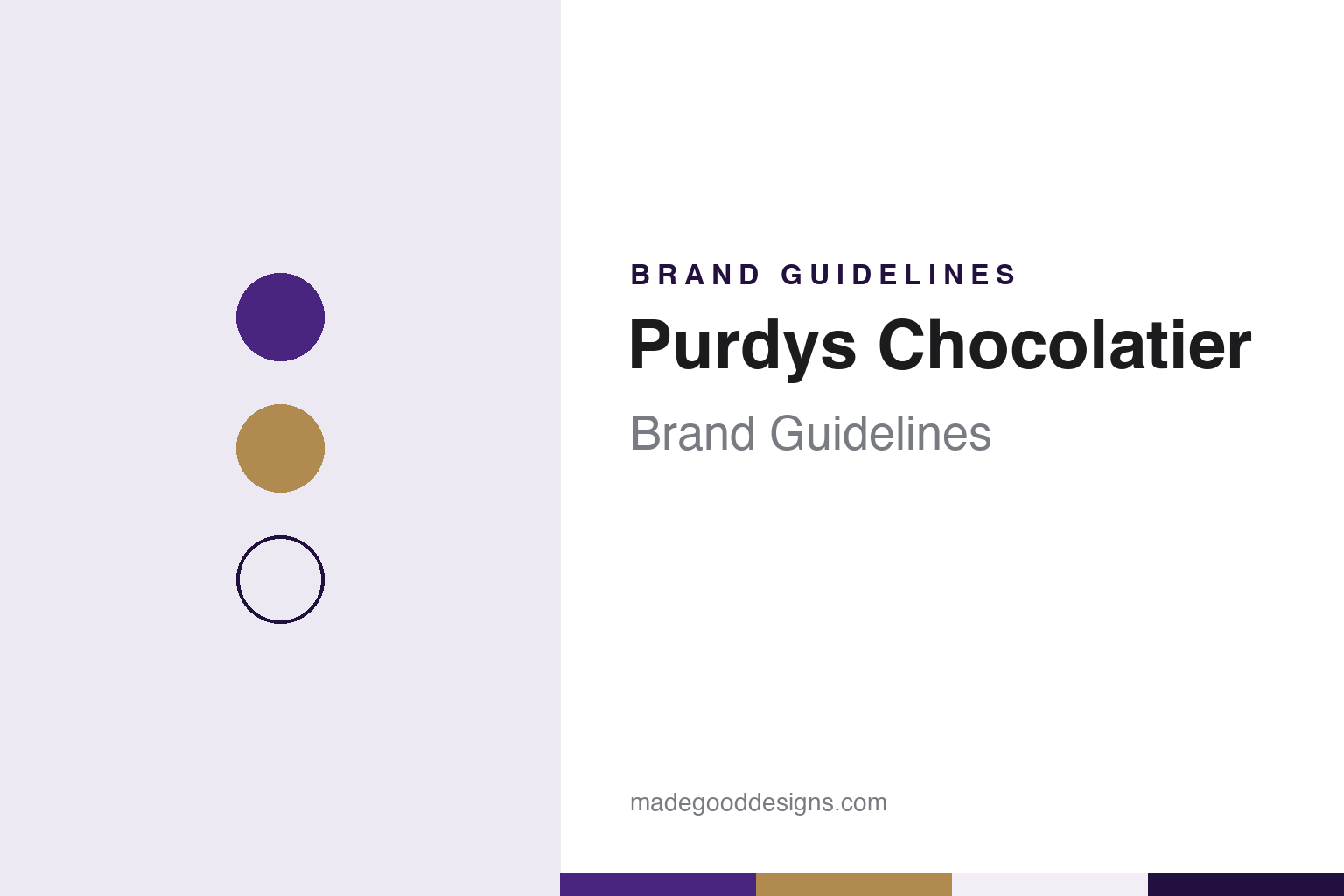
Two constants: a Purdys purple and gold palette and a crested serif register. Abstract homage — not a Purdys product or mark; no box, coat of arms or logo is reproduced.
Robson Street, 1907
A candy maker, a receivership and a bookkeeper.
Purdys Chocolatier traces itself to 1907, when Richard Carmon Purdy opened a chocolate shop on Robson Street in Vancouver. English Wikipedia and the company agree that Purdy had moved west from London, Ontario, and had sold home-made sweets on the street before opening the shop. The company’s heritage timeline says a second shop followed on Granville Street in 1910, opposite the Hudson’s Bay store, and that in 1914 Purdy incorporated R.C. Purdy Chocolates Limited; it quotes a 1918 British Columbia directory listing him as a “Manufacturer and Retailer of High-Class Confectionery.”
The founder did not keep his company. In the early 1920s, the timeline says, Purdy was forced into receivership. One of his creditors, Kirkland and Rose, sent its bookkeeper, Hugh Forrester, to rescue the business, and in 1925 the creditors sold it to him for a token sum. Purdy went back to selling chocolates from a cart and later opened a shop in Burnaby called Window Made Candy, the company says; English Wikipedia gives the same account, though part of it is marked as needing a citation.
Colour
Forresters, Flavelles and a factory on Kingsway.
Under the Forresters the business grew into a manufacturer. The company says that during the Second World War, with sugar, butter and cream rationed, Hugh Forrester bought a dairy farm in Ladner, B.C.; that his son Frank Forrester joined after the war and modernised production; and that in 1949 the company moved into a factory on West 7th Avenue in Fairview Slopes. A small city park there, Choklit Park, was built in 1970 on a site Purdys leased, the company says. It also credits Frank’s wife, Joy, with the Yardlong box of the early 1950s, a 36-inch box of chocolates that could be reused for neckties.
In August 1963 the Forresters sold Purdys to Charles Flavelle and Eric Wilson, the company says; English Wikipedia also gives 1963. Until then Purdys had used dark chocolate for everything, and the company says it began making milk chocolate in response to customers. It followed shoppers into malls, opening in Nanaimo in 1969 and at Calgary’s Chinook Centre, its first store in Alberta, in 1970 (English Wikipedia says 1971). A venture into Seattle, begun in 1980, grew to six stores and was closed in 1993.
In 1982, its 75th year, Purdys moved its factory and head office into a former Canada Dry building at Kingsway and Earles Street in Vancouver, a 57,000-square-foot plant. The company says 17,000 people toured the new factory over its first Thanksgiving weekend. Both the company and English Wikipedia say its chocolates are made there and sent to its shops; the company says the factory remained at Kingsway after its support office and warehouse moved to a second site in 2007.
Typography
Chocolate in three countries.
The seven brands in this group all sell chocolate, and they come from three countries: Haigh’s, Darrell Lea and Koko Black from Australia, Whittaker’s from New Zealand, and Laura Secord, Purdys and Rogers’ Chocolates from Canada. They are grouped here because they share a market position more than a style: each is a home-grown name in a country whose chocolate shelves are also stocked by international groups.
They reach shoppers in different ways. Some are known mainly through their own shops, where the window, the counter and the box do much of the work of a brand; others are known mainly through supermarket shelves, where a wrapper has a few seconds to be recognised. Many sit between the two, and the line between a chocolatier, a confectioner and a chocolate maker is not always drawn the same way from one company to the next.
Each guide separates what independent sources record from what the company says about itself — who founded it, who owns it now, where its cocoa comes from and where its chocolate is made — and marks plainly what rests only on the company’s own word.
Aa
A crested serif — for a brand that added a coat of arms in 2007. (Specimen set in Cormorant Garamond, a serif STAND-IN; NOT the Purdys logo.)
Purdys Chocolatier
Purple and gold, restored.
In 1994, the company says, Charles Flavelle’s daughter Karen Flavelle bought the business from her father and Eric Wilson, and she became president in 1997. The company’s own account of the late 1990s is unusually specific about design: Purdys “had moved away from its iconic purple and gold to a dark navy blue,” and Karen Flavelle made restoring purple and gold “on all packaging and in all stores” a focus, alongside new seasonal ranges. For its centenary in 2007 it says it created commemorative tins and a coat of arms now used in its shops and on its packaging.
Its best-known products came late. The company dates the Hedgehog, a hazelnut gianduja centre in a hedgehog-shaped mould, to the early 1990s, and the Himalayan Pink Salt Caramel to 2009; Sweet Georgia Browns sit beside them among its bestsellers. Purdys and Rogers’ Chocolates of Victoria made the official chocolates for the 2010 Vancouver Winter Olympics, the company says. It dates its first Ontario stores to 2005; English Wikipedia says 2004.
The company says that since 2014 all its chocolate has been made with “sustainable cocoa,” for which it pays a premium, and its cocoa pages describe farmer programmes involving 65 co-operatives in Ivory Coast and growers in Ghana; we give those as its claims. It says the third generation of the Flavelle family is helping to lead the business, and English Wikipedia lists Karen Flavelle as owner and her son, Scott McTavish, as chief executive.
In July 2025 The Canadian Press, in a report carried by Global News, said Purdys would sell four varieties at the western Canadian grocer Save-On-Foods — the first time in its history that it would sell outside its own shops — after interest in Canadian brands rose amid tariff tensions with the United States. Kriston Dean, its vice-president of marketing and sales, told the agency that traffic to its website had jumped by more than 200 per cent and that new customers at Easter were up 25 per cent on the year before; those are the company’s figures.
For a design guide, Purdys shows how a colour pair, once dropped and then restored, can become a retailer’s signature. Compare Laura Secord, its eastern counterpart, and See’s Candies, another shop brand with a fixed house look. For this guide we use purple and gold with a serif, an unofficial interpretation; no product or logo is reproduced.
Explore & save
Keep Purdys Chocolatier’s identity on hand — save it to a board in the Made Good inspiration library.
Purdys Chocolatier identity set
Pin the Purdys purple & gold palette and the crested serif register to your own board.