Tunnock’s Brand Guidelines
The Uddingston family bakery behind the Caramel Wafer and the Teacake.
Aa
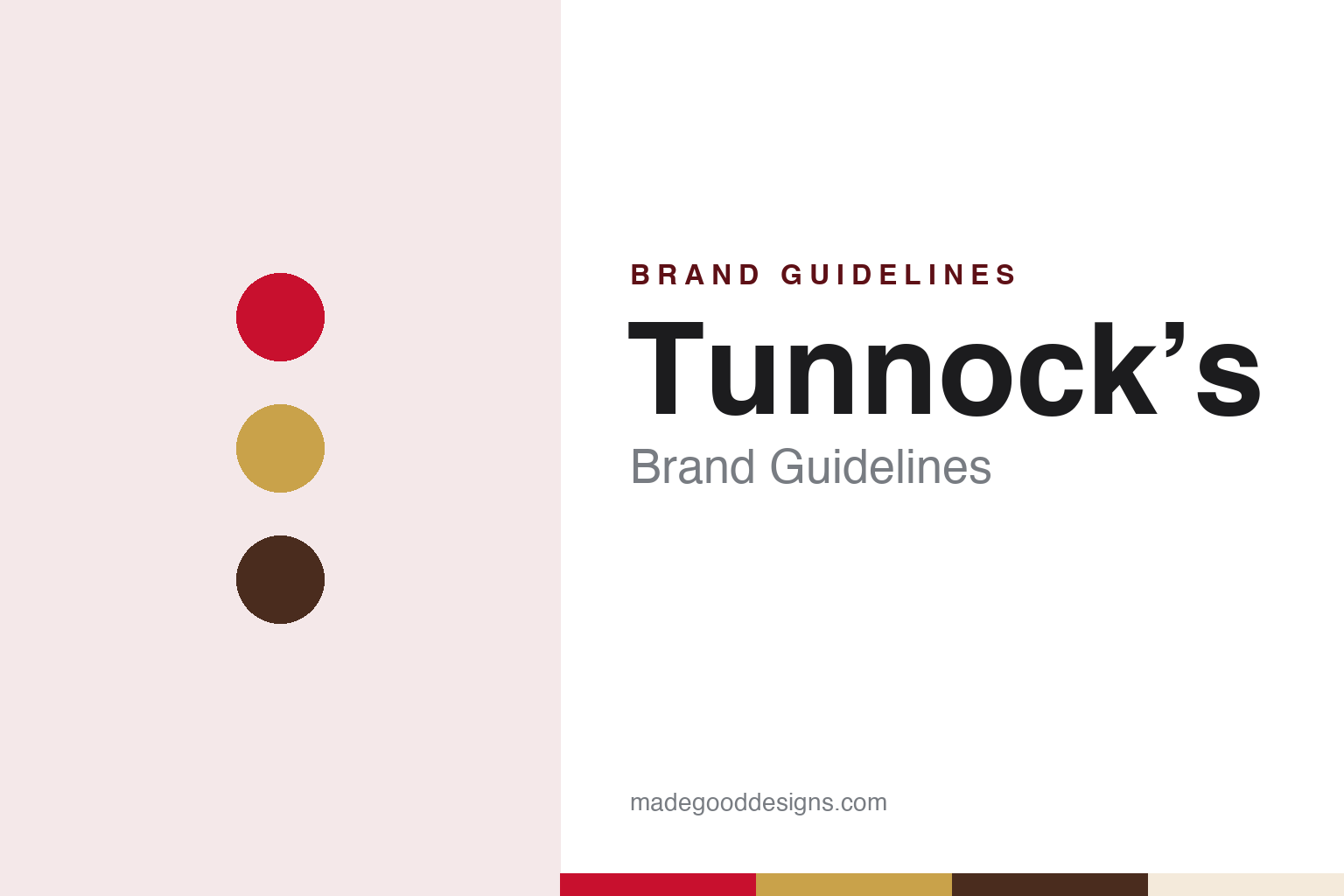
Two constants: a Tunnock’s red, gold and chocolate palette and a bakery serif register. Abstract homage — not a Tunnock’s product or mark; no wrapper, logo or lion is reproduced.
An £80 bakery
A village baker in Lanarkshire.
Tunnock’s began as a village bakery. The company’s own history says Thomas Tunnock, born in Uddingston in 1865, served his apprenticeship at a bakery in Aberdour, saved enough to buy a bakery in Uddingston for £80, and opened as Thomas Tunnock in December 1890. English Wikipedia, citing Carol Foreman’s book Made in Scotland, places the shop in Lorne Place. The business is still registered as Thomas Tunnock Limited and still based in Uddingston, in South Lanarkshire, south-east of Glasgow.
The early business was a bakery and tearoom. The company says that by 1906 Thomas employed six boys to deliver warm rolls around the village, that a fire destroyed the bakery in 1910, and that he built a new one on the main street within two years. After Thomas died in 1920, his son Archie Tunnock, back from army service in Iraq, reopened the bakery with his mother; the company says he opened a larger tearoom above the shop in 1924, and that the shop and tearoom are still there.
The products the brand is known for came after the Second World War. English Wikipedia says the core lines were introduced in the 1950s, when sugar and fat rationing meant the firm needed products that kept longer than cakes. The company tells the same story: Archie, it says, bought a dozen dry wafers and taught himself to make caramel and chocolate.
Colour
Caramel Wafer, Snowball, Caramel Log and Teacake.
The company dates the Caramel Wafer to 1952, the Snowball to 1954, the Caramel Log to 1955 and the Teacake to 1956. The Teacake was developed by Archie’s younger son, Boyd Tunnock: a biscuit base topped with hand-piped Italian meringue and coated in milk chocolate, the company says. English Wikipedia describes the Caramel Wafer as five layers of wafer and four of caramel, coated in chocolate.
The wrappers are the best-documented part of the brand’s design. According to English Wikipedia, the milk-chocolate Caramel Wafer comes in red and gold foil and the dark-chocolate version in blue and gold; the milk-chocolate Teacake comes in red and silver foil, the dark one in blue, black and gold. The packaging also carries the Scottish lion rampant, Wikipedia says, citing the Daily Record. The company says that in 2010 it paid for a visit to Scotland by the Apollo 16 astronaut Charlie Duke, because the mission’s parachutes looked like Teacake wrappers.
That Scottish identity has been tested in public. In January 2016 The Guardian reported that a London Underground campaign had dropped the lion and called the product “Tunnock’s Great British Teacake,” and that some independence supporters had called for a boycott. Boyd Tunnock, then managing director, told the Daily Record: “Down south, people wouldn’t know [the teacake] as Scottish.” In July 2017 The Scotsman reported that wafer creams sold in Japan would be branded “Made in Great Britain.”
The products have also become part of public events. At the opening ceremony of the 2014 Commonwealth Games in Glasgow, dancers dressed as giant Teacakes, and The Guardian reported that Teacake sales at Waitrose were 62% higher the next day. In April 2025 BBC News reported that the RAF Centre of Aviation Medicine had cleared the Teacake to fly again after altitude-chamber tests, ending a ban that, English Wikipedia says, dated from a 1965 incident on a V-bomber. Wikipedia also cites Loganair, the Scottish airline, as estimating in 2025 that it had served about six million Caramel Wafers on its flights.
Typography
Biscuits, wrappers and ownership.
The seven brands in this group all bake biscuits, and they come from five countries: McVitie’s, Walker’s Shortbread and Tunnock’s from Scotland, Fox’s from England, Jacob’s from Ireland, Bahlsen from Germany and Lotus Biscoff from Belgium. Biscuit brands in general sit at many different points in the trade, from family-run bakeries that still work from the town where they began to names that have passed through several corporate owners, and a single packet on a supermarket shelf rarely says which of those it is.
A biscuit brand’s identity is usually carried by a wrapper, a shape and a habit — the biscuit eaten with tea or coffee, at a desk, in a lunchbox or on a plane — more than by the factory behind it, because the name on the front may have changed hands, or changed countries, long after the recipe was settled. That makes the questions behind each name worth asking plainly: who started it, who owns it now, and where its biscuits are actually baked.
Each guide separates what independent sources record from what the company says about itself — its founding story, its owners over time, its factories and its packaging — and marks plainly what rests only on the company’s own word.
Aa
A bakery serif — foil wrappers, not type, carry the brand. (Specimen set in DM Serif Display, a serif STAND-IN; NOT the Tunnock’s logo.)
Tunnock’s
Still family-owned, still in Uddingston.
Tunnock’s has stayed with the founding family. English Wikipedia lists the Tunnock family as owner and describes the company as headed by Boyd Tunnock, grandson of the founder; in 2022 the company told Scottish Grocer that it was privately owned and “now into the fifth generation of the founder’s family.” In 2013, according to a Close Brothers list cited by Wikipedia, it was Scotland’s twentieth-oldest family firm. Boyd Tunnock was appointed MBE in 1987 and CBE in 2004, and was knighted in the 2019 Birthday Honours for services to business and charity, according to the London Gazette entries cited by Wikipedia.
The biscuits are made in Uddingston. The company says factory extensions followed in 1962 and 1965, that a three-storey extension opened in 2018 adding 20,000 square feet and about 10% more capacity, and that it bought its first Teacake-making robot in 2006. It says turnover passed £60 million for the first time in the year to February 2019, and that it paused production in 2020 to protect its 600 staff during the Covid-19 pandemic. The Times reported in 2010, as cited by Wikipedia, that the company does not make own-label biscuits for supermarkets.
The brand also reaches beyond the biscuit aisle: in 2019 and 2020 it sponsored Scottish football’s Challenge Cup, BBC Sport reported, and in 2013 Tesco agreed to stock Tunnock’s-branded tea towels, aprons and mugs made by a Glasgow merchandise firm, The Scotsman reported.
For a design guide, Tunnock’s shows how a small set of wrapper colours, kept for decades, can become the brand itself. Compare Rowntree’s, a family confectioner that was eventually sold, and Cadbury. For this guide we use wrapper red, foil gold and milk-chocolate brown with a serif, an unofficial interpretation; no product or logo is reproduced.
Explore & save
Keep Tunnock’s’s identity on hand — save it to a board in the Made Good inspiration library.
Tunnock’s identity set
Pin the Tunnock’s red, gold and chocolate palette and the bakery serif register to your own board.