Bisca Brand Guidelines
The Møn bakery behind Karen Volf and Danish butter cookies.
Aa
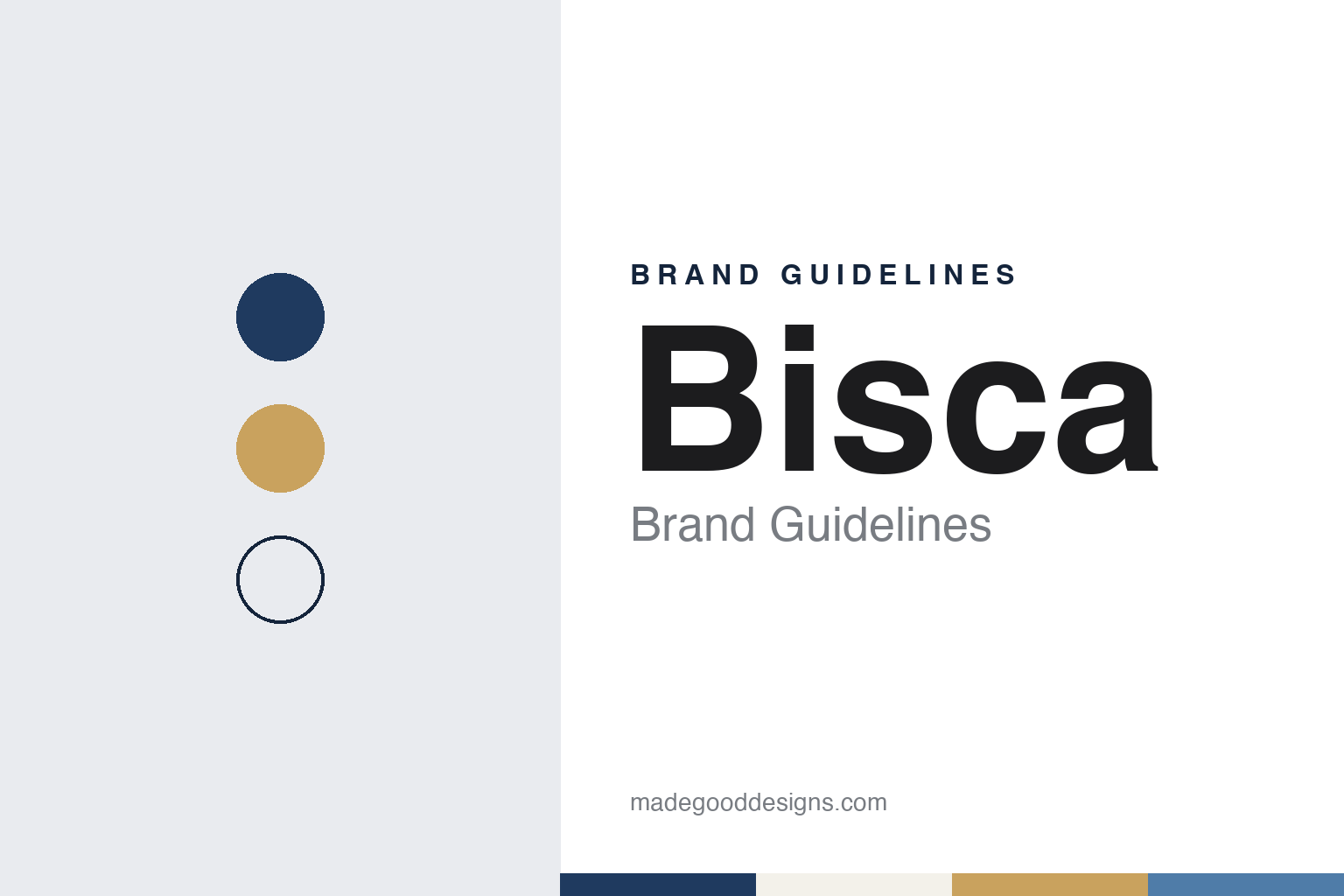
Two constants: a Bisca navy, chalk and gold palette and a clean export sans register. Abstract homage — not a Bisca product or mark; no tin, pack or logo is reproduced.
Biscuit Centralen
A margarine wholesaler, a warehouse and a famous name.
Bisca is the company behind the Karen Volf brand, and its history has two strands. The first is Karen Volf, the baker who opened a shop on Strandvejen in Hellerup in 1890 and built a national cake and biscuit business before her death in 1946. Bisca dates its own roots to that year, and its company history says that in 1922 Karen Volf set up a biscuit bakery inspired by English Digestive and Marie biscuits. Danish Wikipedia places the start of the company’s cracker production in Hjørring in 1922.
The second strand is a wholesaler. According to Bisca, Poul Spangsberg set up on his own in 1953 selling margarine to bakers around Copenhagen and began to take packaged cakes as payment, which he sold on to grocers. In 1956 he opened a small warehouse called Biscuit Centralen to supply independent cake wholesalers. In the same year, the company says, the international group OTA bought the recipe and name rights to Karen Volf.
The strands met in 1967, when Spangsberg bought the rights to the Karen Volf mark. The next year Biscuit Centralen moved into purpose-built premises after outgrowing three warehouses, and production moved to Stege, the largest town on the island of Møn, south of Zealand.
Colour
Stege, expansion and an export arm.
Bisca says capacity in Stege doubled in 1969 and tripled in 1971, and that Biscuit Centralen became Karen Volf A/S in 1972. The following year was busy: the company says it took over the factory Moster’s, which made layer-cake bases, added 2,000 square metres on Møn, built an export plant and took over the home bakery Ullemark, which made puff-pastry goods such as French waffles, kringler and tartlets. Bisca dates its export business to 1973 and says it set up a separate export company, Karen Volf International A/S, in 1979; its English-language site puts the start of the export trade in the 1980s.
On where the baking happens, the company is consistent that production has been in Stege since 1968, and a May 2026 press release repeats that date. Danish Wikipedia gives a later date for full consolidation, saying all production was gathered in Stege in 2006. Bisca’s administration, sales and marketing are based in Albertslund, west of Copenhagen, the company says.
In 1997 the group changed its name from Karen Volf A/S to Bisca A/S. Bisca says it uses Bisca both as the company name and as the brand for its export markets, where its Danish butter cookies are sold, while Karen Volf remains the name on its cakes in Denmark.
Typography
Danish baked goods and the coffee table.
The seven brands in this group all bake biscuits, and they come from two countries: Royal Dansk, Kjeldsens, Karen Volf and Bisca from Denmark, and Jules Destrooper, Dandoy and Vermeiren from Belgium. Biscuit brands in general sit at many different points in the trade, from tins stacked high in a supermarket at Christmas to paper bags filled over the counter of a single shop, and a name that began in one town’s bakery can now be owned by a group based a long way from it.
A biscuit brand’s identity is usually carried by a recipe, a shape and a pack — a tin, a wrapper, a mould pressed into the dough — more than by any single product, and the name on the lid does not always tell you who owns it or where the oven is. That makes the questions behind each name worth asking plainly: who started it, who owns it now, and where its biscuits are actually baked.
Each guide separates what independent sources record from what the company says about itself — its founding story, its owners over time and where its biscuits are made — and marks plainly what rests only on the company’s own word.
Aa
A clean export sans — one company name for markets abroad. (Specimen set in Work Sans, a sans STAND-IN; NOT the Bisca logo.)
Bisca
From Norwegian ownership back to Danish hands.
Bisca holds the Danish royal warrant, the right to call itself purveyor to the Royal Danish Court. Its website says it has used the designation since 1997, while its May 2026 press release says it became the first bakery to be appointed a royal warrant holder in 1952; we give both dates as the company states them.
Ownership has changed twice in recent years. In 2010 Bisca became part of the Norwegian group Scandza, which Bisca describes as offering consumers iconic Scandinavian brands. In March 2024 the Danish private equity firm Erhvervsinvest, which Bisca says invests in long-established Danish companies, announced it had acquired Bisca A/S, and Bisca describes the deal as returning the business to Danish hands. In May 2026 Bisca announced that it had bought East Coast Bakehouse, a biscuit maker founded in 2016 in Drogheda, Ireland, with about 70 staff. Bisca says the Irish business makes branded and private-label products and sells more than 90 per cent of them to UK and Irish retailers; the announcement was made by chief executive Kristian Walsøe.
Bisca’s English-language site says the company bakes more than 200 kinds of cake and has turnover above 65 million euros, and that its 1997 royal warrant was granted under Queen Margrethe II. Danish Wikipedia adds that Bisca holds market shares in Norway and Sweden as well as at home.
Bisca’s brands, the company says, are Karen Volf, Karen’s Bakery, Snøfler, All in one and MØN, covering cakes, biscuits, bars and crispbread. The 2026 press release puts output at about 13,000 tonnes a year and calls Bisca the market leader in Denmark. Danish Wikipedia, using 2010 figures, gives 460 employees and revenue of 728 million kroner, with exports to markets including Finland, Germany, the UK and the Baltic states. The company says it moved to free-range eggs and RSPO-certified palm oil at its Stege bakery in 2015. Locally, it received Vordingborg’s integration council award in 2022 and the Vordingborg business association’s sustainability prize for 2024, Danish Wikipedia and the company report.
For a design guide, Bisca shows how a manufacturer can keep a founder’s name for its home market and a short company name for export. Compare McVitie’s and the Brussels biscuit house Delacre. For this guide we use navy, Baltic blue, chalk white and butter gold with a sans, an unofficial interpretation; no product or logo is reproduced.
Explore & save
Keep Bisca’s identity on hand — save it to a board in the Made Good inspiration library.
Bisca identity set
Pin the Bisca navy, chalk and gold palette and the clean export sans register to your own board.