Katjes Brand Guidelines
The Emmerich liquorice cat that went veggie.
Aa
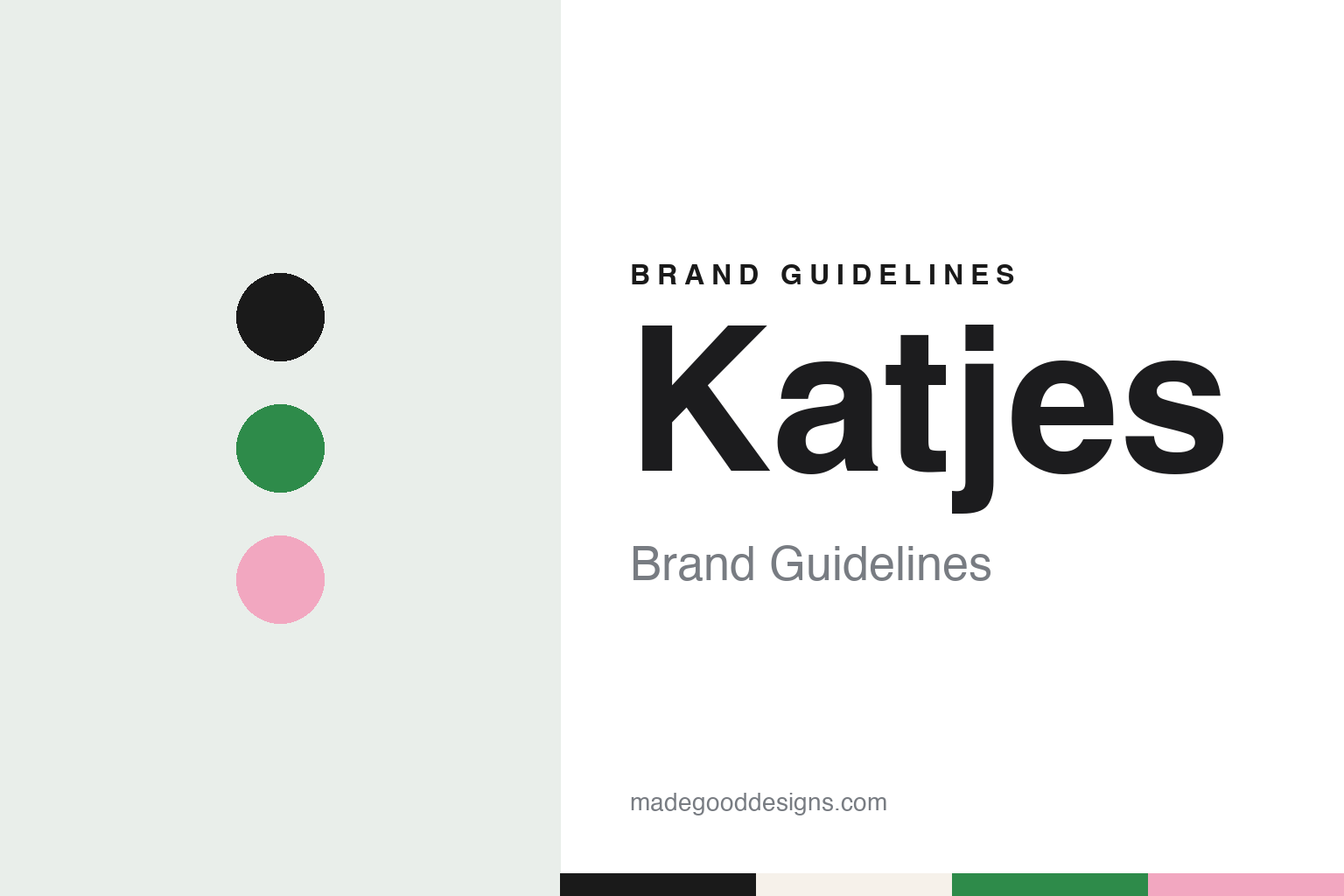
Two constants: a liquorice black, leaf green and yoghurt pink palette and a rounded friendly sans register. Abstract homage — not a Katjes product or mark; no pack, logo or sweet is reproduced.
Flypaper and liquorice
A Dutch border firm, a winter sideline and a cat.
Katjes is made in Emmerich am Rhein, on the German side of the Lower Rhine, but its story begins just across the Dutch border. German Wikipedia, citing a company history and a 2009 history of the firm published by a Dutch philatelic society, says that on 23 November 1910 Josef Langenberg founded a business in ’s-Heerenberg, in the Netherlands, trading in chemical products such as flypaper and colourants. In 1920 his step-brother Xaver Fassin joined as a partner, and after Langenberg’s death Fassin carried the business on; from 1930 it made its own flypaper.
Liquorice came as a winter sideline. Flypaper sold in summer, and both products needed sugar syrup, so liquorice evened out the year, the Rheinische Post reported in 2011. German Wikipedia says the recipe came to Fassin, whose ancestors were Sicilian, from a pharmacist in Catania in 1910; the company itself says its story begins in Sicily in 1910, with a Sicilian liquorice recipe. In the 1930s the firm adopted a moulding technique from the plastics industry and began casting liquorice in the shape of a cat. The sweets were called Katjes, Dutch for “kittens,” and the name went on to give the company its name and, for a time, its logo, German Wikipedia says.
The German company dates from 1950. That year, German Wikipedia says, Xaver Fassin divided production between his two sons. Helmut Fassin kept the drawn products in ’s-Heerenberg, in a business now called Fassin B.V., which sells sweets in the Netherlands under the Katja name. Klaus Fassin took the cast products to neighbouring Emmerich. That split created Katjes Fassin GmbH + Co. KG, which still has its head office in Emmerich.
Colour
Yoghurt-Gums, famous faces and no gelatine.
The best-known Katjes product after the cats is the Yoghurt-Gums. German Wikipedia, citing the company, dates them to 1971 and says Katjes was the first to put yoghurt — in fact skimmed-milk yoghurt powder — into a fruit gum; it counts them among the company’s best-selling lines. From 1988, according to Florian Langenscheidt’s reference book Deutsche Standards: Marken des Jahrhunderts as cited by German Wikipedia, Katjes stopped using artificial colours, replacing them with fruit juices and fruit and plant concentrates.
Katjes advertising leaned on famous faces for more than a decade: the entertainer Stefan Raab from 1999, then the model Heidi Klum from 2001 to 2007, followed by the chef Tim Mälzer and the model Lena Gercke. Die Zeit reported in 2004 that Klum’s Yoghurt-Gums spots had helped lift sales by 21.4% in 2003. German Wikipedia says the company signed no new celebrity contracts for the Katjes brand from 2012.
Its identity since then has rested on what its sweets leave out. Katjes makes its gums without animal gelatine, and in September 2016 it became the first German confectioner to switch its entire range to vegetarian products, the trade site food-monitor and the NRZ newspaper reported at the time; packs carry the yellow V-Label of the European Vegetarian Union, German Wikipedia says. A Grün-Ohr Hase, a green-eared rabbit of foam sugar and fruit gum, followed in 2012 and won the trade magazine Rundschau für den Lebensmittelhandel’s Sweetie award. In 2018 a brand campaign built around the line “jes! Alles Veggie!” won a gold Effie from the German agencies’ association GWA, and in 2019 Katjes received the Deutscher Marketing-Preis, the trade magazine absatzwirtschaft reported. Today the company says almost the whole Katjes range in Germany is vegan and coloured only with natural colours.
Typography
Design and documentation.
The seven brands in this group all make sweets and gummies, and they come from Germany, Sweden, Britain and the United States: Katjes, Trolli, Werther’s Original, Cloetta, Maynards Bassetts, Swizzels and Jelly Belly. Sweet and gummy brands in general sit at many different points in the trade, from family firms that still carry a founder’s surname to names that now belong to much larger confectionery groups, and a single brand can be sold everywhere from a corner shop to a supermarket aisle.
A sweet brand’s identity is usually carried less by a single product than by a pack, a name and the treat it promises, because the company behind the name may have changed hands, moved its factory or grown far beyond the town where it started. That makes the questions behind each name worth asking plainly: who started it, who owns it now, and where its sweets are actually made and packed.
Each guide separates what independent sources record from what the company says about itself — its founding story, its owners over time, where its sweets are made and how its packaging has changed — and marks plainly what rests only on the company’s own word.
Aa
A rounded friendly sans for a brand named after kittens. (Specimen set in Nunito, a sans STAND-IN; NOT the Katjes logo.)
Katjes
A family firm, a partner and a sister holding company.
Katjes has stayed in the Fassin family while bringing in an outside partner. In 1996 Klaus Fassin, then 65, hired Tobias Bachmüller, previously general manager for Suchard at Kraft Jacobs Suchard, as managing director and stepped back, the Süddeutsche Zeitung reported in 2009; Bachmüller gradually acquired a 10% stake. Klaus Fassin’s son Bastian Fassin joined as a managing partner in 2004, and the two men run the company together. German Wikipedia gives the ownership as 90% Bastian Fassin and 10% Bachmüller. Klaus Fassin died in June 2021 at the age of 89, Handelsblatt and Der Spiegel reported.
Growth came partly through German brands. Katjes Fassin bought Villosa, maker of the Sallos liquorice sweets, in 2000; Frigeo, with the Ahoj-Brause fizz powder, in 2002; and the Gletschereis sweets from Ragolds in 2003. From 2015 it took over the Europe-wide marketing of Procter & Gamble’s Wick sweets, the trade service Sweets Global Network reported. German Wikipedia names three German production sites: Emmerich for liquorice and fruit gums, Remshalden for fizz products and Potsdam-Babelsberg for boiled sweets, where a glass-walled sweet factory opened to visitors in October 2006. German Wikipedia puts 2024 revenue at €393 million and calls Katjes the third-largest maker in the German sugar-confectionery market, behind Haribo and Storck.
A sister company, Katjes International, set up in 1972 and also based in Emmerich, holds the group’s acquisitions abroad. Since 2010 it has bought the Dutch liquorice maker behind Harlekijntjes, the Franco-Belgian sweet maker Lamy Lutti (a majority in 2010, all of it in 2011), the German dragée maker Piasten in 2014 and Italy’s Sperlari in 2017, and at the end of 2018 it merged Lutti into the French Carambar & Co group, German Wikipedia says, citing the company’s press releases. Its holdings have since spread beyond sweets, from oral care to a majority stake in the fashion house Bogner, agreed in August 2025.
For a design guide, Katjes shows how a cat-shaped liquorice and a “veggie” promise can carry one brand from the 1930s to today. Compare Trolli, another German gummy maker, and Darrell Lea, the Sydney liquorice maker. For this guide we use liquorice black, a leaf green and a yoghurt pink with a rounded sans, an unofficial interpretation; no product or logo is reproduced.
Explore & save
Keep Katjes’s identity on hand — save it to a board in the Made Good inspiration library.
Katjes identity set
Pin the Katjes liquorice black, leaf green and yoghurt pink palette and the rounded friendly sans register to your own board.