Irn-Bru Brand Guidelines
The Falkirk iron brew that became Scotland’s other national drink.
Aa
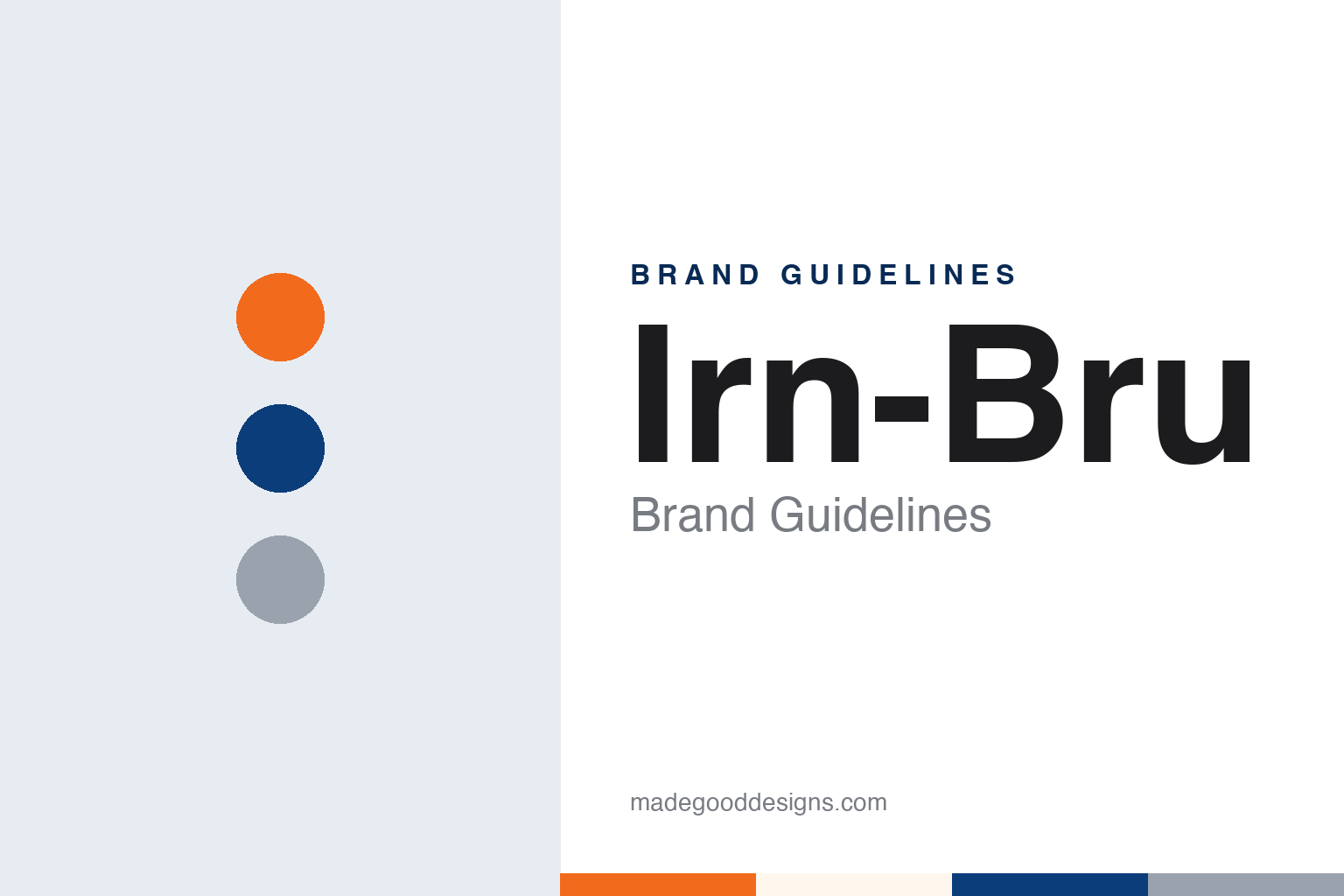
Two constants: a Bru orange, Barr blue and girder steel palette and a heavy poster sans register. Abstract homage — not an Irn-Bru product or mark; no can, bottle, logo or strongman is reproduced.
Iron Brew
A Falkirk firm, a Glasgow branch and a borrowed strongman.
Irn-Bru is made by A.G. Barr, a company that began in Falkirk in 1875, founded there by Robert Barr, according to the company’s own history. In 1887 his son Robert Fulton Barr opened a branch in Glasgow, a much larger market, and in 1892 that branch passed to his brother Andrew Greig Barr, whose initials gave the business its name. The Falkirk and Glasgow firms ran side by side for decades before merging in 1959; the combined company joined the London Stock Exchange in 1965.
The drink itself began as a copy of a category. The scholar David Leishman, writing in the journal Études Écossaises in 2017, traces the first “Iron Brew” to the New York chemicals firm Maas & Waldstein in 1889; the London essence house Stevenson & Howell launched a similar drink in 1898 and supplied it to bottlers across Britain, many of whom sold their own versions. Barr’s gives 1901 as the official launch date of its Iron Brew, but a document in the firm’s archives shows that the two Barr businesses were already selling it well by May 1899, English Wikipedia says, citing Leishman. Even the strongman who still stands on the brand had been trademarked by Stevenson & Howell in 1898; Barr’s ordered its labels from the London firm. Early advertising used real strongmen too, with testimonials from the Highland Games athletes Donald Dinnie and Alex Munro.
The spelling came half a century later. Barr’s applied to register the name Irn-Bru in July 1946, while the drink was off sale under wartime controls, and first sold it under the new name in 1948, English Wikipedia says, citing the UK trademark record and the company’s archive. New labelling rules were cracking down on misleading claims and set minimum standards for drinks claiming to contain minerals such as iron. According to Robert Barr, chairman from 1947 to 1978, there was a commercial reason as well: “Iron Brew” had become a generic name, while “Irn-Bru” could be protected as a brand.
Colour
Ba-Bru, girders and a maverick streak.
Barr’s built Irn-Bru with advertising that ran for decades. A comic strip, “The Adventures of Ba-Bru,” appeared in local newspapers from April 1939 to October 1970, and a large neon Ba-Bru sign stood above Glasgow Central station on Union Street until 1983, when it was replaced by an illuminated display reading “Your Other National Drink.” That line, a nod to whisky, became one of the brand’s best-known claims, alongside “Made in Scotland from girders,” used from the 1980s in advertisements in which Irn-Bru drinkers turned unusually strong or magnetic — a joke on the drink’s rusty orange colour.
Around 2000 the advertising agency Leith gave the brand a deliberately cheeky tone, with campaigns meant to “dramatise the extraordinary appeal of Irn-Bru in a likeably maverick style,” Campaign reported. In 2006 Irn-Bru ran its first Christmas advertisement, a parody of the animated film The Snowman, and a sequel followed in December 2018. The brand even has its own tartan.
On the pack, the strongman and the orange have stayed while the details changed. In 2016 the design consultancy Jones Knowles Ritchie (JKR) redrew the range in what The Drum called the eighth redesign in the brand’s history, bringing back the original strongman and putting girders “front and centre on our packs,” in the words of Adrian Troy, then head of marketing. The Drum said the blue and orange colour scheme dated from 1947. In December 2025, ahead of the drink’s 125th anniversary in 2026, A.G. Barr began a phased packaging refresh built on the strongman insignia, the “Made in Scotland from Girders” line and the orange, the trade titles Scottish Local Retailer and Grocery Gazette reported; Irn-Bru Sugar Free went back to its old name, Diet Irn-Bru, and Irn-Bru Xtra became Irn-Bru Zero, with recipes unchanged. “As we head into our 125th year, we’re refreshing the way Irn-Bru shows up on shelf by amplifying the iconic elements people know and love,” said Kenny Nicholson, the brand director.
Typography
Design and documentation.
The seven brands in this group all make soft drinks or cordials, and all of them come from Britain: Irn-Bru, Vimto, Ribena, Lucozade, Tango, Fentimans and Belvoir Farm. British soft-drink brands in general sit at many different points in the trade, from family firms that still carry a founder’s name to names that now belong to much larger drinks groups, and a single brand can be sold everywhere from a corner shop to a supermarket shelf.
A soft-drink brand’s identity is usually carried less by a single recipe than by a bottle, a colour, a name and the moment it promises, because the company behind the name may have changed hands, moved its bottling or grown far beyond the town where it started. That makes the questions behind each name worth asking plainly: who started it, who owns it now, and where its drinks are actually made and bottled.
Each guide separates what independent sources record from what the company says about itself — its founding story, its owners over time, where its drinks are made and how its packaging has changed — and marks plainly what rests only on the company’s own word.
Aa
A heavy poster sans for a drink sold with a strongman. (Specimen set in Archivo Black, a sans STAND-IN; NOT the Irn-Bru logo.)
Irn-Bru
Made in Cumbernauld, owned by a listed family firm.
A.G. Barr is still based in Scotland, with its head office at Cumbernauld in North Lanarkshire, and it remains listed in London as a member of the FTSE 250. Irn-Bru is produced at the company’s plant in Westfield, Cumbernauld, which became the main site after Barr’s left its old factory in Parkhead, Glasgow, in the mid-2000s and later closed its Mansfield plant, English Wikipedia says; it also names Milton Keynes as a second A.G. Barr production site.
The recipe has been changed in public view. In January 2018, ahead of the UK soft drinks levy that took effect that April, Barr’s cut the sugar in standard Irn-Bru to below the levy threshold of 5g per 100ml; The Guardian and The New York Times reported the change and the “Save Real Irn-Bru” campaign that fans launched against it. In October 2019 the company brought back a version made to the original 1901 recipe as a limited edition, Irn-Bru 1901, with an old-style label and a traditional glass bottle, and in March 2021 made it a permanent part of the range. The Irn-Bru family has since added an energy drink in 2019 and the Pwr-Bru energy range in 2023.
The company around the drink has grown by buying brands. A.G. Barr bought Tizer in 1972, the exotic-fruit drinks maker Rubicon in 2008 and the cocktail-mixer business Funkin in 2015. In December 2022 it bought the Boost energy-drink business for £20 million from its founders, The Times reported, and the same month took full control of the oat-milk maker MOMA, in which it had bought a majority stake in 2021, according to Food Manufacture. The Rio tropical drink followed in 2023, and in February 2026 A.G. Barr completed the purchase of the Northumberland botanical-drinks maker Fentimans for £38 million and the Devon juice brand Frobishers for £13 million, Just Drinks and RTÉ reported. A proposed merger with Britvic, agreed in November 2012, was abandoned in July 2013, and in March 2022 the company cut its ties with the Russian market after the invasion of Ukraine, the BBC reported.
For a design guide, Irn-Bru shows how a borrowed strongman, one loud colour and a running joke about girders can make a generic drink into a national brand. Compare Fentimans, now a sister brand under A.G. Barr, and Tunnock’s, another Scottish family firm with a famous wrapper. For this guide we use a bright orange, a deep blue and a steel grey with a heavy sans, an unofficial interpretation; no product or logo is reproduced.
Explore & save
Keep Irn-Bru’s identity on hand — save it to a board in the Made Good inspiration library.
Irn-Bru identity set
Pin the Irn-Bru orange, Barr blue and girder steel palette and the heavy poster sans register to your own board.