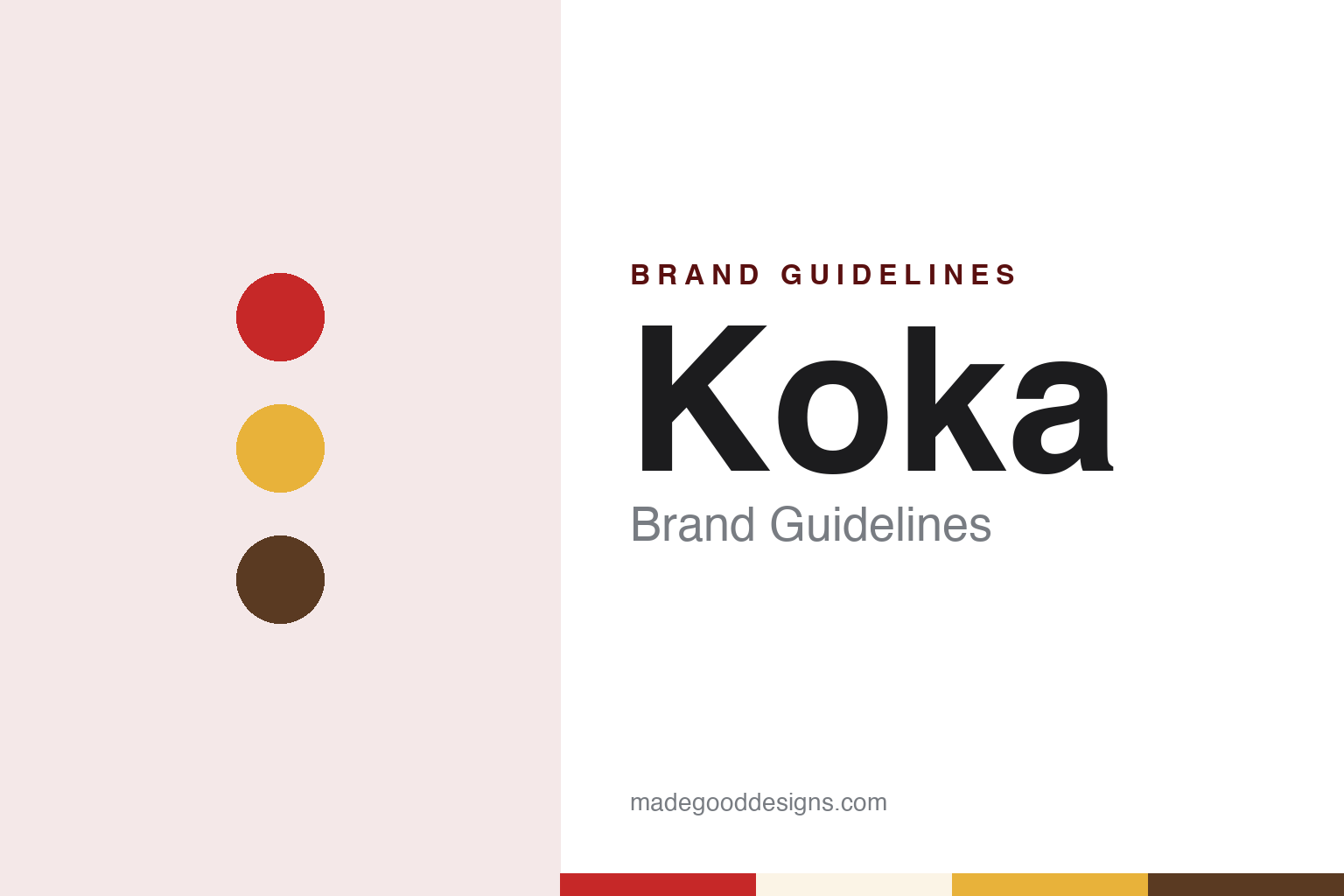
Koka Brand Guidelines
The Singapore instant noodle exported since 1987.
Aa
Two constants: a chilli red, noodle gold and soy brown palette and a rounded bold sans register. Abstract homage — not a Koka product or mark; no pack, logo or noodle is reproduced.
可口
A Singapore noodle maker and a name that means “delicious.”
Koka is an instant noodle brand from Singapore. It is made by Tat Hui Foods Pte. Ltd., a Singapore company, and both names come from Mandarin. The company’s marketing team told the noodle review site The Ramen Rater in 2017 that KOKA is derived from the brand’s Mandarin name, 可口, which means “delicious,” and that the spelling plays on how the word sounds when spoken. Tat Hui, the team said, comes from the company’s Mandarin name, 达辉, which it translates as “to achieve brilliance.”
The company’s own accounts of its start differ by a year. Tat Hui’s earlier website, as archived by the Wayback Machine in December 2013, says the company was incorporated in Singapore in 1986, and English Wikipedia gives the same year. The current KOKA website says the business was founded in 1985 by Mr and Mrs Lim Hi Lay, and its timeline places the start of the company’s journey in Singapore, with a small range of instant noodles, in 1986. In the 2017 interview the marketing team said the founder, Lim Hi Lay, “laid the first foundations” of KOKA in 1985, and that he wanted to share Singaporean cuisine with the rest of the world through instant noodles.
The first product, the company said in the same interview, was KOKA Original instant noodles, and it remained the range most popular in overseas markets. English Wikipedia lists KOKA Original packets in flavours from chicken and curry to mi goreng, tom yum and masala, alongside bowls and cups, citing the KOKA website.
Colour
Asian grocers first, then mainstream shelves abroad.
Koka went abroad early. Tat Hui’s archived website says that in 1987 Lim Hi Lay set out to take the company’s products to the international stage, and the company told The Ramen Rater the same in a 2012 interview. The products went first to the Chinese grocery market in the United States, Europe and Australia; in the following phase Tat Hui moved into mainstream European and Middle Eastern markets, and the company says its sales volume rose ten-fold. English Wikipedia, citing a Euromonitor report on noodles in Ireland, says Koka is a leading brand in Ireland, behind Unilever’s Pot Noodle, and is distributed there by Boyne Valley Foods. The current KOKA website says its products are sold in more than 40 countries across Asia Pacific, North America, the Middle East and Europe, and that the range runs to more than 100 products.
The figures for its size come from different years and measure different things. A 2011 book on intellectual property in Asia by David Llewelyn, Invisible Gold in Asia, is cited by English Wikipedia as saying that Tat Hui, together with its Sanwa noodle brand, exports more than 100 million packets a year. In 2017 the company told The Ramen Rater that it produced around 320 million packs a year. Tat Hui’s archived website named three brands it sold internationally: Koka, Sanwa and Yoodles.
The range has grown in stages, the company’s timeline shows. It introduced recipes without added MSG in 1999, non-fried noodles in 2003 and purple wheat noodles in 2009, adding three purple wheat recipes in 2011. A crushed noodle soup followed in 2015, sold as KOKA Creamy Soup, then multigrain baked cup noodles in 2019 and a spicy broad noodle bowl series in 2022. In 2017 the company listed six ranges: Original, Signature, Delight, Silk, Purple Wheat and Creamy Soup. It told The Ramen Rater that its fried noodles are made much as other brands make theirs, while its non-fried noodles are steamed and baked instead.
Typography
Design and documentation.
The seven brands in this group all make instant noodles, and they come from Japan, Indonesia, Thailand, Britain, South Korea and Singapore: Nissin, Maruchan, Indomie, Mama, Pot Noodle, Nongshim and Koka. Instant noodle brands in general sit at many different points in the trade, from family firms that still carry a founder’s name to names that now belong to much larger food groups, and a single brand can be sold everywhere from a corner shop to a supermarket shelf on another continent.
An instant noodle brand’s identity is usually carried less by a single product than by a pack, a name and the quick meal it promises, because the company behind the name may have changed hands, opened factories abroad or grown far beyond the city where it started. That makes the questions behind each name worth asking plainly: who started it, who owns it now, and where its noodles are actually made and packed.
Each guide separates what independent sources record from what the company says about itself — its founding story, its owners over time, where its noodles are made and how its packaging has changed — and marks plainly what rests only on the company’s own word.
Aa
A rounded bold sans for a noodle brand named after the word for “delicious.” (Specimen set in Baloo 2, a sans STAND-IN; NOT the Koka logo.)
Koka
Made in Jurong, repacked in 2016.
Koka noodles are made in Singapore. English Wikipedia says they are manufactured and packed at Tat Hui’s factory in Jurong, and the company’s address, on its archived site and on its current one, is in Jurong. Tat Hui’s archived website says that from 2002 the company invested SGD 10 million in research and development, new production facilities and equipment, and lists the food-safety systems it had adopted: an ISO quality-management standard from 1999, HACCP from 2002 and the BRC Global Standard from 2005.
The same archived page lists the company’s awards. They include an Asia Star 2005 packaging award and two awards in 2009 from the Singapore Institute of Food Science and Technology (SIFST): a Food Product Innovation Award for Koka Purple Wheat Noodles and a Food Product Merit Award for Koka Black Pepper Non-Fried Noodles. The current KOKA website says its multigrain baked cup noodles won a SIFST Best Product Award in 2019, and that the company redesigned its packaging in 2016 to better represent its range.
Koka has also had independent attention. The Ramen Rater, the review site run by Hans Lienesch, says Tat Hui was the first company to take part in its “Meet The Manufacturer” series, in 2012. Its first Top Ten Singaporean Instant Noodles list, published in August 2017, included three KOKA products: Delight Tomato at number ten, Signature Laksa Singapura at number six and Creamy Soup with Crushed Noodles Sweet Corn at number five. The Signature Laksa Singapura was back at number eight in the 2026 edition of the list, published in August 2025.
For a design guide, Koka shows how a Singapore noodle maker built an export brand on a single Mandarin word for “delicious.” Compare Pot Noodle, the British brand that English Wikipedia places ahead of Koka in Ireland, and Mama, the Thai instant noodle brand. For this guide we use chilli red, a noodle gold and a soy brown with a rounded sans, an unofficial interpretation; no product or logo is reproduced.
Explore & save
Keep Koka’s identity on hand — save it to a board in the Made Good inspiration library.
Koka identity set
Pin the Koka chilli red, noodle gold and soy brown palette and the rounded bold sans register to your own board.