Jumex Brand Guidelines
The Mexican juice brand that grew up inside a little blue can.
Aa
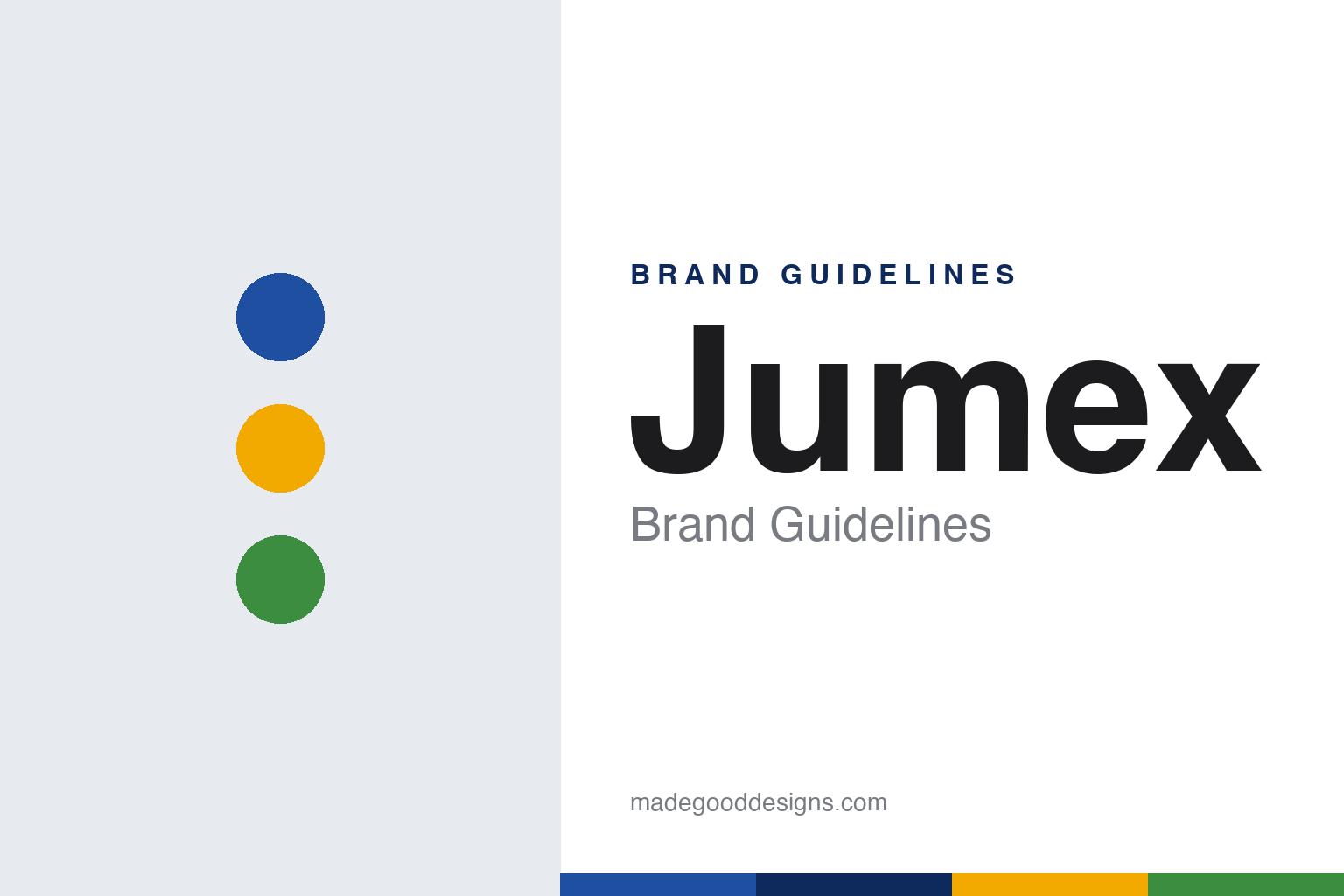
Two constants: a Jumex blue, mango and green palette and a rounded sans register. Abstract homage — not a Jumex product or mark; no can, logo or label is reproduced.
Frugo
A nectar company, a Frugo label and a new name.
Jumex began as Empacadora de Frutas y Jugos, S.A., a company created on 27 April 1961, according to a history the company published on its website in the 2000s and to English Wikipedia. Its founder was Eugenio López Rodea: English Wikipedia’s article on his son, the art collector Eugenio López Alonso, cites the Mexico City newspaper Reforma describing López Rodea as the founder of Jumex. The firm’s first nectars were sold under the name Frugo.
Accounts of the very first product differ. English Wikipedia says López Rodea filled the first apple nectar into a 350-millilitre can on 6 June 1961. The company’s current timeline says production began with peach, packed in a 150-millilitre can that carried no lithographed print, only a label bearing the Frugo name. The archived company history says the Frugo nectars were sold first at the Feria del Hogar fair and then through the Cemerca chain of stores, in flavours including apricot, apple, pear, guava, plum and mango.
The name came in 1964. Jumex is short for Jugos de México, “juices of Mexico,” as both English and Spanish Wikipedia explain, and the company says it began the process of registering the mark that year with the slogan “la latita azul” — the little blue can. Spanish Wikipedia says the blue can introduced in 1964 is still in use.
The group grew partly by making its own supplies. The archived history says Botemex was set up in 1976 to install a can-making factory, giving the company more control over supply and costs, and that Jugomex, a juice plant, was incorporated in 1981. The Vigor nectar line appeared in 1973, the history says, and children’s drinks followed in the 1980s, among them Pau-Pau in 1989. Wikipedia lists the group’s companies as Frugosa, Botemex, Jugomex, Alijumex and three Vilore companies, including Vilore Foods, Inc. in the United States.
Colour
A rocket, a tree and a necked can.
Jumex’s identity has been built on the package as much as on the logo. After the blue can, the company says, came a 1969 change of image under the slogan “Jumex: La Bebida del Futuro,” the drink of the future, represented by a figure sitting on a can that blasted off like a rocket, a reference to the Moon landing. In 1979 a new slogan arrived, “Jumex: Fruta fresca nada más” — fresh fruit, nothing more — and with it the Jumex tree, which the company says has accompanied the brand ever since.
The formats multiplied. The company dates a one-litre glass bottle to 1984, in apple, grape, orange and grapefruit as well as tomato, and a 250-millilitre bottle to 1989. In 1990 it began packing one-litre nectars in Tetra Brik cartons; its history archived in 2005 also lists a 200-millilitre Minibrik carton among the formats of that decade, alongside new lines such as Amí, Chocoloco, Frutástica and Vigor Sport.
In 1994, the company says, it completed one of the brand’s largest projects: giving the can a different shape. The new 335-millilitre can, with a necked body, replaced the traditional 350-millilitre can. In 2007 it launched what it calls the “Lata Botella,” a can-bottle it describes as two packages in one and says it was the first to bring to market, and in 2011 it names the Tetra Prisma carton among its newer packs.
The logo itself has been refreshed rather than replaced. In 2013, the company says, the Jumex mark was renewed with “more modern and clean lines” while keeping the tradition and colours of the original identity, and in 2020 Grupo Jumex renewed its corporate image. Today the brand website groups more than a dozen labels under the Jumex family, from Jumexito to Pau Pau, Vigor and Kermato.
Typography
Design and documentation.
The seven brands in this group are all food brands, and all of them come from Mexico and the United States: Goya, Herdez, Bimbo, Maseca, Jumex, Sabritas and Gamesa. Food brands in general sit at many different points in the trade, from family firms that still carry a founder’s surname to names that now belong to much larger food groups, and a single brand can be sold everywhere from a corner shop to a supermarket shelf.
A food brand’s identity is usually carried less by a single product than by a pack, a name and the meal or snack it promises, because the company behind the name may have changed hands, moved its factory or grown far beyond the town where it started. That makes the questions behind each name worth asking plainly: who started it, who owns it now, and where its food is actually made and packed.
Each guide separates what independent sources record from what the company says about itself — its founding story, its owners over time, where its food is made and how its packaging has changed — and marks plainly what rests only on the company’s own word.
Aa
A rounded sans for a fruit-drink brand. (Specimen set in Nunito, a sans STAND-IN; NOT the Jumex logo.)
Grupo Jumex
A private group in Ecatepec, a US nectar brand and a museum.
Grupo Jumex is a private company with its headquarters in Ecatepec de Morelos, in the State of Mexico, north of Mexico City, according to English Wikipedia, which cites the company’s own contact and privacy pages and gives its workforce as more than 4,000 people.
It has expanded beyond Mexico. On 18 February 2009 Jumex opened its first plant outside Mexico, in El Salvador, to make and distribute juices for Central America and the Caribbean, with an investment of more than US$20 million, the Salvadoran newspaper La Prensa Gráfica reported, as cited by Spanish Wikipedia. On 26 September 2013 Jumex completed its purchase of Kern’s Beverages, the US juice and nectar brand, which had been a subsidiary of Stremicks Heritage Foods since 2004, according to a press release from GulfStar Group, the Houston bank that advised Jumex on the deal. That release described Jumex’s portfolio as more than twelve beverage brands sold in more than 30 countries; the company now says its products reach more than 40 countries.
The company also describes where its fruit comes from. Grupo Jumex says it transforms 350,000 tonnes of fruit a year, naming growing states across Mexico for its oranges, mangoes, guavas, apples and other fruit, and says that at its Chihuahua plant the residue left after pressing apples becomes feed for the region’s cattle.
The Jumex name also travels in the art world. Eugenio López Alonso, the founder’s son, created Fundación Jumex Arte Contemporáneo, formally established on 3 March 2001 with support from Grupo Jumex, English Wikipedia says. Its Museo Jumex, designed by the British architect David Chipperfield, opened in Mexico City’s Nuevo Polanco district on 14 November 2013, according to Spanish Wikipedia, which also describes a gallery at the Ecatepec factory.
For a design guide, Jumex shows how a package — a small blue can — can carry a brand for six decades while the logo is refreshed around it. Compare Valentina, another Mexican everyday staple, and Herdez, a Mexican pantry brand. For this guide we use can blue, navy, mango and green with a rounded sans, an unofficial interpretation; no product or logo is reproduced.
Explore & save
Keep Jumex’s identity on hand — save it to a board in the Made Good inspiration library.
Jumex identity set
Pin the Jumex blue, mango and green palette and the rounded sans register to your own board.