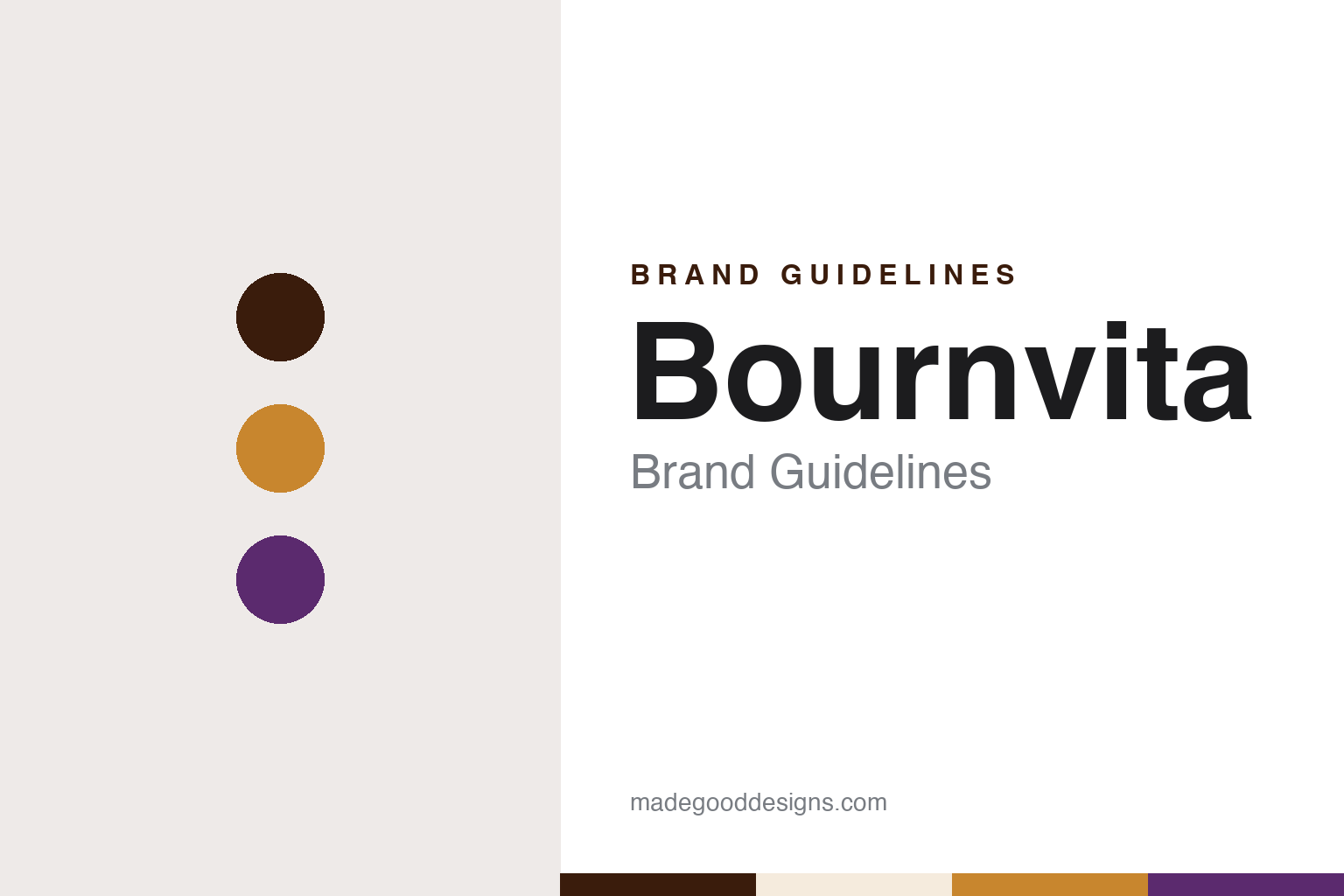
Bournvita Brand Guidelines
Cadbury’s Bournville malt drink that became an Indian staple.
Aa
Two constants: a cocoa brown, malt amber and plum palette and a warm chocolate serif register. Abstract homage — not a Bournvita product or mark; no jar, logo or label is reproduced.
Bourn + vita
A Birmingham chocolate maker, a model village and a malt drink.
Bournvita is a Cadbury product, and its name is a piece of company geography. Cadbury was founded in Birmingham in 1824 by John Cadbury, a Quaker who sold tea, coffee and drinking chocolate. In 1879 his son George Cadbury opened a new plant in the countryside four miles south of the city, at Bournville, the model village the family built around it and which the BBC has described as “the factory in a garden.” English Wikipedia says the drink’s name joins Bournville to vita, the Latin word for life: Bourn plus vita.
The drink itself dates from the late 1920s. English Wikipedia, citing H.V. Verma’s 2006 textbook Brand Management, says Bournvita was developed in England in that decade and was marketed as a health food. It describes the original recipe as including full-cream milk, fresh eggs, malt, edible casein and chocolate. A 1969 issue of the British journal Engineering, quoted in the same article, set out how it was made by then: cocoa mixed with malt, glucose, sugar and egg, pumped into a continuous vacuum band drier, dried into a honeycomb sheet and then granulated before packing.
Bournvita travelled early. English Wikipedia, citing an Australian newspaper report of 28 April 1933 headed “New Health-Food,” says the drink was first made and sold in Australia that year. Cadbury had been selling in Australia since the nineteenth century: three cases of its cocoa and chocolate were advertised in Adelaide in 1853, and its first overseas order, in 1881, was for the Australian market, English Wikipedia says. Today the encyclopedia lists Bournvita as sold in the United Kingdom and North America as well as India, Nepal, Bangladesh, Nigeria, Benin and Togo.
Colour
An Indian launch, a quiz show and a long life on air.
Bournvita’s biggest market became India. Cadbury began operating there in 1948 by importing chocolates, and the Indian company was incorporated on 19 July 1948, English Wikipedia says. Mondelez International’s brands page, as cited by English Wikipedia, gives the same year for Bournvita’s first sale in India. Cadbury India’s own Bournvita page, archived in 2013, put it more directly: the drink was “launched in 1948” and had “continuously re-invented itself in terms of product, packaging, promotion & distribution.” In India it sits alongside Cadbury Dairy Milk, Perk, Gems and Bournville chocolate in a portfolio the Indian company describes as spanning chocolate, beverages, biscuits, gum and candy.
The brand’s most lasting piece of marketing is not a pack but a programme. The Cadbury Bournvita Quiz Contest, sponsored by Cadbury India, began on 12 April 1972, according to English Wikipedia. It started as a live contest held in cities around the country and then became a radio show, hosted first by the broadcaster Hamid Sayani and later by his brother, the broadcaster Ameen Sayani. In June 1992 it moved to television on Zee TV, and later ran on Sony Entertainment Television, Pogo and Colors; its television host is the quizmaster Derek O’Brien.
English Wikipedia describes the Zee TV and Sony years of the 1990s as the show’s peak, when school teams competed in English or Hindi and the contest was treated as a matter of school pride. In 2015 it ran its first YouTube-only season, with the Nagpur school Centre Point named all-India champions, and it then moved to an app of its own on which viewers could play along.
Typography
Design and documentation.
The seven brands in this group make malted drinks, snacks and sauces, and they come from Switzerland, Britain, India, Malaysia and China: Ovaltine, Horlicks, Bournvita, Mamee, Julie’s, Munchy’s and Pearl River Bridge. Brands like these sit at many different points in the trade, from family firms that still carry a founder’s name to labels that now belong to much larger food groups, and a single brand can be sold everywhere from a corner shop to a supermarket shelf far from home.
A food brand’s identity is usually carried less by a single product than by a jar, a packet, a bottle and the name on it, because the company behind the name may have changed hands, moved its factory or grown far beyond the place where it started. That makes the questions behind each name worth asking plainly: who started it, who owns it now, and where its products are actually made and packed.
Each guide separates what independent sources record from what the company says about itself — its founding story, its owners over time, where its products are made and how its packaging has changed — and marks plainly what rests only on the company’s own word.
Aa
A warm chocolate serif for a malt drink named after a factory village. (Specimen set in Fraunces, a serif STAND-IN; NOT the Bournvita logo.)
Bournvita
From Cadbury to Kraft to Mondelez.
Bournvita has changed owners only as Cadbury has. The British company traded for years as Cadbury Schweppes before its drinks business was separated, and on 19 January 2010 Cadbury agreed to be bought by the American group Kraft Foods for £8.40 a share, a deal valuing it at £11.5 billion, the BBC reported at the time. The takeover drew wide public opposition in Britain, including from the trade union Unite. Cadbury and its brands now belong to Mondelez International, the snacks company spun off from Kraft Foods. In India the change reached the company name: on 21 April 2014 Cadbury India became Mondelez India Foods Limited, the Press Trust of India reported, though the drink is still sold as Cadbury Bournvita.
In India, Bournvita’s marketing has also drawn regulators’ attention. In April 2023 a video by the influencer Revant Himatsingka questioned the drink’s sugar content; Mondelez India sent him a legal notice and called his claims unscientific, and he took the video down, The Economic Times and India Today reported. That month the National Commission for Protection of Child Rights asked the brand to withdraw packaging, labels and advertisements it described as misleading. In December 2023 India Today reported that the brand had cut the added sugar in its formula by 14.4%. In April 2024 India’s Ministry of Commerce and Industry advised e-commerce companies to remove Bournvita and similar drinks from any “health drink” category, The Economic Times reported, after the child-rights commission concluded that Indian food law does not define such a category.
Across those changes the drink has kept the same outline: a Cadbury malt drink named after Bournville, made in Australia from the 1930s, sold in India since 1948 and attached for more than five decades to one of the country’s best-known school quizzes.
For a design guide, Bournvita shows how a factory village’s name and a sponsored quiz can carry a malt drink across a century and several continents. Compare Horlicks, its long-time rival among malted drinks, and Fry’s, the Bristol chocolate maker that also became part of Cadbury. For this guide we use a cocoa brown, a malt amber and a plum with a warm serif, an unofficial interpretation; no product or logo is reproduced.
Explore & save
Keep Bournvita’s identity on hand — save it to a board in the Made Good inspiration library.
Bournvita identity set
Pin the Bournvita cocoa brown, malt amber and plum palette and the warm chocolate serif register to your own board.