Yeo’s Brand Guidelines
The Zhangzhou soy sauce shop that became Singapore’s drinks brand.
Aa
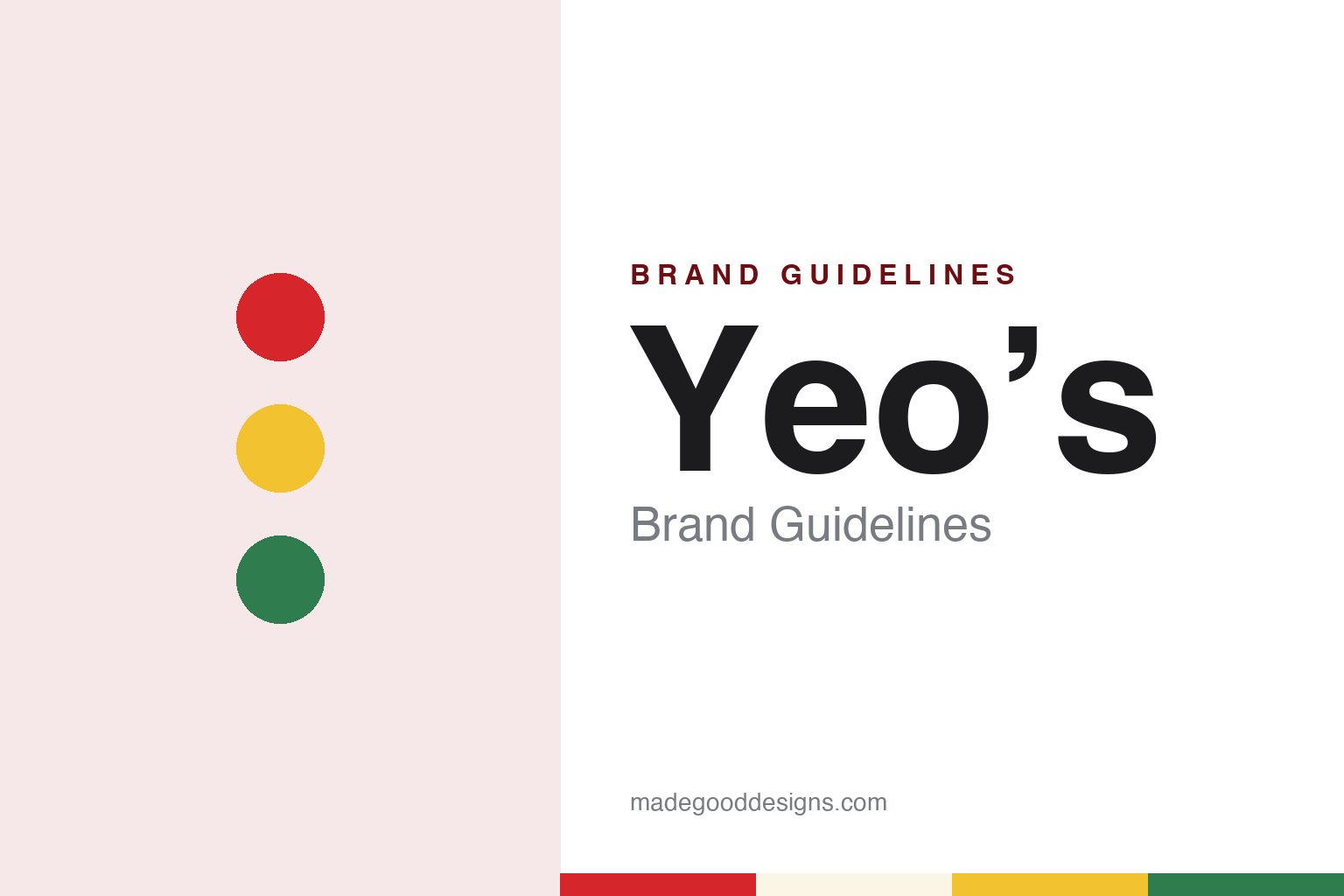
Two constants: a Yeo red, chrysanthemum yellow and tea-leaf green palette and a rounded humanist sans register. Abstract homage — not a Yeo’s product or mark; no pack, can, logo or label is reproduced.
Soy sauce from Zhangzhou
A sauce shop in Fujian, a new start in Singapore.
Yeo’s is the consumer brand of Yeo Hiap Seng, a company that began not in Singapore but in China. The company says its founder, Yeo Keng Lian, started the business in 1901 as a small shop making soy sauce in Zhangzhou, in Fujian province; Asiaweek also dated the family business to 1901 in China in a 1995 report. English Wikipedia names the original concern the Yeo Hiap Seng Sauce Factory.
In the 1930s the business moved south to Singapore, the Nanyang of Chinese emigrants, where soy sauce became a household staple, the company says. English Wikipedia, citing the company’s heritage pages, dates the re-established Yeo Hiap Seng Sauce Factory in Singapore to 1938. The company was incorporated on 20 December 1955 as Yeo Hiap Seng Canning and Sauce Factory Private Limited, and in 1969 it listed on the Singapore stock exchange and took its shorter present name, English Wikipedia says, citing a 2016 company press release.
From sauce the company moved into tins and drinks. English Wikipedia says that in the 1950s it began canning curry chicken and bottling soy milk. The company makes two firsts of its own: it says it was the first company in the world to offer curry chicken in a can, and the first to pack Asian drinks in Tetra Brik aseptic cartons using UHT processing. Starting from soy bean milk, it says, it built a range of Asian drinks and then widened its food line into chilli sauce, cooking sauces, sesame oil and instant noodles. Today its own brand pages group the business into Asian drinks and tea, soy drinks, the H-TWO-O isotonic drink, coconut and jelly drinks, canned food, noodles, pastes, sauces and spreads. The name Yeo’s should not be confused with Yeo Valley, the unrelated British dairy brand.
Colour
A family split, an American detour and a takeover fight.
By the 1990s Yeo’s was a well-known Asian brand, and its company was the subject of one of Singapore’s best-reported takeover battles. Asiaweek reported in July 1995 that Yeo Hiap Seng’s 1994 sales of $188 million had been lifted by its Yeo’s tea and juice, a hit across Asia, and by its Pepsi bottling franchises in Singapore and Malaysia. But the company had stumbled abroad. In 1989, under its chairman Alan Yeo, it bought the American canned-food maker Chun King from Nabisco for $52 million; the business lost ground, Yeo Hiap Seng took a $25 million charge on it in 1994, and in March 1995 it agreed to sell some Chun King assets to Hunt-Wesson for $10 million, the magazine reported.
The losses split the Yeo family. Asiaweek described a feud between Alan Yeo and his nephew Charles, the dissolution of the family holding company in 1994, and the appointment that October of Chng Hee Kok as the company’s first chief executive from outside the family. Into that gap came two outside investors. The property developer Ng Teng Fong’s family had raised its stake to 24.9% by mid-1995, and his son Robert Ng became chairman in June that year. Days later the Malaysian financier Quek Leng Chan of the Hong Leong group, holding more than 26%, announced a bid of his own. Much of the attraction, Asiaweek said, was the land under Yeo Hiap Seng’s factory in Bukit Timah, which had been rezoned for housing.
The Ngs won. English Wikipedia, citing Michael Backman’s 2001 book Asian Eclipse, says they used the Yeo family’s divisions to buy up about 86% of the company, and cites Hong Kong’s The Standard, which in 1997 called the contest one of the most colourful takeover struggles in Singapore’s history.
Typography
Design and documentation.
The seven brands in this group all make food, and all of them come from South Korea, Singapore and Southeast Asia: CJ CheilJedang, Haitai, Binggrae, Paldo, Khong Guan, Yeo’s and Ayam Brand. Food brands from this part of Asia in general sit at many different points in the trade, from family firms that still carry a founder’s name to names that now belong to much larger food groups, and a single brand can be sold everywhere from a neighbourhood shop to a supermarket shelf abroad.
A food brand’s identity is usually carried less by a single product than by a pack, a name and the meal or snack it promises, because the company behind the name may have changed hands, moved its factories or grown far beyond the city where it started. That makes the questions behind each name worth asking plainly: who started it, who owns it now, and where its food is actually made and packed.
Each guide separates what independent sources record from what the company says about itself — its founding story, its owners over time, where its food is made and how its packaging has changed — and marks plainly what rests only on the company’s own word.
Aa
A rounded humanist sans for a brand of everyday drinks. (Specimen set in Nunito Sans, a sans STAND-IN; NOT the Yeo’s logo.)
Yeo’s today
A listed company, a property family and five plants.
Yeo Hiap Seng is still listed in Singapore, and it remains under the Ng family’s control. Its 2025 annual report lists Far East Organization as the largest shareholder, holding 53.84% directly as of 3 March 2026, with the estate of Ng Teng Fong deemed to hold 67.25% through Far East Organization and related companies; about 21% of the shares were in public hands. The company’s board page names Na Wu Beng as chairman and says Adrian Ho became chief executive on 1 September 2026.
The same annual report names the places where Yeo’s is made: plants in Singapore, in Shah Alam and Ipoh in Malaysia, in Cambodia and in China. It also records a difficult 2025. The Shah Alam plant shut unexpectedly after a gas outage in April that year, and the company ended a manufacturing collaboration with Oatly in Singapore, both of which, it said, weighed on its gross margin.
The heritage still does much of the brand work. In 2025, the report says, Yeo’s was the official partner of Singapore HeritageFest with the National Heritage Board, and to mark SG60, Singapore’s 60th year of independence, it released a special edition of its Orchid Chrysanthemum Tea and staged Yeo’s Kampong Games around traditional childhood pastimes. In Malaysia it promoted its soy milk around World Plant Milk Day, and in Cambodia it paired special-edition bird’s nest drinks with baskets made by local weavers for the Pchum Ben festival.
For a design guide, Yeo’s shows how a soy sauce maker from Zhangzhou turned its family name into a shelf of everyday Asian drinks, and kept that name through a change of owner. Compare Lee Kum Kee, the oyster sauce house of 1888, and Amoy, the soy sauce maker founded in Xiamen, also in Fujian. For this guide we use a Yeo red, a chrysanthemum yellow and a tea-leaf green with a sans, an unofficial interpretation; no product or logo is reproduced.
Explore & save
Keep Yeo’s’s identity on hand — save it to a board in the Made Good inspiration library.
Yeo’s identity set
Pin the Yeo’s red, chrysanthemum yellow and tea-leaf green palette and the rounded humanist sans register to your own board.