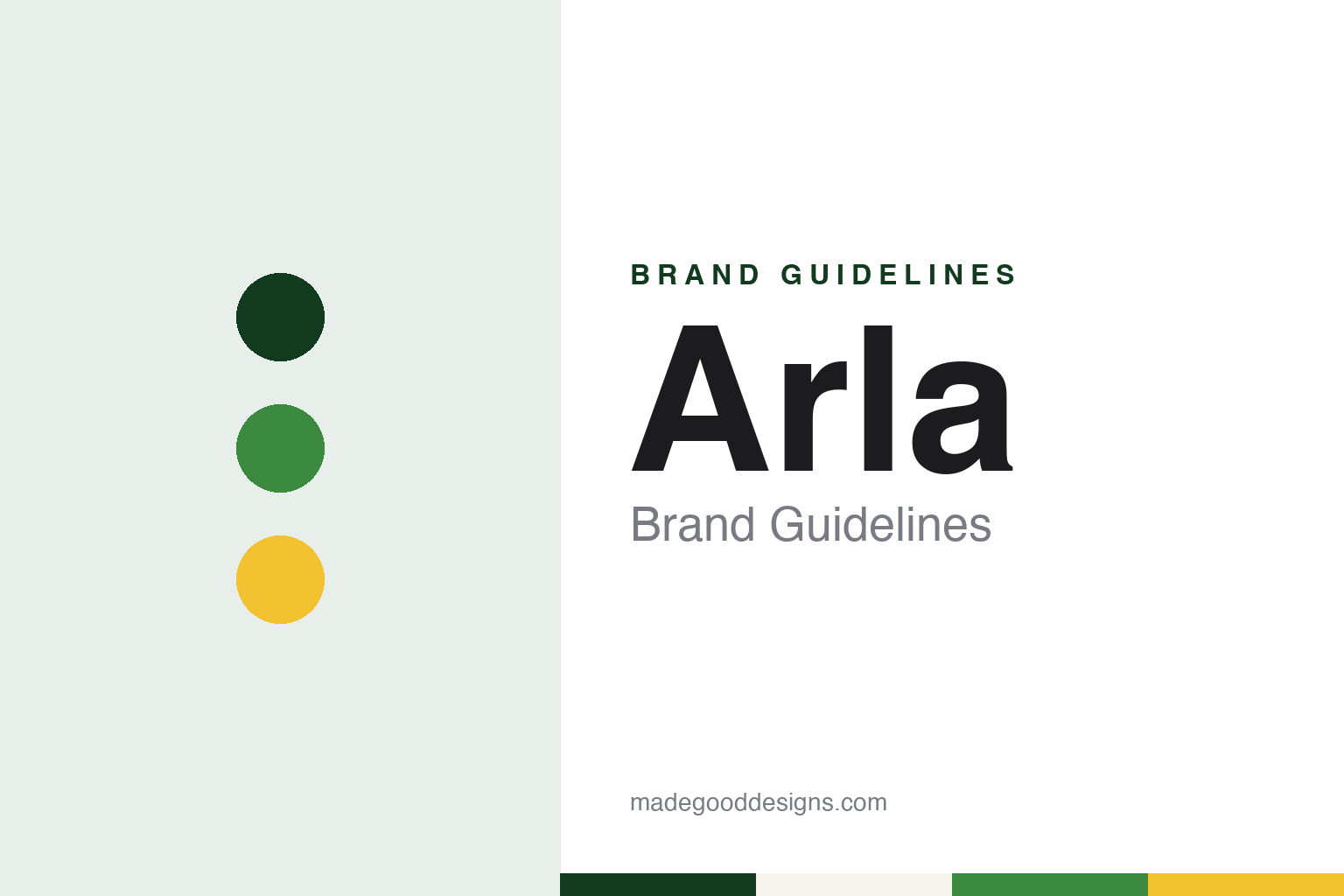
Arla Brand Guidelines
The farmer-owned dairy named for the early morning.
Aa
Two constants: a meadow green, buttercup yellow and milk white palette and a friendly geometric sans register. Abstract homage — not an Arla product or mark; no pack, logo or cow is reproduced.
Early in the morning
A Västmanland farm, a Stockholm milk centre and a Danish dairy group.
Arla’s name is older than the company that carries it. English Wikipedia, citing Arla’s own history pages, says the first Swedish dairy co-operative was set up in 1881 at Stora Arla Gård, a farm in the province of Västmanland, under the name Arla Mejeriförening. The word is an archaic Swedish term for “early,” as in early in the morning, and shares its root with the English word. Denmark’s first co-operative dairy followed a year later, in 1882, at Hjedding near Ølgod in southern Jutland.
The Swedish organisation that became Arla grew out of Stockholm. On 26 April 1915, dairy farmers in Stockholm and the surrounding counties formed Lantmännens mjölkförsäljningsförening, the Farmers’ Milk Retail Association, which ran dairies and a chain of milk shops. In 1927 it registered the name Mjölkcentralen, “the Milk Centre,” or MC for short, and from the 1950s co-operative dairies elsewhere in Sweden began to join it. In 1975 MC renamed itself Arla, a name that, the company says, had been used not only by the first co-operative dairy but also by the largest dairy retailer in Gothenburg between 1909 and 1965. By the end of the century Arla held about 65% of the Swedish market, the trade site Just Food reported in 2000.
The Danish side was younger. On 1 October 1970, four dairy companies and three individual dairies set up Mejeriselskabet Danmark, or MD, Aarhus University’s Danmarkshistorien portal says. It renamed itself MD Foods in 1988, signed a co-operation agreement with Denmark’s second-largest dairy company, Kløver Mælk, in 1992 and merged with it in 1999.
Colour
One co-operative, a green oval and a red cow.
The two groups came together in 2000. Swedish Wikipedia says Arla’s members met at Norra Latin in Stockholm in March 2000, where the merger was carried by 197 votes to seven; the merger with MD Foods took effect on 17 April 2000, and the new company, Arla Foods amba, took its name on 6 June. English Wikipedia gives the headquarters as Viby J, on the edge of Aarhus. The company is a co-operative owned by the dairy farmers who supply its milk; at the start of 2022, its annual report said, 8,492 farmers in Denmark, Sweden, Germany, the United Kingdom, Belgium, the Netherlands and Luxembourg owned it.
The merger brought a new mark. Swedish Wikipedia, citing Arla’s Swedish history pages, says the combined company adopted a logo of a green oval carrying the words Arla Foods. In autumn 2008 a revised version followed, in which the buttercup that had sat to the right of the older logo moved to the top, according to an Arla press release of that year. The older Swedish symbol was kept: the red Arla cow remains in use in Sweden as a mark for products and brands made with milk from Swedish farms, the company says.
English Wikipedia names four strategic brands sold worldwide: Arla itself, which it describes as both the co-operative’s brand and a brand across all product categories; Lurpak butter; Puck; and Castello cheeses. Swedish Wikipedia adds Nordic names such as Bregott, Kelda and Keso. Arla also has a long-term partnership with Starbucks to make, distribute and market its ready-to-drink coffee in Europe, the Middle East and Africa, the company announced in 2018 when it extended the deal.
Typography
Design and documentation.
The seven brands in this group are all Nordic food and dairy names: Kalles Kaviar, Felix, Estrella, Valio, Arla, Stabburet and Nidar. Nordic food brands in general sit at many different points in the trade, from names that still carry a founder’s story to brands that now belong to much larger food groups or farmer-owned co-operatives, and a single brand can be sold everywhere from a corner shop to a supermarket shelf.
A food brand’s identity is usually carried less by a single product than by a pack, a name and the meal or snack it promises, because the company behind the name may have changed hands, moved its factory or grown far beyond the town where it started. That makes the questions behind each name worth asking plainly: who started it, who owns it now, and where its food is actually made and packed.
Each guide separates what independent sources record from what the company says about itself — its founding story, its owners over time, where its products are made and how its packaging has changed — and marks plainly what rests only on the company’s own word.
Aa
A friendly geometric sans for a co-operative named for the early morning. (Specimen set in Figtree, a sans STAND-IN; NOT the Arla logo.)
Arla
Mergers across northern Europe, and a boycott.
Arla has grown largely by merging with other farmer-owned dairies. Swedish Wikipedia records mergers with Germany’s Hansa-Milch, approved by the EU authorities in April 2011, and Allgäuland-Käserei, completed in November 2011. In 2012 the British farmer co-operative Milk Link joined, and Sweden’s Gefleortens dairy followed in 2017. In 2011 Arla made its ingredients division, Arla Foods Ingredients, a separate subsidiary, and in May 2016 it sold its juice maker Rynkeby Foods to the Eckes-Granini Group.
One episode tested the brand abroad. In early 2006, after cartoons of the Prophet Muhammad were published in the Danish newspaper Jyllands-Posten, a boycott of Danish goods spread across the Middle East; on 3 February Arla said its sales in the region had stopped, The Daily Telegraph reported, and in April 2006 the BBC reported that its products were returning to shops there.
The largest merger came in 2026. Arla announced on 8 April 2025 that it planned to merge with the German dairy co-operative DMK Deutsches Milchkontor, Swedish Wikipedia says, and the company announced that the merger took effect on 1 June 2026. The combined co-operative keeps the name Arla Foods and its headquarters in Viby J, and the company says it is owned by about 11,200 farmers in seven countries. Its brands now include DMK’s MILRAM, Humana, Oldenburger and Uniekaas alongside Arla, Lurpak, Castello and Puck, the company says. Peder Tuborgh is chief executive and Jan Toft Nørgaard chairs the board.
For a design guide, Arla shows how a co-operative can keep its local symbols while one name travels: a green oval for the group and a red cow for Swedish milk, with a buttercup moved to the top of the mark in 2008. Compare it with Lurpak, the butter brand it owns, and with Finland’s Valio. For this guide we use meadow green, buttercup yellow and milk white with a friendly geometric sans, an unofficial interpretation; no product or logo is reproduced.
Explore & save
Keep Arla’s identity on hand — save it to a board in the Made Good inspiration library.
Arla identity set
Pin the Arla meadow green, buttercup yellow and milk white palette and the friendly geometric sans register to your own board.