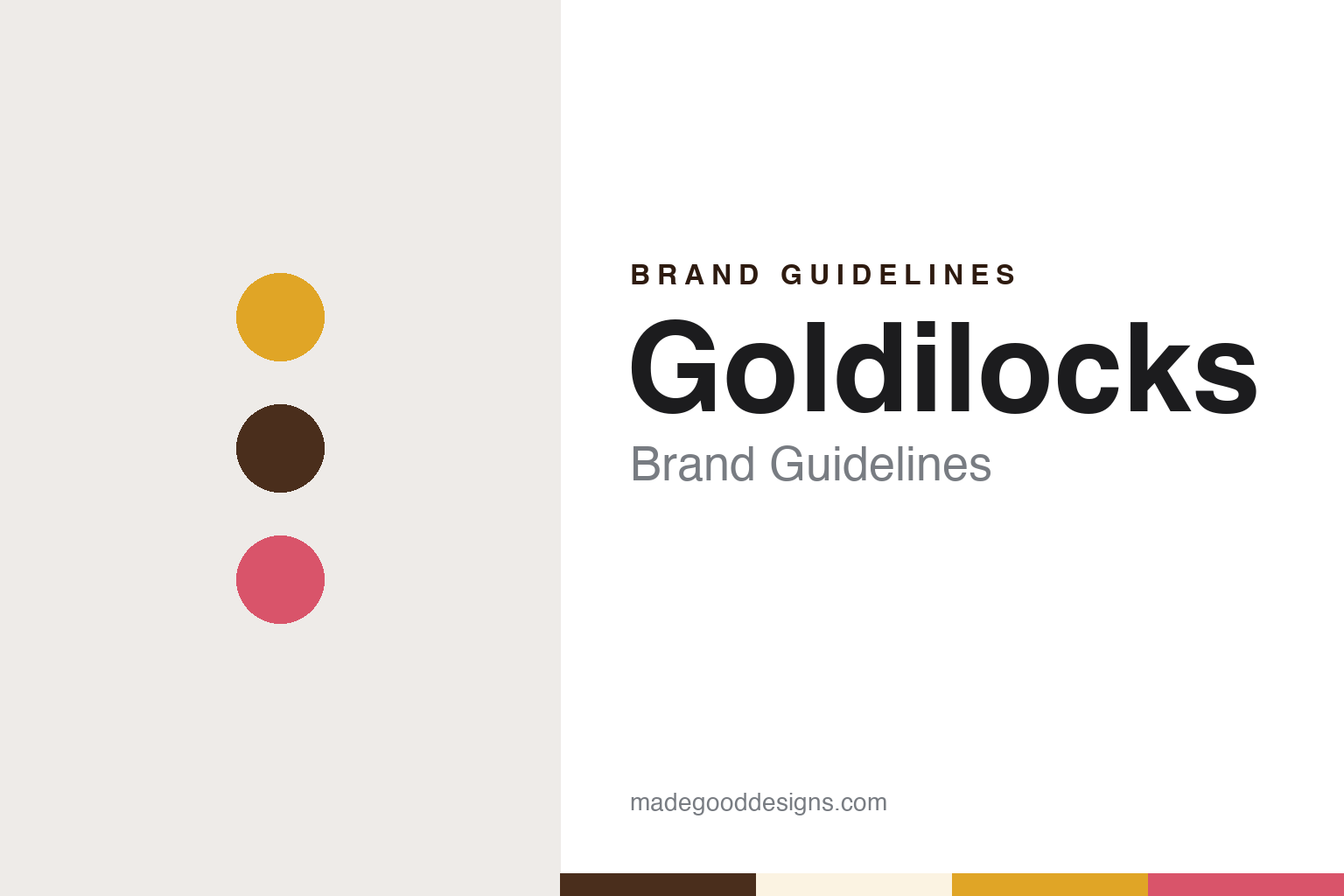
Goldilocks Brand Guidelines
The Makati bakeshop named for a fairy tale.
Aa
Two constants: a golden crust, cocoa and strawberry icing palette and a storybook serif register. Abstract homage — not a Goldilocks product or mark; no cake, box, logo or store front is reproduced.
Once upon a time in Makati
Two sisters, a sister-in-law and ten employees.
Goldilocks opened on 15 May 1966 in Makati, in Metro Manila. English Wikipedia, citing the Philippine Daily Inquirer and a 2015 profile in MDWK Magazine, names its founders as the Chinese Filipino sisters Milagros Leelin Yee and Clarita Leelin Go and their sister-in-law Doris Wilson Leelin. The first shop occupied a space of about 70 square metres on the ground floor of a three-storey building on Pasong Tamo Street, and it started with ten employees.
The company tells its own history as a fairy tale. Its milestones page begins “Once upon a time in 1966…” and describes the first branch opening “on a cheerful day in May” in Pasong Tamo. A second branch followed in 1968 on Taft Avenue in Manila, and in 1969 the bakeshop added catering, the company says.
The name came from the same source. According to English Wikipedia, which cites a 2013 GMA News report and the MDWK profile, the chain was named after the girl in Goldilocks and the Three Bears because the name would be easy for children and their mothers to remember, and because it suggested the words “gold” and “luck,” which the founders saw as auspicious. The name was suggested by the founders’ sister, Maria Flor.
In 2013 GMA News reported that CNN had listed the Goldilocks founders among the world’s “trailblazer” female chief executives. English Wikipedia’s infobox names Richard L. Yee as president and gives the headquarters as Shaw Boulevard in Mandaluyong, where the company’s website lists its cake plant.
Colour
Franchising, Los Angeles and nearly a thousand stores.
Goldilocks went abroad within ten years. In 1976 it opened its first store in the United States, in Los Angeles; English Wikipedia says further stores followed elsewhere in California, including San Francisco and San Jose, and in Las Vegas. The company dates its first Canadian store, in Vancouver, to 1984, and its first store in Bangkok, Thailand, to 2010.
At home the growth came through franchising. The company launched a franchising programme in 1991, which English Wikipedia, citing a 2006 Inquirer article, credits with the opening of hundreds of stores across the Philippines. By the company’s count it opened its 100th store in 1999, its 200th in 2006, its 300th in Quezon City in 2010 and its 400th in 2013. It reached Mindanao with a store in Davao in 2002, and opened in Baguio in 2003.
Production followed the stores. The company says it opened a commissary in Cebu in 1995 to serve the southern market, and inaugurated a new plant in Cebu in 2015. In 2007 it opened the Goldilocks Cake City Tour, a visit to see how its products are made, and in 1994 it introduced computerised edible portrait cakes, it says. In 1981 it was the official caterer for the visit of Pope John Paul II, according to its milestones page.
Its range today runs from celebration cakes, rolls and petite cakes to snack bouquets of mamon, alongside a foodshop line of Filipino dishes such as kare-kare, caldereta and lumpiang Shanghai, according to its website.
The brand has been redrawn more than once. The company says it updated its store design and visual elements in 2001 and rebranded in 2012, “updating its identity elements and strengthening its legacy”; English Wikipedia, citing GMA News in 2013, dates a full re-branding to 2010. In Philippine Daily Inquirer reporting in February 2024, the chain announced plans to open 60 more stores and finish the year with 986 branches. English Wikipedia counted at least 900 stores in the Philippines in 2019, with others in Thailand, California, Nevada and Canada.
Typography
Design and documentation.
The seven brands in this group are food and drink brands from the Philippines and Thailand: Jack ’n Jill, Ligo, Mega, Oishi, Goldilocks, Lactasoy and Dutch Mill. Food and drink brands in general sit at many different points in the trade, from family firms that still carry a founder’s name to names that now belong to much larger food groups, and a single brand can be sold everywhere from a neighbourhood store to a supermarket shelf.
A food or drink brand’s identity is usually carried less by a single product than by a pack, a name and the snack, meal or drink it promises, because the company behind the name may have changed hands, moved its factory or grown far beyond the town where it started. That makes the questions behind each name worth asking plainly: who started it, who owns it now, and where its products are actually made and packed.
Each guide separates what independent sources record from what the company says about itself — its founding story, its owners over time, where its products are made and how its packaging has changed — and marks plainly what rests only on the company’s own word.
Aa
A storybook serif for a bakeshop named after a fairy tale. (Specimen set in Fraunces, a serif STAND-IN; NOT the Goldilocks logo.)
Goldilocks
A family bakeshop that joined a conglomerate.
For most of its history Goldilocks was a private family company. English Wikipedia records that a planned purchase of the chain by Pancake House International fell through, citing the Philippine Daily Inquirer and The Manila Times.
The eventual buyer was SM Investments, the holding company of the SM group. According to English Wikipedia, which cites Rappler, SM Investments acquired a 34 per cent stake in 2018 and in 2021 bought a majority stake, making Goldilocks a subsidiary; Rappler reported the majority deal on 4 August 2021. Wikipedia’s infobox gives SM Investments’ holding as 74 per cent.
Other long-lived Philippine food names also belong to large groups: Magnolia, the Manila ice cream brand dating from 1925, is part of San Miguel.
The anniversaries carry the same voice. The company marked 2006 as “40 Thoughtful Years” in the Philippines and 2016 as “50 Sweet and Delightful years,” and its milestone entries switch into regional languages as the chain spreads, greeting Cebu in Cebuano when the commissary opened there in 1995 and Davao when the chain reached Mindanao in 2002. By 2004, it says, there were 17 Goldilocks stores across key cities in the United States.
For a design guide, Goldilocks shows how a single story can carry a brand: a fairy-tale name chosen for children and their mothers, a milestones page that opens “Once upon a time,” and a celebration-cake business built on birthdays and weddings. Compare Magnolia and Jack ’n Jill. For this guide we use golden crust, cocoa and strawberry icing with a serif, an unofficial interpretation; no product or logo is reproduced.
Explore & save
Keep Goldilocks’s identity on hand — save it to a board in the Made Good inspiration library.
Goldilocks identity set
Pin the Goldilocks golden crust, cocoa and strawberry icing palette and the storybook serif register to your own board.