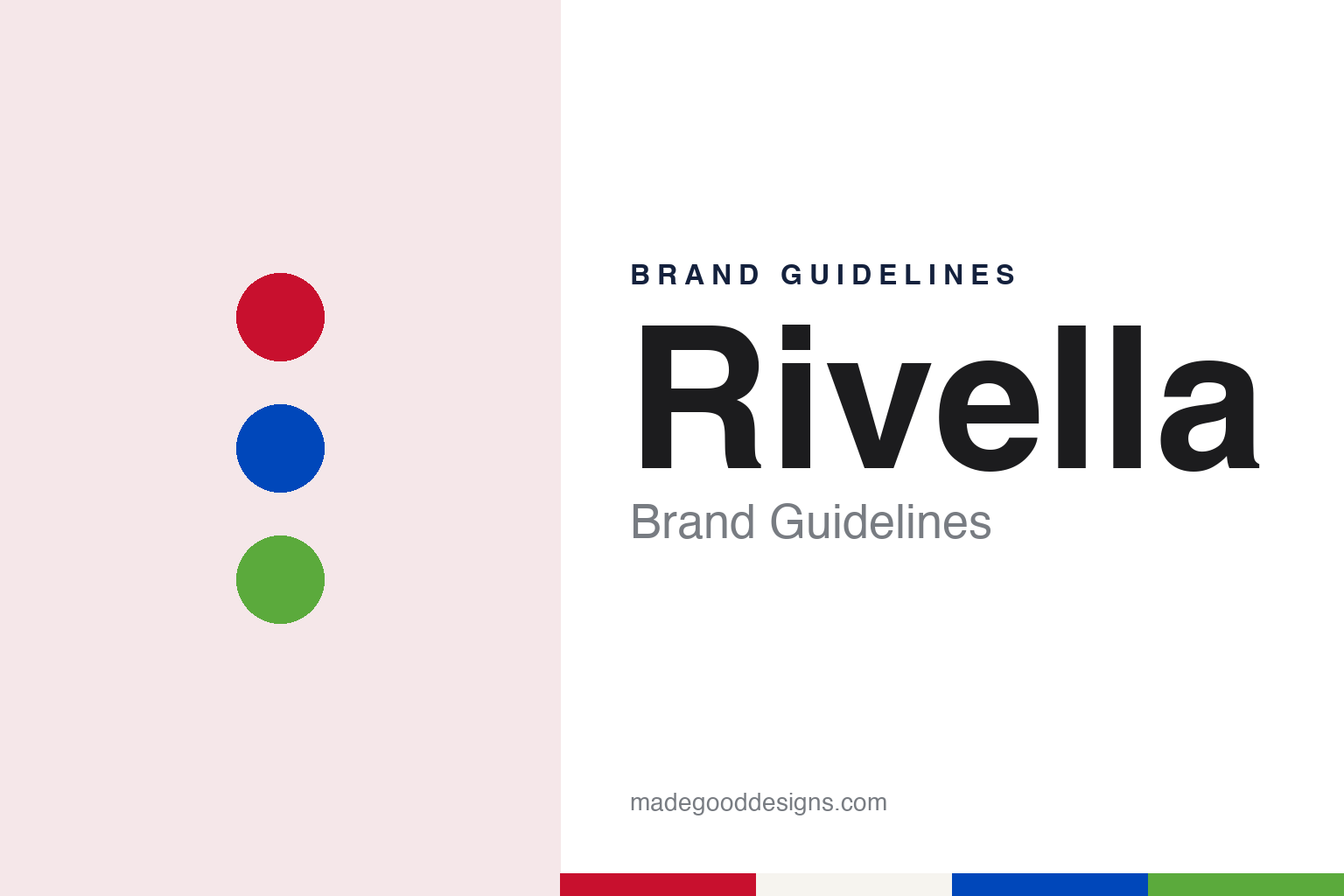
Rivella Brand Guidelines
Robert Barth’s Swiss milk-serum soft drink in colour codes.
Aa
Two constants: a red, blue and green-tea palette and a geometric sans register. Abstract homage — not a Rivella product or mark; no bottle, label or logo is reproduced.
Whey in a wine shop
A law student, a dairy biologist and a village on Lake Zurich.
Rivella is a carbonated soft drink made with milk serum, the liquid obtained from whey once its fat and protein are filtered out, and it has been made in Switzerland since 1952. Its inventor was Robert Barth, then a law student. The Swiss National Museum’s blog, in a 2018 history by Gabriel Heim, says it began in 1951 in a bathroom in Rapperswil on Lake Zurich, where Barth experimented with mixtures of mineral water, herbal flavourings and milk serum, and that he found the specialist who worked out the technical basis for production in Hans Süsli, a dairy biologist at ETH Zurich. The St. Galler Tagblatt reported in 2009 that Barth began experimenting in 1950, at 28, and founded the Milkin-Institut Robert R. Barth in Stäfa in 1951.
Production started in Stäfa, on Lake Zurich, in 1952, the year to which the company dates the founding of Rivella AG and the first bottles of Rivella Rot (red) on sale. Barth bought second-hand machines and set them up in a former wine shop, the Tagblatt and the museum’s blog say. The name, by the company’s account, has two sources: the Ticino village of Riva San Vitale and the Italian word rivelazione, “revelation.” The museum’s blog, calling this the company legend, adds that the word was cut in half because a full “Rivelazione” did not sound like a snappy order.
The drink depended on the dairy industry. In 1953, the museum says, Barth built a plant for milk-serum concentrate next to the Nordostschweizer Milchverband dairy cooperative in Uster, with fresh whey from milk processing fed straight in, which gave the dairies a use for a by-product they otherwise had to dispose of. In 1954 the company moved to Rothrist in Aargau, where it is still based; the Tagblatt says Barth wanted a central site on the Swiss Plateau with good water.
Colour
Boycotts, skiers and colours.
Rivella had to fight its way in. According to the museum’s blog, the Swiss mineral-springs association threatened innkeepers and shopkeepers with a halt to deliveries of its waters and soft drinks if they stocked the newcomer, and the Federal Gymnastics Festival in summer 1955 banned it from being served. Barth, the museum says, turned the boycott threats into an advertising campaign against the associations and won public sympathy. The Tagblatt adds that in the early years the drink was poured and promoted at countless sporting events, from amateur football tournaments to fun runs and ski races.
Sport has stayed at the centre of the brand. Rivella began its partnership with the Swiss national ski team in 1977, and the museum calls “legendary” a television spot from that year in which the team sings the Rivella song. In 2009 the Tagblatt described Rivella as the official drink of the Swiss Olympic team, the national ski team and the national floorball team. The company’s own archive of advertising runs from “Rivella darf beim Einkauf nicht fehlen” (Rivella mustn’t be missing from the shopping) in 1966 and “Sportler trinken Rivella” (athletes drink Rivella) in 1973 to the 2001 line “Welche Farbe hat Dein Durst?” — “What colour is your thirst?”
That question points to the range, which the brand codes by colour. Rivella Rot is the original. Rivella Blau (blue), made with sweeteners instead of sugar, was launched first in the Netherlands in 1958 and in Switzerland in 1959, the company says. Rivella Grün (green), with green-tea extract, followed in 1999. A soy-based Rivella Gelb (yellow) appeared in 2008, the Tagblatt reported; a new, fully vegan Gelb without milk serum arrived in 2024, the company says. From 1995 Rivella also made an own-label version, Mivella, for Migros, the Tagblatt says; Migros announced in 2008 that it was switching to the Rivella brand.
Typography
Design and documentation.
The seven brands in this group all make food or drink, and all of them come from Austria or Switzerland: Zipfer, Gösser, Inzersdorfer, Rivella, Emmi, Kägi and Rauch. Austrian and Swiss food and drink brands in general sit at many different points in the trade, from family firms that still carry a founder’s surname to names that now belong to much larger groups, and a single brand can be sold everywhere from a village shop to a supermarket shelf.
A food or drink brand’s identity is usually carried less by a single product than by a pack, a name and the meal or moment it promises, because the company behind the name may have changed hands, moved its production or grown far beyond the town where it started. That makes the questions behind each name worth asking plainly: who started it, who owns it now, and where its products are actually made and packed.
Each guide separates what independent sources record from what the company says about itself — its founding story, its owners over time, where its products are made and how its packaging has changed — and marks plainly what rests only on the company’s own word.
Aa
A geometric sans for a drink sorted by colour. (Specimen set in Poppins, a sans STAND-IN; NOT the Rivella logo.)
Rivella
A family company in Rothrist.
Rivella AG has stayed with the founding family. Robert Barth handed the chair of the board to his eldest son, Alexander Barth, in 2000, the company says. German Wikipedia, citing cash.ch, says the business has been wholly owned by Alexander Barth and his son Tano Barth since 2025, and, citing swissinfo.ch in April 2026, that Tano Barth, the founder’s grandson, is to succeed his father as chairman in spring 2027. The company, now trading as Rivella Group, took over the fruit-juice brand Michel in 1983 and the vitamin-water maker fluidfocus in 2019, and it says it first filled its drinks in PET bottles in 1995.
Abroad, Rivella has rarely caught on. The Tagblatt counted launch attempts in about two dozen countries by 2009, and the museum’s blog says only the Netherlands really took to it; German Wikipedia calls the Netherlands its largest foreign market. The Badische Zeitung reported in March 2019 that Rivella was ending sales in Germany. At home, Rivella is listed in the Culinary Heritage of Switzerland inventory, and the Tagblatt wrote in 2009 that surveys placed it among the 20 best-known brands in the country.
Its look has been renewed several times. The Tagblatt called the brown bottle part of everyday Swiss life and printed the 1952 bottle beside the 2007 one. German Wikipedia records a relaunch of the whole brand in 2007, with a new look and bottle policy, and another in 2016 with a new design and logo, a year the company also gives for its new design. The museum’s blog calls Rivella a red-and-blue brand. In 2022 Lidl Switzerland launched a vegan drink called Livetta, which the Aargauer Zeitung reported under a headline about the same bottle and the same colour.
For a design guide, Rivella shows a whey drink that built a national identity on colour-coded flavours and decades of sports sponsorship. Compare Emmi, the Swiss dairy group, and Ricola, the Laufen herb-drop maker. For this guide we use red, blue and green-tea green with a geometric sans, an unofficial interpretation; no product or logo is reproduced.
Explore & save
Keep Rivella’s identity on hand — save it to a board in the Made Good inspiration library.
Rivella identity set
Pin the Rivella red, blue and green-tea palette and the geometric sans register to your own board.