Atria Brand Guidelines
The Finnish co-operative meat name behind a red-green logo.
Aa
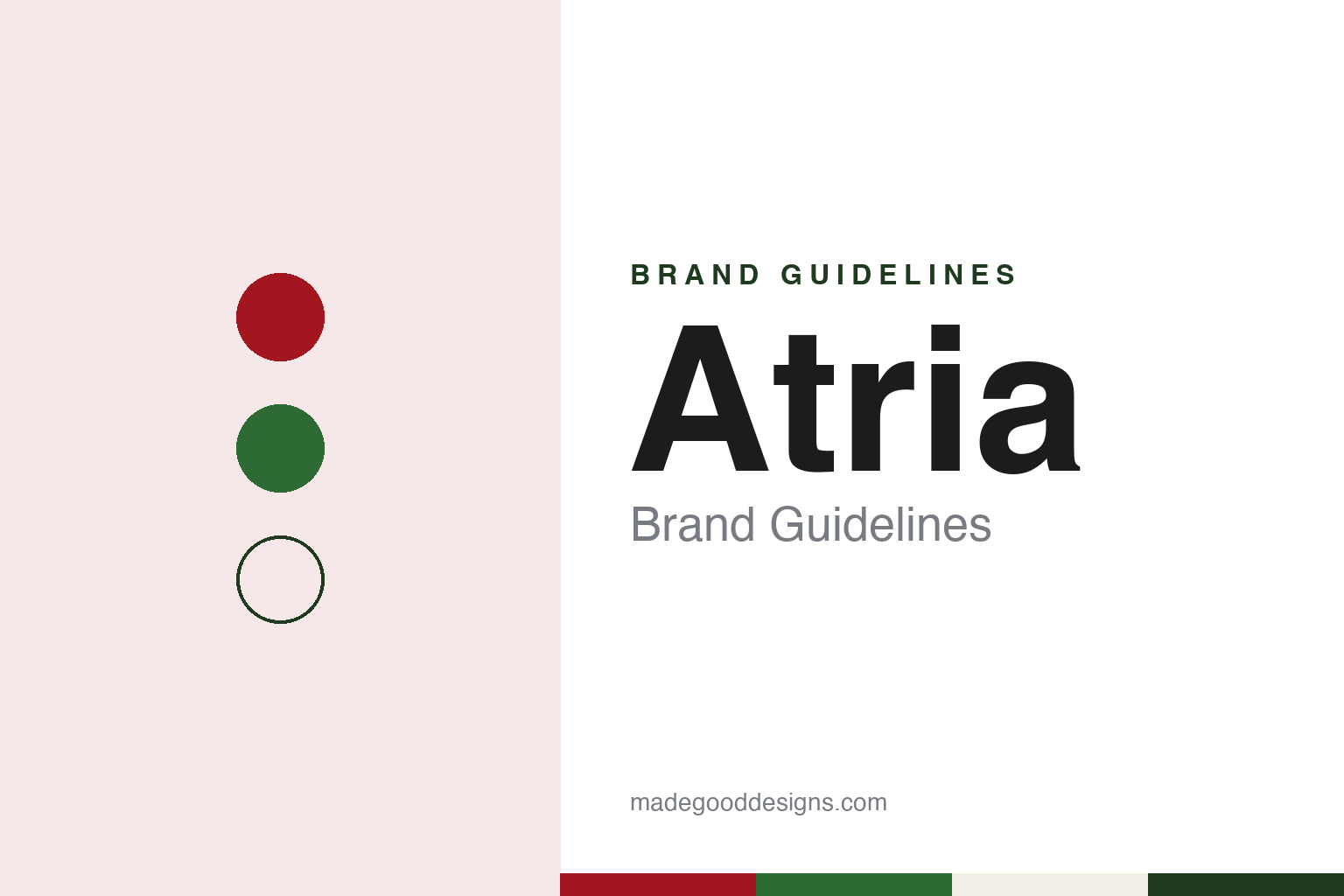
Two constants: an Atria red and green palette and a sturdy grotesque register. Abstract homage — not an Atria product or mark; no pack, logo or label is reproduced.
Two co-operatives
A livestock co-operative in Kuopio and another in Seinäjoki.
Atria is a Finnish meat and food company, and its story starts with farmers rather than a founder’s name. English and Finnish Wikipedia both trace its oldest root to 1903, when the Kuopio livestock sales co-operative (Kuopion Karjanmyyntiosuuskunta) was founded in Kuopio, in eastern Finland; Finnish Wikipedia says it was set up under the leadership of Bruno Ilmoniemi. The company itself describes 1903 as the year “a small group of farmers set up the first Finnish cooperative meat company,” which at first sold and brokered livestock and within a few years was also processing meat. The first products it sold, the company says, were sausages; Wikipedia dates the co-operative’s purchase of a sausage factory to 1910.
The Kuopio co-operative changed its name twice. In 1938 it became Savo-Karjalan Osuusteurastamo, the Savo-Karelia co-operative slaughterhouse, and in 1956 Lihakunta, as its work widened into manufacturing and trade. It merged with Karjapohjola in 1972, taking it into northern Finland, and in 1988 set up a subsidiary, Lihapolar Oy, to run its production, sales and marketing.
The second root lies in western Finland. Itikka, a livestock co-operative, was founded in Seinäjoki in South Ostrobothnia in 1914 and built a sausage factory three years later, both Wikipedias record. It too grew by buying smaller meat companies — Maan Liha in the mid-1970s and OK-Liha in the mid-1980s — and in 1988 moved its industrial and commercial work into a subsidiary, Itikka Liha-botnia Oy. In 1981 both Lihakunta and Itikka had taken part of the meat business of the wholesale co-operative OTK.
Colour
From a co-operative label to a group name.
The two subsidiaries merged in 1990. According to English Wikipedia, the combined company began operating as Itikka-Lihapolar in 1991, when it also took over Osuuskunta Pohjanmaan Liha, the Ostrobothnia meat co-operative, and was listed on the stock exchange; Finnish Wikipedia gives both 1991 and 1994 for the listing.
The name Atria is older than the company that now carries it. The company says the Atria brand was created in 1963 to represent TLK, the central organisation of Finland’s co-operative slaughterhouses, and that the merged company took over its use in 1992, when that organisation was wound up. In 1994, the company says, “the Atria brand, which was already highly respected, became the name of the entire group,” and English Wikipedia also dates the company name to 1994. The listed parent is today Atria Plc (Atria Oyj), which gives its head office as Seinäjoki; Atria Finland is run from Nurmo, on the northern side of Seinäjoki, where Wikipedia locates the group’s large slaughterhouse and food plant.
Nurmo is where most of the company’s recent building has happened, by its own account. Atria opened a new poultry unit there in August 2024, and in January 2026 the foundation stone was laid for a new convenience-food factory on the same site. Its history page also names a cattle slaughterhouse at Kauhajoki, opened in 2013, and chicken production at Sahalahti in Kangasala, which came with Saarioinen’s procurement, slaughtering and cutting business in 2014. In 1999 it bought Liha ja Säilyke of Forssa, owner of the Forssan brand.
Typography
Food and drink from Finland and Norway.
The seven brands in this group all make food or drink, and they come from Finland and Norway: Hartwall, Koff, Mills, Solo, Olvi, Lapin Kulta and Atria. Food and drink brands in general sit at many different points in the trade, from family firms that still carry a founder’s surname to names that now belong to much larger groups, and a single brand can be sold everywhere from a corner kiosk to a supermarket aisle.
A food or drink brand’s identity is usually carried less by a single product than by a pack, a name and the meal or drink it promises, because the company behind the name may have changed hands, moved its production or grown far beyond the town where it started. That makes the questions behind each name worth asking plainly: who started it, who owns it now, and where its products are actually made and packed.
Each guide separates what independent sources record from what the company says about itself — its founding story, its owners over time, where its products are made and how its packaging has changed — and marks plainly what rests only on the company’s own word.
Aa
A sturdy grotesque — for a red-green mark. (Specimen set in Archivo, a sans STAND-IN; NOT the Atria logo.)
Atria
A red-green logo, redrawn in 2020.
The best-documented part of Atria’s design history is its logo. In 2020 Atria Finland announced that it was renewing what it called its “traditional red-green brand logo,” which it says research shows to be one of the best-known logos in the Finnish food industry, and which had served “in its current form” since 1991. The new version reached packaging from August 2020. The company says the logo was created with the British design agency BrandMe, after a year of design work and several rounds of research, and that the packaging was changed at the same time to give more room to traceability, responsibility and Finnish origin. Its marketing director at the time, Sanna Päällysaho, described the aim as bringing out “approachability, community and warmth.” Atria’s brand page says the brand “took on its current character” at the beginning of 2020.
Outside Finland, Atria has grown by buying brands rather than exporting its own name. In Sweden it bought Lithells in 1997, and with it Sibylla, a hot-dog brand from 1932 that the company calls its most international; the Sardus deal of 2007 brought Lönneberga, Arboga and the Danish 3-Stjernet, and it later added Ridderheims, the poultry company Lagerbergs in 2016 and the convenience-food business Gooh! in 2024. In Estonia it owns Maks & Moorits, acquired in 2005, and Wõro and VK, both acquired in 2008; in Denmark, the organic cold-cuts maker Aalbæk, from 2015. Atria sold its Russian subsidiary Pit-Product to a member of the Cherkizovo Group in April 2021, the company says.
The group now reports three business areas — Atria Finland, Atria Sweden and Atria Denmark & Estonia — and says Finland accounts for roughly 73 per cent of its net sales. Kai Gyllström became chief executive on 1 June 2023, succeeding Juha Gröhn, according to the company.
For a design guide, Atria shows how a co-operative label can become a corporate name and still keep its colours, with the logo redrawn while the red and green stay. Compare Fazer, another Finnish food name whose colour is part of its identity, and Campofrío, a Spanish charcuterie brand. For this guide we use sausage red, pasture green and rye cream with a sturdy sans, an unofficial interpretation; no product or logo is reproduced.
Explore & save
Keep Atria’s identity on hand — save it to a board in the Made Good inspiration library.
Atria identity set
Pin the Atria red and green palette and the sturdy grotesque register to your own board.