Maestrani Brand Guidelines
The 1852 chocolate house behind Minor and Munz.
Aa
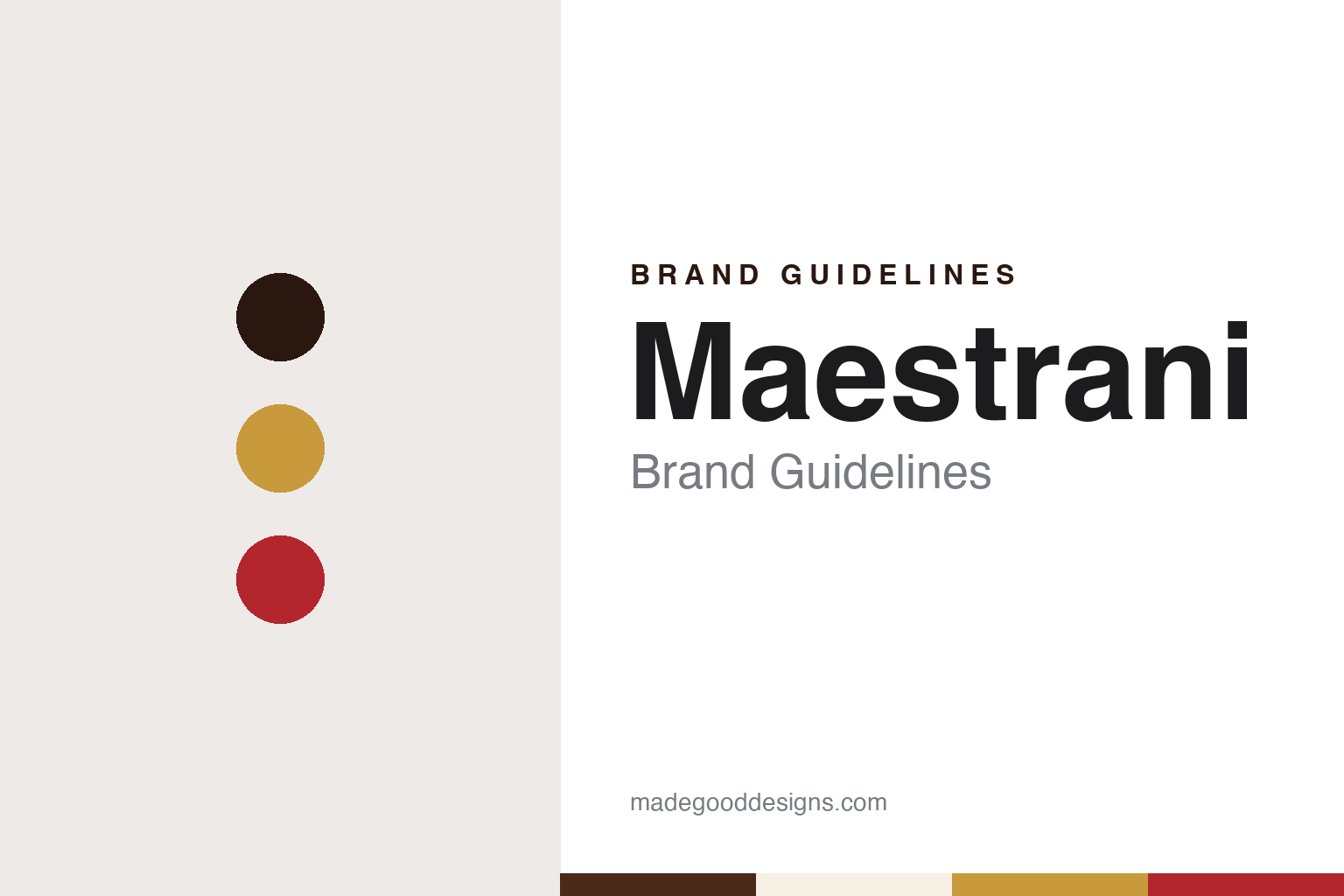
Two constants: a cocoa brown, hazelnut gold and St. Gallen red palette and a rounded confectioner sans register. Abstract homage — not a Maestrani product or mark; no pack, logo or bar is reproduced.
Lucerne, 1852
A Ticinese chocolatier moves north.
Maestrani is one of the oldest names in Swiss chocolate. Its founder, Ludovico “Aquilino” Maestrani, came from Aquila in the Blenio valley of Ticino, a village that is now part of the commune of Blenio. The Historical Dictionary of Switzerland (HLS) says his father, Giuseppe, had emigrated to Lombardy and on his return worked as a chocolatier in Lugano from 1826 to 1829, and that Aquilino learned the trade in his father’s business. After working in Italy and Germany from 1846 to 1852, Aquilino founded a chocolate factory in Lucerne in 1852, the HLS says; German Wikipedia places his first shop on the Krongasse there. The company still uses the year in its tagline, “Passion Chocolat Suisse 1852.”
The business soon moved east. The HLS dates the move to St. Gallen to 1859; the company’s own timeline gives 1875 and says the growing textile city promised steady demand all year round. In 1875, the HLS says, Maestrani added a delicatessen business and moved manufacturing to Espenmoos, where it could use water power, and his products sold mainly in Italy and Austria. The company calls him an “entrepreneur and inventor.”
His three sons, Ludovico, Roberto and Savino, took the business on. They enlarged the premises in 1884 and ran a branch in Bregenz, Austria, from 1887 to 1897, the HLS says. German Wikipedia says the firm bought a former spinning mill in St. Georgen, a district of St. Gallen, in 1884 and moved production there the following year, and that St. Georgen remained its base into the 21st century. Maestrani was known abroad early: German Wikipedia, citing the Handelszeitung in 2005, says King Umberto I of Italy made it a purveyor to his court.
Ambition brought trouble. In 1905 the company raised outside capital to break into the American market, and in a further recapitalisation in 1912–13 the Maestrani family lost control, the HLS says; from then on the firm traded as Maestrani Schweizer Schokoladen AG. In 1923 the trustee Jakob Guyer restructured it on behalf of a creditor bank and, managing it until 1961, returned it to commercial success, the same source says.
Colour
Minor, Munz and a move to Flawil.
The brands many Swiss shoppers know best from Maestrani are not called Maestrani. In 1936 the company launched Minor, a chocolate bar with extra hazelnuts, the company says, and it is marking Minor’s 90th anniversary in 2026. German Wikipedia describes Minor as an angular chocolate stick and contrasts it with the round sticks sold under the second house brand, Munz.
Munz came from a rival. That chocolate factory was founded in Flawil, in the canton of St. Gallen, in 1874 by Johann Georg Munz, German Wikipedia says, citing Nau.ch. Maestrani took it over at the end of the 1990s: the company dates the takeover to 1997 and says it moved its headquarters to Flawil, German and French Wikipedia give 1998, and the HLS describes a merger carried out between 1998 and 2001. A new factory hall was built in Flawil, and the whole of production moved there from St. Georgen in 2003 and 2004, German Wikipedia says. The company says it now makes its chocolate exclusively in Flawil.
For a time the group sold three brands, Maestrani, Minor and Munz. In 2021 it moved to two: German Wikipedia says the Maestrani-branded bars, an organic and Fairtrade range, were switched to the Munz name, and an archived 2020 version of the Maestrani bar website announced the range would soon appear in a new design. The company says Maestrani was the first chocolate maker in the world to produce organic chocolate, in 1987. Its current consumer brands, the company says, are Munz, Minor, Avelines and Chocolat Ammann, with more than 150 products, and it also makes private-label chocolate for international customers and retail chains.
In 2017 Maestrani opened the Chocolarium at its Flawil factory, a visitor centre with an interactive tour and a view of production, SRF reported. The company calls it “the happiness factory of Munz and Minor” and says it welcomes more than 230,000 visitors a year.
Typography
Design and documentation.
The seven brands in this group all make food or drink, and all of them come from Switzerland or Norway: Villars, Maestrani, Ramseier, Appenzeller Alpenbitter, Elmer Citro, Ringnes and Tine. Food and drink brands from these two countries in general sit at many different points in the trade, from family firms that still carry a founder’s surname to co-operatives and names that now belong to much larger groups, and a single brand can be sold everywhere from a village shop to a supermarket shelf.
A food or drink brand’s identity is usually carried less by a single product than by a pack, a name and the taste it promises, because the company behind the name may have changed hands, moved its production or grown far beyond the town where it started. That makes the questions behind each name worth asking plainly: who started it, who owns it now, and where its products are actually made and packed.
Each guide separates what independent sources record from what the company says about itself — its founding story, its owners over time, where its products are made and how its packaging has changed — and marks plainly what rests only on the company’s own word.
Aa
A rounded sans for a house of chocolate sticks and pralines. (Specimen set in Nunito, a sans STAND-IN; NOT the Maestrani logo.)
Maestrani Schweizer Schokoladen AG
Buying brands in the 2020s.
Maestrani has been growing by acquisition. In January 2022 it entered a strategic cooperation with the Swiss chocolate maker Favarger and set up Avelines Chocolats SA, hallowil.ch reported; the company’s timeline lists 2022 as the year it acquired Avelines, a praline brand it says expands its premium segment. The same year it held a 170th-anniversary event in St. Gallen, the company says.
In April 2025 the farming newspaper Schweizer Bauer reported that Maestrani was considering taking over Chocolat Ammann of Heimberg, in the canton of Bern, whose owner had found no successor. At the end of that month the takeover was announced, effective from August 2025, with production moving to Flawil and the Heimberg site closing, SRF reported. The company says Ammann’s chocolate kisses, made of marshmallow foam and a wafer under a chocolate coating, have been sold since 1949. In June 2025 Maestrani also took over the Belgian praline maker Delafaille, with its subsidiary Ostrapack, as part of a succession arrangement, Blick and foodaktuell reported.
Christoph Birchler has been chief executive since the start of 2021, succeeding Markus Vettiger, the St. Galler Tagblatt reported in 2020. The Tagblatt put the Flawil workforce at 165 in 2020, and the company has given its annual output as about 3,500 tonnes. Maestrani describes itself as a traditional and innovative family company, and German Wikipedia lists it as a member of IG Bio, the Swiss organic industry group.
For a design guide, Maestrani shows how a house can let its product brands take the front of the shelf while the founder’s name and the year 1852 carry the heritage. Compare Frey, the Aarau chocolate maker owned by Migros, and Halba, the chocolate maker owned by Coop. For this guide we use cocoa brown, hazelnut gold and a St. Gallen red with a rounded sans, an unofficial interpretation; no product or logo is reproduced.
Explore & save
Keep Maestrani’s identity on hand — save it to a board in the Made Good inspiration library.
Maestrani identity set
Pin the Maestrani cocoa brown, hazelnut gold and St. Gallen red palette and the rounded confectioner sans register to your own board.