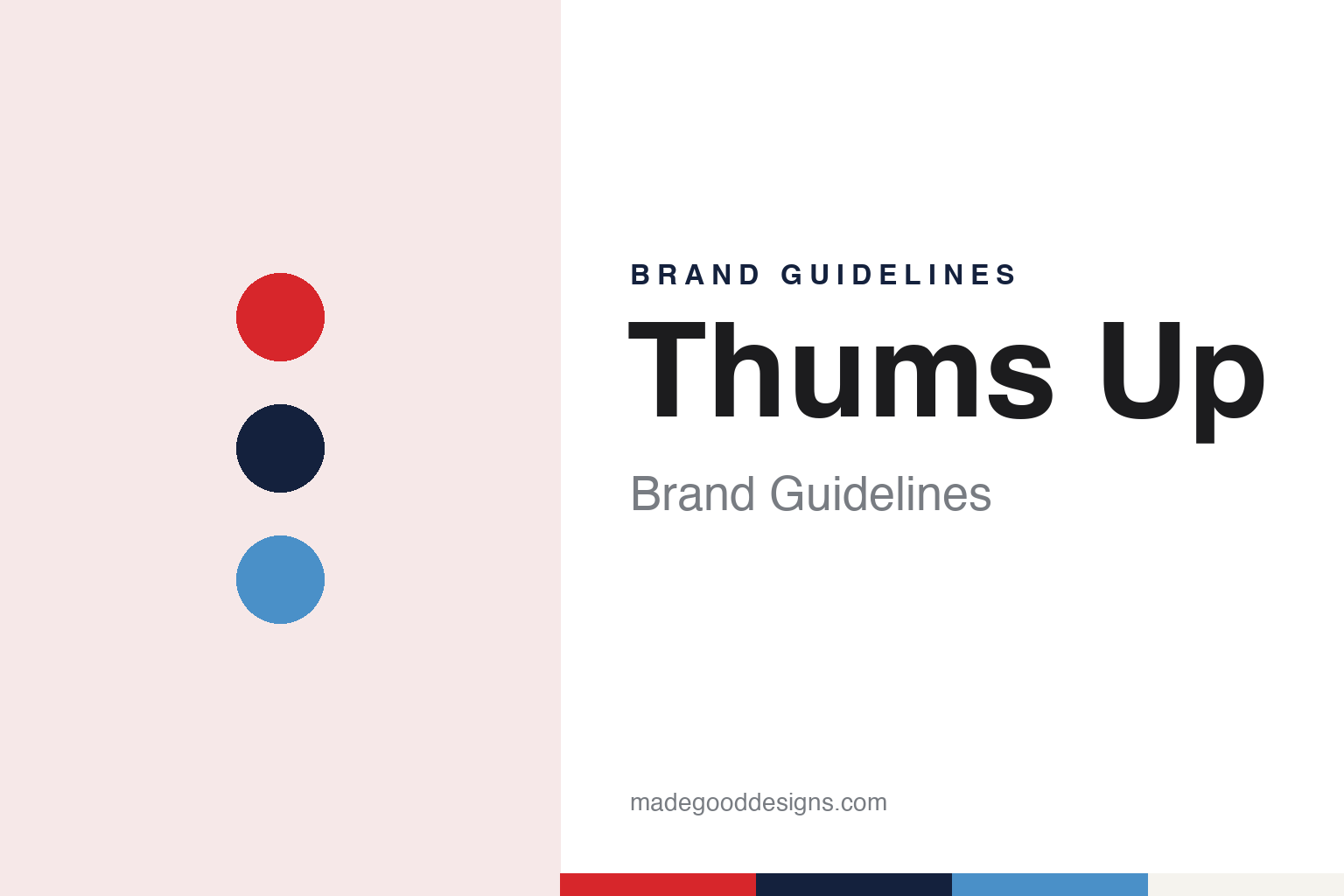
Thums Up Brand Guidelines
The Indian cola that a thumbs-up made famous.
Aa
Two constants: a Thums Up red, navy and blue palette and a slanted condensed sans register. Abstract homage — not a Thums Up product or mark; no bottle, logo or hand gesture is reproduced.
After Coca-Cola left
A cola made for a market Coca-Cola had left.
Thums Up was born of a gap in the Indian market. In 1977 The Coca-Cola Company withdrew from India rather than comply with rules that would have required it to disclose its formula and reduce its foreign shareholding to 40%, English Wikipedia says, citing the Financial Times and Coca-Cola’s own retrospective. The cola that took its place came from the Chauhan family’s soft-drinks business in Mumbai, led by Ramesh Chauhan. It traded as Parle Exports, later as Parle Bisleri, and is today Bisleri International. It is a separate company from Parle Products, the biscuit maker behind Parle-G, and from Parle Agro, the maker of Frooti, although all three trace back to the Chauhan family’s original Parle business in Vile Parle, English Wikipedia says.
The soft-drinks side had a longer history than the cola. In a 2008 interview with the Mumbai newspaper DNA, Ramesh Chauhan said his father had set up Parle Bottling in 1949 with a drink called Gluco Cola, advertised in 1950 by the cartoonist R. K. Laxman, before a legal dispute with Coca-Cola over the name led to a change to Parle Cola and, later, to the orange drink Gold Spot. By 1977 the business already sold Gold Spot and the lemon drink Limca, English Wikipedia says.
English Wikipedia credits Ramesh Chauhan with developing the Thums Up formula, saying his team experimented with spices such as cinnamon and cardamom and wanted a drink that stayed fizzy even when it was not ice-cold, so that street vendors could sell it. It also says the drink was to be called “Thumbs Up” and that the “b” was dropped to make the name distinctive. Thums Up quickly became India’s best-selling cola, and English Wikipedia describes a near-monopoly through the 1980s over rivals including Campa Cola and Double Seven. When the Economic Times reported Coca-Cola’s plans for the brand in 2018, it still called Chauhan “the creator of Thums Up.”
Colour
Cricket, MahaCola and the 1993 sale.
The 1980s built the brand’s public habits. Thums Up appeared in the background of many Hindi films, Outlook Business reported in 2013, and it sponsored cricket, including matches in Sharjah; in the early 1980s it issued postcards of the cricketers Sunil Gavaskar and Imran Khan, according to the trade site Adgully. Its slogan until the early 1980s was “Happy days are here again,” English Wikipedia says, later followed by “I want my thunder” and “Taste the thunder.”
When India opened its market to multinationals in 1991, Pepsi arrived first and signed film stars; Thums Up answered with more cricket sponsorship and a larger 300 ml bottle, up from 250 ml, which was marketed as “MahaCola,” meaning great cola, India.com reported in 2016. In 1993 Coca-Cola returned after an absence of 16 years and bought Thums Up from Ramesh Chauhan’s Parle Bisleri together with Limca, Gold Spot, Citra and Maaza, Mint reported in 2022; Thums Up then held more than 80% of the Indian cola market, the paper said. Chauhan told DNA that he sold the brands but not the company: of 62 bottling plants, only four were his own, and most of the franchised bottlers wanted to move to Coca-Cola. He kept Bisleri, and in 1998 he sold his bottling companies, Delhi Bottling Company and Coolaid, to Coca-Cola, Business Standard reported.
Coca-Cola at first cut back advertising for Thums Up to steer drinkers towards its own cola, Outlook Business reported, but found that Thums Up drinkers switched to Pepsi rather than to Coke. It relaunched Thums Up instead, positioning it against Pepsi as a strong, grown-up drink with campaigns such as “Grow up to Thums Up”; Business Today called it “the brand that refused to die” in 2009.
Typography
Design and documentation.
The seven brands in this group are all drink names from India: Thums Up, Limca, Frooti, Paper Boat, Rasna, Bisleri and Maaza. Indian drink brands in general sit at many different points in the trade, from family firms that still carry a founder’s name to names that now belong to much larger food and drink groups, and a single brand can be sold everywhere from a corner shop to a supermarket shelf.
A drink brand’s identity is usually carried less by a single product than by a pack, a name and the drink it promises, because the company behind the name may have changed hands, moved its production or grown far beyond the place where it started. That makes the questions behind each name worth asking plainly: who started it, who owns it now, and where its products are actually made and packed.
Each guide separates what independent sources record from what the company says about itself — its founding story, its owners over time, where its products are made and how its packaging has changed — and marks plainly what rests only on the company’s own word.
Aa
A slanted condensed sans for a cola sold on “thunder.” (Specimen set in Barlow Condensed Italic, a sans STAND-IN; NOT the Thums Up logo.)
Thums Up
A billion-dollar brand under Coca-Cola.
Thums Up has since become Coca-Cola’s biggest brand in India. In February 2022 Coca-Cola’s chief executive, James Quincey, said on an earnings call that Thums Up had become a billion-dollar brand in India in 2021, the first in the company’s Indian portfolio to reach that mark; Mint called it the largest soft-drink brand in the country. In 2018 Coca-Cola said it would launch Thums Up in other South Asian markets, the first time the brand would be marketed outside India, although it had already been made in small quantities in the Middle East for the Indian diaspora, The Economic Times reported. English Wikipedia names those markets as Bangladesh, Nepal, Pakistan and Sri Lanka.
Its advertising has leaned on film stars and athletes. Coca-Cola India signed the actor Mahesh Babu in February 2012 and re-signed Salman Khan in October 2012, with a tie-in to his film Dabangg 2. The fast bowler Jasprit Bumrah fronted the “Toofan” campaign of 2021–22, Mint and The Hindu BusinessLine reported, and Shah Rukh Khan became an ambassador in 2022, The Economic Times reported. For the Tokyo 2020 Olympic and Paralympic Games, held in 2021, Thums Up issued limited-edition packs carrying Indian athletes such as the wrestler Bajrang Punia and the high jumper Mariyappan Thangavelu. Coca-Cola India’s site today lists Thums Up alongside a variant, Thums Up X-Force, and features a campaign film with Shah Rukh Khan titled “Dum Hai Toh Dikha.”
The mark has changed less than the owner. English Wikipedia describes the original logo as a red thumbs-up hand with slanted white sans-serif lettering, later modified by Coca-Cola with blue strokes and more modern type.
For a design guide, Thums Up shows how a single gesture, a hand giving a thumbs-up, can carry a cola through a change of owner and nearly five decades of advertising. Compare Inca Kola, Peru’s golden national soda, and Bisleri, the water brand Ramesh Chauhan kept. For this guide we use a thunder red, a deep navy and a sky blue with a slanted condensed sans, an unofficial interpretation; no product or logo is reproduced.
Explore & save
Keep Thums Up’s identity on hand — save it to a board in the Made Good inspiration library.
Thums Up identity set
Pin the Thums Up thunder red, deep navy and sky blue palette and the slanted condensed sans register to your own board.