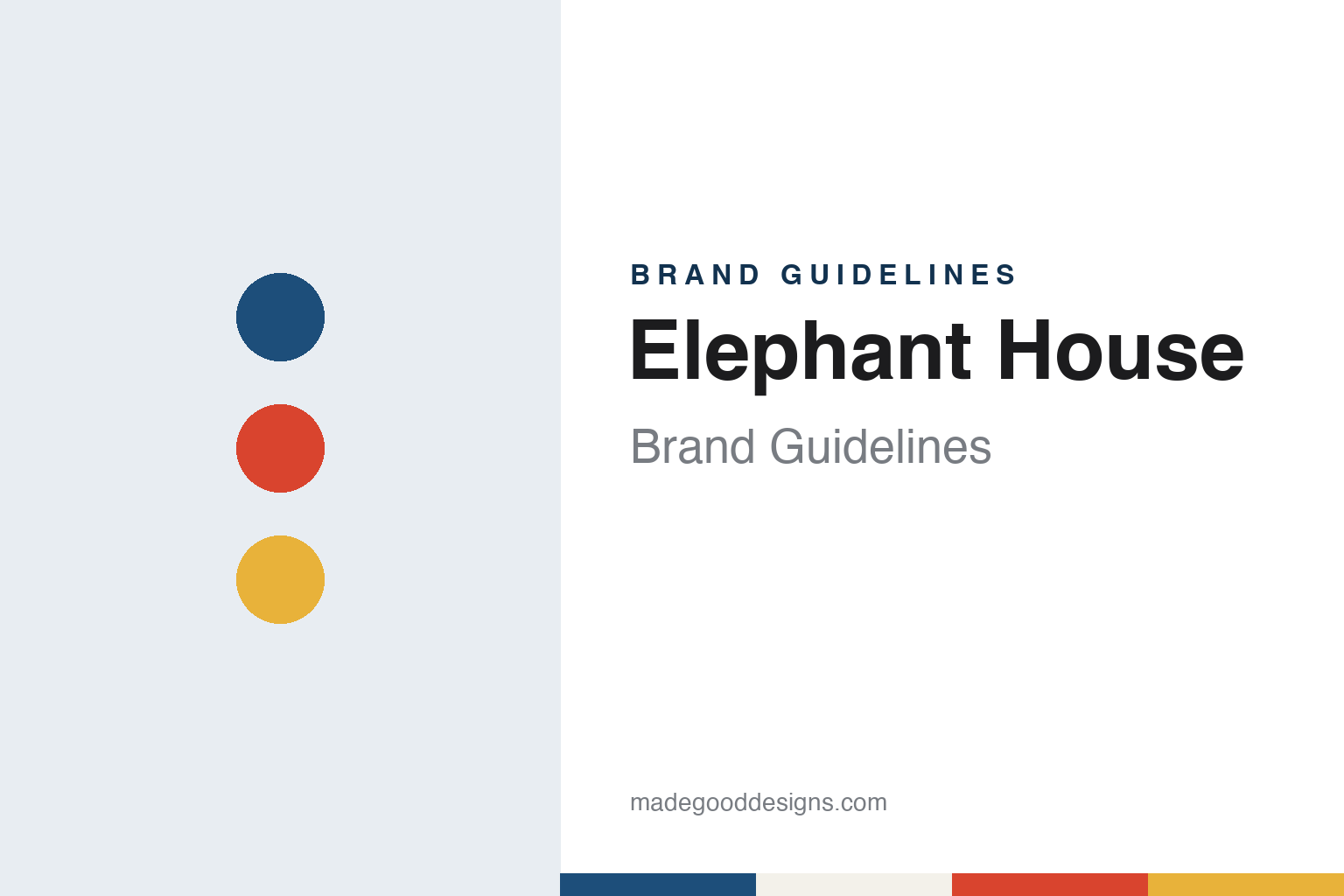
Elephant House Brand Guidelines
Sri Lanka’s soda and ice-cream brand, from an 1866 ice company.
Aa
Two constants: a bottle blue, Necto red and ginger gold palette and a vintage soft serif register. Abstract homage — not an Elephant House product or mark; no bottle, logo or elephant is reproduced.
The ice company
Imported ice, a German manager and an elephant on the bottle.
Elephant House is the trading name of Ceylon Cold Stores, a Colombo company whose first business was ice. The Daily News of Sri Lanka, in a 2003 history of the firm, said the first ice-making machine was imported into Ceylon in 1863, and that ice production on a commercial scale began with the formation of the Colombo Ice Company in 1866. The company’s heritage page put its start-up at £1,600 of capital, two steam engines and 22 employees, run by its manager, a German engineer named Arthur Von Possner. Its works on Glennie Street in Slave Island were known locally as the “Ice Kompaniya,” and the name passed to the surrounding district, Kompaniveediya, the Sunday Times of Sri Lanka reported in 2002.
The ice company also made aerated waters, and it is through them that the elephant arrived. The Sunday Times said in 2002 that it was Von Possner, as the firm’s manager, who stamped the distinctive “Elephant” trademark on the bottles. The company’s own heritage page told it differently: Von Possner left in 1882, set up his own aerated-water business in 1883 and introduced the elephant trademark there. That business, Von Possner’s British Aerated and Mineral Water Company, was bought by the ice company in 1919, the Daily News reported.
The original Colombo Ice Company did not last. It went into liquidation and was bought by a syndicate headed by Tom Walker, owner of a competing aerated-water firm, the company said; the New Colombo Ice Company dates from 8 May 1894, with Walker as managing director. The Daily News said its early output was six tons of ice and 700 bottles a day, sold mostly to ships’ chandlers, hotels, clubs and shops.
Colour
Crown corks, cold stores and a change of name.
The New Colombo Ice Company grew by buying its rivals, the Daily News reported: the Galle Face Ice Company in 1910, Von Possner’s mineral-water business in 1919, the Pure Ice and Aerated Water Manufactory in the late 1920s and its biggest competitor, the Ceylon Ice and Cold Storage Company, in November 1934. In 1922 it replaced its old rubber-ringed bottles with crown corks and announced the change under the caption “a tale of two bottles,” the paper said; the change also brought an effigy of an elephant on the bottle, as a sign that it held the “Right Stuff.” There were no advertising agencies in Ceylon at the time,, and the paper said the company’s advertisements were written in-house.
Cold storage gave the company its later name. It opened cold stores in Colombo on 1 December 1928 and bought Ceylon Creameries outright in 1932, adding fresh milk and ice cream. In 1935 it installed its own carbonic-acid gas plant, making carbon dioxide and dry ice, and set up its own printing press. In 1941 the New Colombo Ice Company became Ceylon Cold Stores Limited, “in view of the ever extending operations of the Company,” the Daily News said.
By then the range ran well beyond ice. A 2002 Sunday Times report listed ice cream, milk, jam, cordials, sauces, pickles and bakery goods among the company’s old lines, and named ginger beer and soda as the oldest drinks in the Elephant House range, each more than a century old, with orange barley over 75 years old and a raspberry-flavoured Necto among the best known. In 2002, the paper said, the company had narrowed its focus to soft drinks and ice cream, with a smaller range of cold meats.
Typography
Design and documentation.
The seven brands in this group are all food and drink names from Pakistan and Sri Lanka: Shan, National Foods, Rooh Afza, Olper’s, Tapal, Elephant House and Munchee. Pakistani and Sri Lankan food and drink brands in general sit at many different points in the trade, from family firms that still carry a founder’s name to names that now belong to much larger food and drink groups, and a single brand can be sold everywhere from a corner shop to a supermarket shelf.
A food or drink brand’s identity is usually carried less by a single product than by a pack, a name and the meal, snack or drink it promises, because the company behind the name may have changed hands, moved its production or grown far beyond the place where it started. That makes the questions behind each name worth asking plainly: who started it, who owns it now, and where its products are actually made and packed.
Each guide separates what independent sources record from what the company says about itself — its founding story, its owners over time, where its products are made and how its packaging has changed — and marks plainly what rests only on the company’s own word.
Aa
A vintage soft serif for a brand that began on a bottle. (Specimen set in Fraunces, a serif STAND-IN; NOT the Elephant House logo.)
Elephant House
A Ceylonese chairman, a listing and John Keells.
The company passed into Sri Lankan hands in stages. In 1964 Mallory Wijesinghe became its first Ceylonese chairman, and the Daily News said all of its key staff were by then Ceylonese. English Wikipedia says Ceylon Cold Stores was listed on the Colombo Stock Exchange in January 1970. After a period of change in the 1980s it was taken over by John Keells in 1991, the Sunday Times reported; English Wikipedia says it came under John Keells Holdings through that group’s acquisition of the Whittalls Group. The Sunday Times gave John Keells’ stake as 54% in 2002; English Wikipedia, citing the 2022/23 annual report, gives it as 70.66%. Ceylon Cold Stores PLC remains a listed John Keells company.
Competition from abroad shaped the modern brand. Trade liberalisation in 1977 brought multinationals such as Coca-Cola into the market, the Sunday Times said, and after the John Keells takeover the company split its drinks into separate brand positions in 1992: Necto for children, lemonade for sport, cream soda for music and Orange Crush for young couples, a director told the paper.
Elephant House is made in Sri Lanka. The company says its factory at Ranala has made Elephant House soft drinks and ice creams since 1997, with its own essence plant producing ginger extracts and vanilla essences from vanilla and ginger bought from local farmers. A second ice-cream factory, built by its subsidiary Colombo Ice Company (Pvt) Ltd in the Seethawaka Export Processing Zone at Avissawella, was commissioned in 2018 for the Elephant House impulse range; the company calls it the largest ice-cream plant in Sri Lanka. The brand has no connection with The Elephant House café in Edinburgh.
For a design guide, Elephant House shows how a mark on a bottle can outlive the ice business that carried it. Compare Munchee, the Sri Lankan biscuit brand, and Inca Kola, another national soda. For this guide we use a bottle blue, a Necto red and a ginger gold with a soft serif, an unofficial interpretation; no product or logo is reproduced.
Explore & save
Keep Elephant House’s identity on hand — save it to a board in the Made Good inspiration library.
Elephant House identity set
Pin the Elephant House bottle blue, Necto red and ginger gold palette and the vintage soft serif register to your own board.