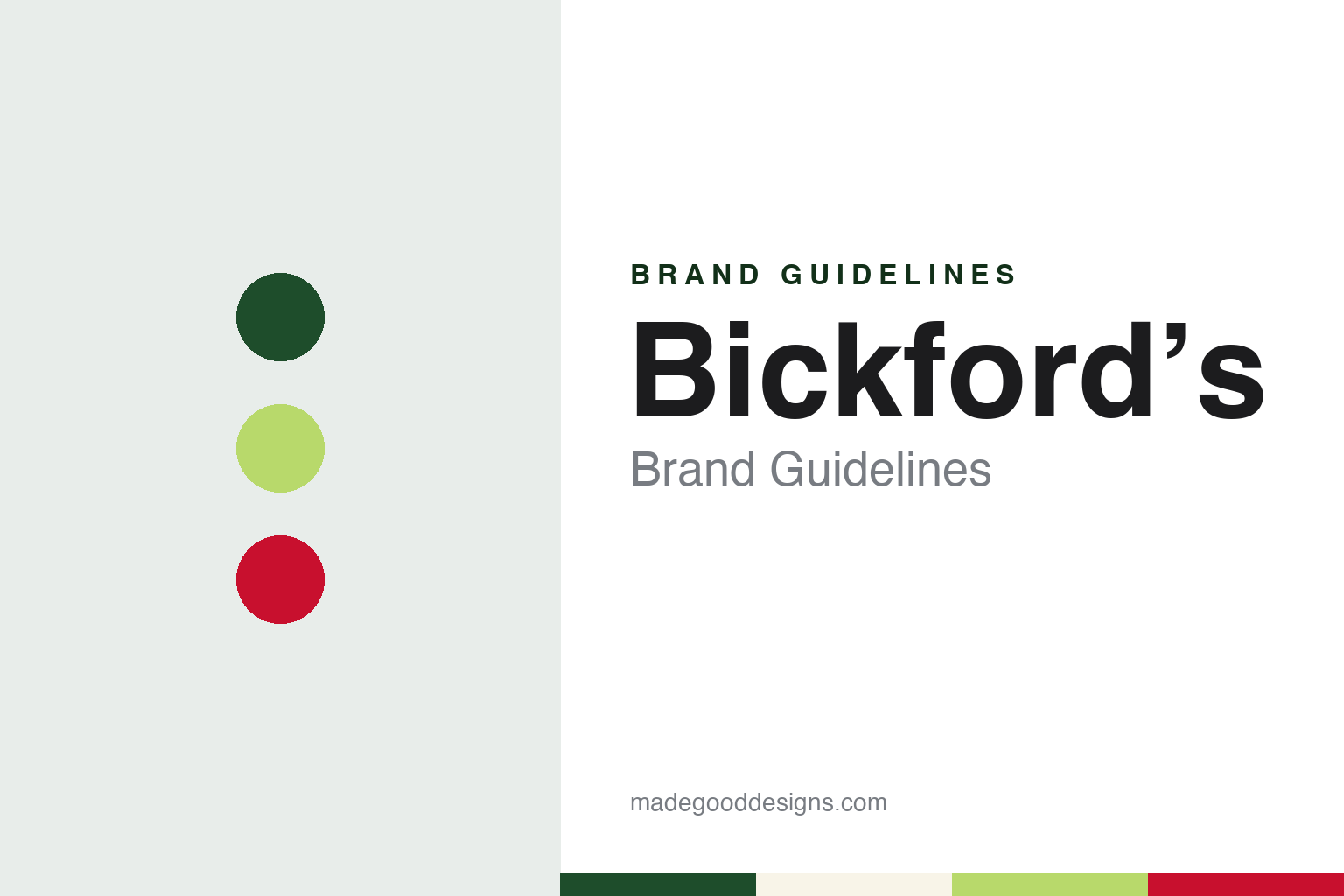
Bickford’s Brand Guidelines
The Adelaide chemist’s lime juice cordial.
Aa
Two constants: a bottle green, lime and label red palette and a Victorian label serif register. Abstract homage — not a Bickford’s product or mark; no bottle, label or logo is reproduced.
A Hindley Street chemist
A Devon druggist, a widow and her two sons.
Bickford’s started as a chemist’s shop, not a drinks company. English Wikipedia says William Bickford, who had been apprenticed to a druggist in Devon, arrived at Port Adelaide in February 1839, worked in a doctor’s dispensary on North Terrace and by September 1840 had opened his own shop in Hindley Street, where the wholesale side soon became the larger part of the business. The company today puts the start at 1839, when, it says, William and Ann Bickford opened an apothecary on Hindley Street that made and sold medicines and tonics as well as pickles, sauces and soaps.
From 1850, English Wikipedia says, his widow Ann Margaret Bickford kept the business going with the help of hired chemists. In February 1864 she drew up a deed taking her son Harry into partnership as Bickford and Son, and in 1871 a new partnership with her elder son William created A. M. Bickford & Sons — the name, built on her initials, that the brand still carries. The Encyclopaedia of Australian Science, cited by the same article, dates A. M. Bickford & Sons from 1863, so sources differ on the exact start of the partnership.
Cordials came next. In 1872, English Wikipedia says, citing a report in The Advertiser that December, the firm built the South Australian Cordial Factory on Waymouth Street, where a range was made that centred on lime juice cordial, raspberry vinegar and raspberry balm. Production began in 1874, the year the company still gives as the start of its cordials, and in 1876 the factory was expanded into the South Australian Cordial and Aerated Water Factory, with aerated drinks made on French equipment under a Frenchman, H. Foureur, The Advertiser reported. The company says Lime Juice Cordial was one of the earliest cordials it made and remains one of its best sellers.
Colour
A labelled signature, coffee essence and a heritage icon.
The firm grew well beyond cordial. English Wikipedia says its retail shop was sold around 1870 as wholesaling and manufacturing took over, and that offices and a warehouse in Currie Street served as headquarters from 1879. In 1902 it joined the Melbourne chemists Felton Grimwade & Co in a Western Australian venture, Felton Grimwade & Bickford, and in 1903 it became a limited company, A. M. Bickford & Sons Ltd, The Advertiser reported in a 1923 profile.
The brand’s second icon arrived after the First World War. The company dates its Essence of Coffee and Chicory to 1919; English Wikipedia gives 1920 and says the product, now sold as Iced Coffee Syrup, won a gold medal at the All-Australian Exhibition in 1930. Both the cordial and the coffee essence would outlast the chemist’s business that made them.
Part of the brand’s look is a line of Victorian trade warning. English Wikipedia notes that Bickford’s labels still carry the statement that, “on account of spurious imitations,” none is genuine unless it bears the signature of A. M. Bickford & Sons, and that the Bickford’s logo on its labels reads “Since 1874.” The company says its lime cordial bottle has been through “a few fashion changes” over the decades but has returned to its original shape, and that its label design has stayed recognisable across generations.
The cordial itself has been formally recognised. In 2006 the National Trust of South Australia named Bickford’s Lime Juice Cordial one of its Heritage Icons, according to the Trust’s 2006 awards listing. In 2024 the company marked what it called 150 years of making cordials with a set of celebration flavours.
Typography
Design and documentation.
The seven brands in this group are all soft-drink names from Australia, Britain and the United States: Kirks, Solo, Passiona, Bickford’s, Ben Shaws, Fever-Tree and Shasta. Australian, British and American soft-drink brands in general sit at many different points in the trade, from family firms that still carry a founder’s name to names that now belong to much larger drinks groups, and a single brand can be sold everywhere from a corner shop to a supermarket shelf.
A soft-drink brand’s identity is usually carried less by a single product than by a bottle or can, a name and the flavour it promises, because the company behind the name may have changed hands, moved its production or grown far beyond the place where it started. That makes the questions behind each name worth asking plainly: who started it, who owns it now, and where its drinks are actually made and bottled.
Each guide separates what independent sources record from what the company says about itself — its founding story, its owners over time, where its drinks are made and how its packaging has changed — and marks plainly what rests only on the company’s own word.
Aa
A high-contrast Victorian serif for a label that dates its cordial to 1874. (Specimen set in Playfair Display, a serif STAND-IN; NOT the Bickford’s logo.)
Bickford’s
Drug Houses of Australia, FGB and the Kotses family.
The Bickford family’s ownership ended in 1930. That year, The Advertiser reported, A. M. Bickford & Sons Ltd joined chemists from every mainland state in a new holding company, Drug Houses of Australia. English Wikipedia says the group sold medicines under the DHA name while the cordials and soft drinks kept the A. M. Bickford & Sons name. In 1968 DHA was taken over by the British bank Slater Walker, and in 1974 it was broken up and sold. The Melbourne businessman Peter Abbott bought its manufacturing arm, which included Bickford’s Lime Juice Cordial and Bickford’s Coffee Essence, and in 1975 renamed it Felton Grimwade & Bickford, or FGB, English Wikipedia says, citing the Encyclopaedia of Australian Science.
FGB sold the cordial, the coffee essence and the A. M. Bickford & Sons name in 1987, English Wikipedia says. In 1999 the business was bought by the Kotses family, and English Wikipedia names Angelo Kotses as the key figure. The company describes itself today as an Australian family-owned and managed business that came to its current owner “after several changes of ownership during the 20th century.” In 2005 it moved into what it called a new manufacturing facility at Salisbury, north of Adelaide, according to its archived company timeline.
The company says all Bickford’s products are made in Australia at those premises, where it creates its recipes and blends and bottles on site. Under the Kotses family the range has spread from cordials into sodas, juices, syrups, milk mixes and Bickford & Sons mixers, and the company’s sister business, VOK Beverages, makes alcoholic drinks; together they form the Bickford’s Group. In February 2014, Adelaide Now reported plans for a spirits distillery in the Riverland, and quoted the view that the key to the group’s success had been buying unloved brands and working out how to rebuild them.
For a design guide, Bickford’s shows how an 1870s signature warning and a lime cordial bottle can keep a chemist’s name alive long after the chemist’s shop. Compare Cottee’s, the Coola cordial brand, and Haigh’s, another long-lived Adelaide name. For this guide we use a bottle green, a lime and a label red with a Victorian serif, an unofficial interpretation; no product or logo is reproduced.
Explore & save
Keep Bickford’s’s identity on hand — save it to a board in the Made Good inspiration library.
Bickford’s identity set
Pin the Bickford’s bottle green, lime and label red palette and the Victorian label serif register to your own board.