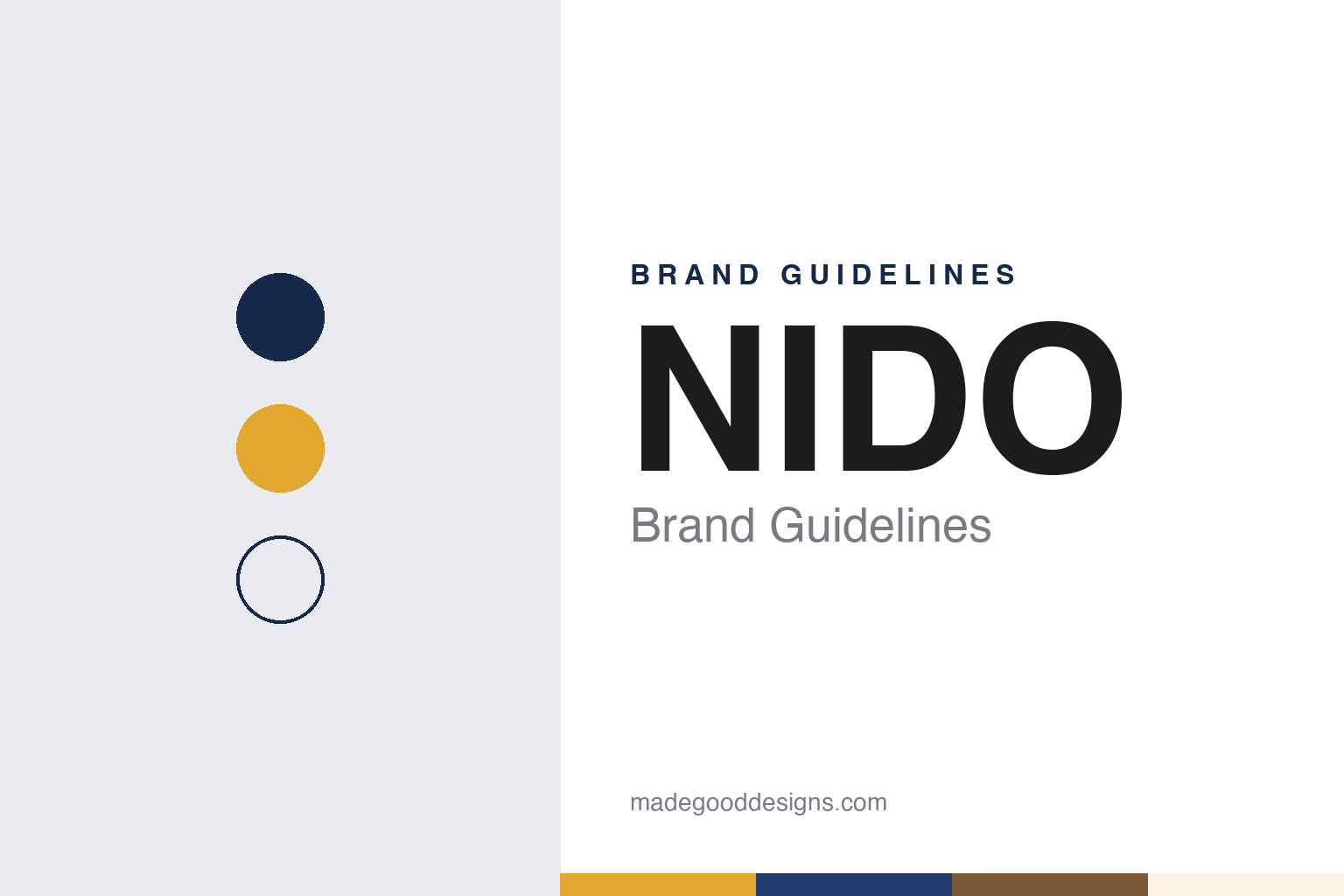
NIDO Brand Guidelines
Nestlé’s Swiss powdered milk brand of 1944.
Aa
Two constants: a NIDO gold, navy and cream palette and a rounded family sans register. Abstract homage — not a NIDO product or mark; no tin, logo or pack is reproduced.
A Swiss milk powder
Nestlé dates the brand to 1944.
NIDO is a powdered milk brand owned by Nestlé, the food group based in Vevey, Switzerland. The company dates it to 1944. A timeline on Nestlé’s Middle East NIDO website, as archived in November 2019, put “The Start of Nestlé NIDO” in that year and said that “Nestlé produced NIDO milk powder in Switzerland”; the same site said NIDO had been sold “for over 70 years,” and Nestlé’s current regional site says “over 80 years.” English Wikipedia’s infobox also gives 1944 and Switzerland. Nestlé writes the name in capitals, as NIDO.
The timeline sets the brand inside Nestlé’s longer history of milk products. It begins with Henri Nestlé’s first infant food, Farine lactée, in 1867, and the 1905 merger of his company with the Anglo-Swiss Condensed Milk Company, its long-time rival. Nestlé’s own corporate history adds context for the 1940s: during the Second World War, it says, exporting milk from Europe became impossible, so the company supplied Africa and Asia from the United States and Australia and expanded in Latin America.
The name is a common word. Nido means “nest” in Spanish and Italian, and the brand’s Brazilian name, Ninho, means the same in Portuguese. That has one practical consequence: in Spain, English Wikipedia notes, the name Nido is used for a bird food sold by Nestlé Purina PetCare, a different product from the milk.
Colour
Many countries, several names.
NIDO is sold across Latin America, Asia, the Middle East and much of Africa, according to English Wikipedia, which also lists the United Kingdom, Portugal and parts of the United States, where it is mainly found in Walmart Supercenters. The brand does not carry the same name everywhere. In Brazil it is Ninho; in Indonesia the equivalent product is sold as Dancow; and in some regions Nestlé uses the name Nespray, English Wikipedia says.
Indonesian Wikipedia gives Dancow a longer history than NIDO itself. It says the Dancow trademark was registered in London in 1922 and exported to Indonesia from 1930, that Nestlé brought Dancow under the NIDO line in 1954, and that the milk has been produced locally since 1979 at Nestlé’s Kejayan factory in Pasuruan, East Java.
For the Gulf, the Middle East website’s timeline gave a sequence of dated milestones. It placed the first NIDO instant milk powder in 1978 and a “refreshing new look” for the range in 1983, followed by Nestlé’s Middle East office in the United Arab Emirates in 1997, the launch of NIDO Fortified Full Cream Milk Powder in 2007 and, in 2008, a NIDO manufacturing facility in Dubai, which the site described as “where it is made today.” Those are the company’s own statements for that region; NIDO sold elsewhere comes from other factories, and English Wikipedia notes that some NIDO whole milk sold in the United States is a product of the Netherlands.
The range has grown from a single whole-milk powder into a family of products for different ages, with names that vary by market, such as NIDO Fortificada and NIDO Kinder 1+. Nestlé says NIDO products are not suitable for children under one year of age, English Wikipedia reports, citing the product pages.
Typography
Design and documentation.
The seven brands in this group are all milk, chocolate and fruit drink names: Milo, Nido, La Lechera, Cacaolat, Granini, Ting and Bigga. Milk, chocolate and fruit drink brands in general sit at many different points in the trade, from family firms that still carry a founder’s name to names that now belong to much larger food and drink groups, and a single brand can be sold everywhere from a corner shop to a supermarket shelf.
A drink brand’s identity is usually carried less by a single product than by a pack, a name and the taste or moment it promises, because the company behind the name may have changed hands, moved its production or grown far beyond the place where it started. That makes the questions behind each name worth asking plainly: who started it, who owns it now, and where its drinks are actually made and packed.
Each guide separates what independent sources record from what the company says about itself — its founding story, its owners over time, where its products are made and how its packaging has changed — and marks plainly what rests only on the company’s own word.
Aa
A rounded family sans — the register of a kitchen tin. (Specimen set in Nunito, a sans STAND-IN; NOT the NIDO logo.)
NIDO
A global name for milk in a tin.
NIDO’s marketing has leaned on families and on well-known faces. In the Philippines, English Wikipedia lists a run of actresses and television presenters as the brand’s ambassadors over the years, including Marian Rivera from 2019. The Middle East website framed the brand the same way, under the line “Raising generations through love and nutrition,” and told its history as a story of mothers and children across generations. Those are advertising positions, given here as the company’s words.
The brand has also drawn scrutiny. In April 2024 the Swiss organisation Public Eye and the International Baby Food Action Network published an investigation reporting that most of the 29 NIDO products for young children it examined in lower- and middle-income countries contained added sugar, while NIDO formulas for the same age group in Germany, France and the United Kingdom did not; Nestlé told the investigators it was phasing out sucrose and glucose syrup from its NIDO growing-up milks worldwide and that its products comply with the Codex Alimentarius and local laws.
Across its markets the constants are the name, the owner and the 1944 Swiss start that Nestlé gives, with Ninho, Dancow and Nespray as the local names for the same family milk powder. In Nestlé’s milk portfolio NIDO sits beside brands such as La Lechera, the sweetened condensed milk.
For a design guide, NIDO shows how a plain word can become a global name while still changing its spelling from market to market. Compare La Lechera, Nestlé’s condensed milk, and Dutch Lady, the Malaysian dairy brand that also sells milk powders. For this guide we use a warm tin gold, a navy and a cream with a rounded sans, an unofficial interpretation; no product or logo is reproduced.
Explore & save
Keep NIDO’s identity on hand — save it to a board in the Made Good inspiration library.
NIDO identity set
Pin the NIDO gold, navy and cream palette and the rounded family sans register to your own board.