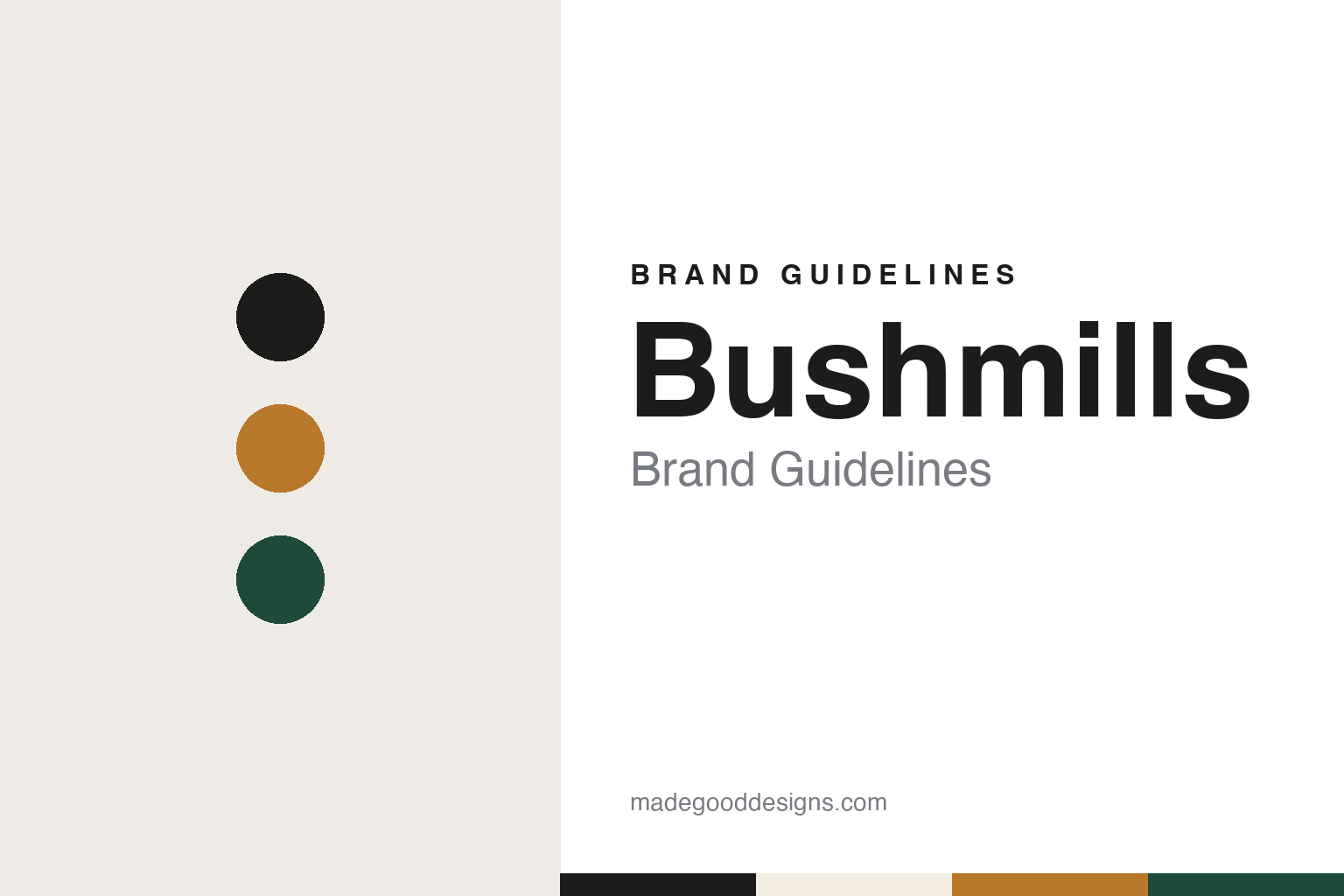
Bushmills Brand Guidelines
The County Antrim whiskey behind the 1608 licence and the square bottle.
Aa
Two constants: a basalt black, whiskey amber and Antrim green palette and a heritage serif register. Abstract homage — not a Bushmills product or mark; no bottle, label or logo is reproduced.
Two dates on one label
A royal licence, a distillery company and a village on the Antrim coast.
Bushmills is made in the village of Bushmills, in County Antrim on Northern Ireland’s north coast, and its story carries two dates that are easy to confuse. The first, 1608, is printed on the label and refers to a royal licence. In that year King James I granted Sir Thomas Phillips the right to distil spirits for seven years in the county of Coleraine and in the Route district of County Antrim, according to George Hill’s 1877 history of the Plantation of Ulster, as cited by English Wikipedia. Wikipedia is clear that the licence covered the area, not this particular distillery.
The second date is 1784, when the company that built the distillery was formed. Wikipedia, citing the company’s own history, names its founder as Hugh Anderson. The early decades were uneven: the distillery went through several closures, Wikipedia says, and does not appear in official records in 1802 or 1822. In 1860 a Belfast spirit merchant, James McColgan, and Patrick Corrigan bought it, and in 1880 they formed a limited company. Fire destroyed the original buildings in 1885, and the distillery was rebuilt quickly; Wikipedia describes it as running more or less continuously since then. Its water is drawn from Saint Columb’s Rill, a tributary of the River Bush.
Ownership passed through several hands in the twentieth century. After the Second World War the businessman Isaac Wolfson bought the distillery. In 1972 it was taken over by Irish Distillers, which meant that one group then controlled the production of all Irish whiskey, and in June 1988 Irish Distillers itself was bought by the French drinks group Pernod Ricard. In June 2005 Bushmills was bought by Diageo, which announced a large advertising campaign to win back market share for the brand, Wikipedia says.
Colour
Three blends, a run of single malts and a square bottle.
The core range is built around blends and single malts. Bushmills Original, sometimes called White Bush, is the standard blend. Black Bush has a much higher share of malt whiskey, aged in casks that held Spanish oloroso sherry, and Red Bush uses malt matured in former bourbon casks, Wikipedia says. The single malts are sold by age. A 12-year-old joined the core range in 2022, and in September 2025 it replaced the 10-year-old in the UK as the introductory single malt, The Spirits Business reported; master blender Alex Thomas called the 12-year age statement a “sweet spot.” A 25-year-old and a 30-year-old were added to the core range in 2023. Bushmills 1608 began as a 400th-anniversary release, and since 2009 it has been sold only at the distillery shop and in duty-free, Wikipedia says, citing a 2007 Diageo announcement.
The bottle is where the brand’s design is most visible. Bushmills has used a square bottle since the late 1800s, The Spirits Business reported in June 2026. In 2021 the single malts were relaunched in a revamped pack with a transparent neck sleeve that shows a wood-and-cork closure and a hexagonal punt in the base, a detail inspired by the basalt columns of the Giant’s Causeway, a short way from the distillery on the North Antrim coast. In June 2026 Black Bush received its first visual update in nearly 20 years. The square shape stays, but the bottle is taller and slimmer, with sharper exterior angles, and it now shares the neck sleeve and hexagonal punt of the single malts. The glass was made by Encirc, and master distiller Colum Egan said that nothing about the whiskey had changed, “but the way it shows itself to the world has.” The new bottle was due in the UK, Spain and Poland from June 2026, in Ireland and the United States later that year and worldwide in early 2027, the magazine reported.
The distillery has also appeared on money. In 2008 the Bank of Ireland issued a new series of Northern Ireland sterling banknotes carrying an illustration of the Old Bushmills Distillery, replacing Queen’s University Belfast on the previous series; the bank announced the design in February 2008, and BBC News reported on the notes that April.
Typography
Design and documentation.
The seven brands in this group are all whisky names from Ireland and Scotland: Bushmills, Tullamore D.E.W., Glenfiddich, The Glenlivet, The Macallan, Chivas Regal and The Famous Grouse. Irish and Scotch whisky brands in general sit at many different points in the trade, from names that still carry a founder’s or a place’s name to names that now belong to much larger drinks groups, and a single brand can be sold everywhere from a local bar to an airport shop.
A whisky brand’s identity is usually carried less by a single bottle than by a label, a name and the place it promises, because the company behind the name may have changed hands, moved its production or grown far beyond the place where it started. That makes the questions behind each name worth asking plainly: who started it, who owns it now, and where its whisky is actually made and bottled.
Each guide separates what independent sources record from what the company says about itself — its founding story, its owners over time, where its whisky is made and how its packaging has changed — and marks plainly what rests only on the company’s own word.
Aa
A heritage serif for a whiskey that leads with its dates. (Specimen set in Cormorant Garamond, a serif STAND-IN; NOT the Bushmills logo.)
Bushmills
A tequila group, a second distillery and the same village.
Bushmills changed hands again in November 2014, when Diageo agreed to pass it to the Mexican tequila maker Jose Cuervo in exchange for the half of the Don Julio tequila brand that Diageo did not already own, The Guardian and the Irish Independent reported at the time. The brand now belongs to Proximo Spirits, the Jersey City company founded in 2007 by the Beckmann family, which is a subsidiary of Becle, the listed group behind Jose Cuervo, English Wikipedia says. In June 2026 The Spirits Business, citing the drinks analysts IWSR, described Bushmills as the second most valuable Irish whiskey brand in the world, and it called the site the world’s oldest licensed distillery.
Production has stayed in the village. In April 2023 Bushmills opened a second distillery, Causeway Distillery, next to the Old Bushmills Distillery and named after the Giant’s Causeway. The Spirits Business reported that it raised capacity from five million to eleven million litres of alcohol a year, that the new site was built to keep the character of the original and that its whiskey would go into Bushmills rather than a separate brand. The same report said Bushmills had passed one million cases in annual sales for the first time in 2022. Egan said at the opening that the second distillery would carry the brand’s triple-distilled single malts forward alongside future releases.
For a design guide, Bushmills shows how a whiskey can build an identity on a place: a coastline, a village and a distillery, carried by a square bottle and, since 2021, a hexagon borrowed from the rocks along the shore. Compare Tullamore D.E.W., the Irish whiskey named after a midlands town and a distillery manager’s initials, and Glenfiddich, the Speyside single malt. For this guide we use basalt black, a whiskey amber and an Antrim green with a heritage serif, an unofficial interpretation; no product or logo is reproduced.
Explore & save
Keep Bushmills’s identity on hand — save it to a board in the Made Good inspiration library.
Bushmills identity set
Pin the Bushmills basalt black, whiskey amber and Antrim green palette and the heritage serif register to your own board.