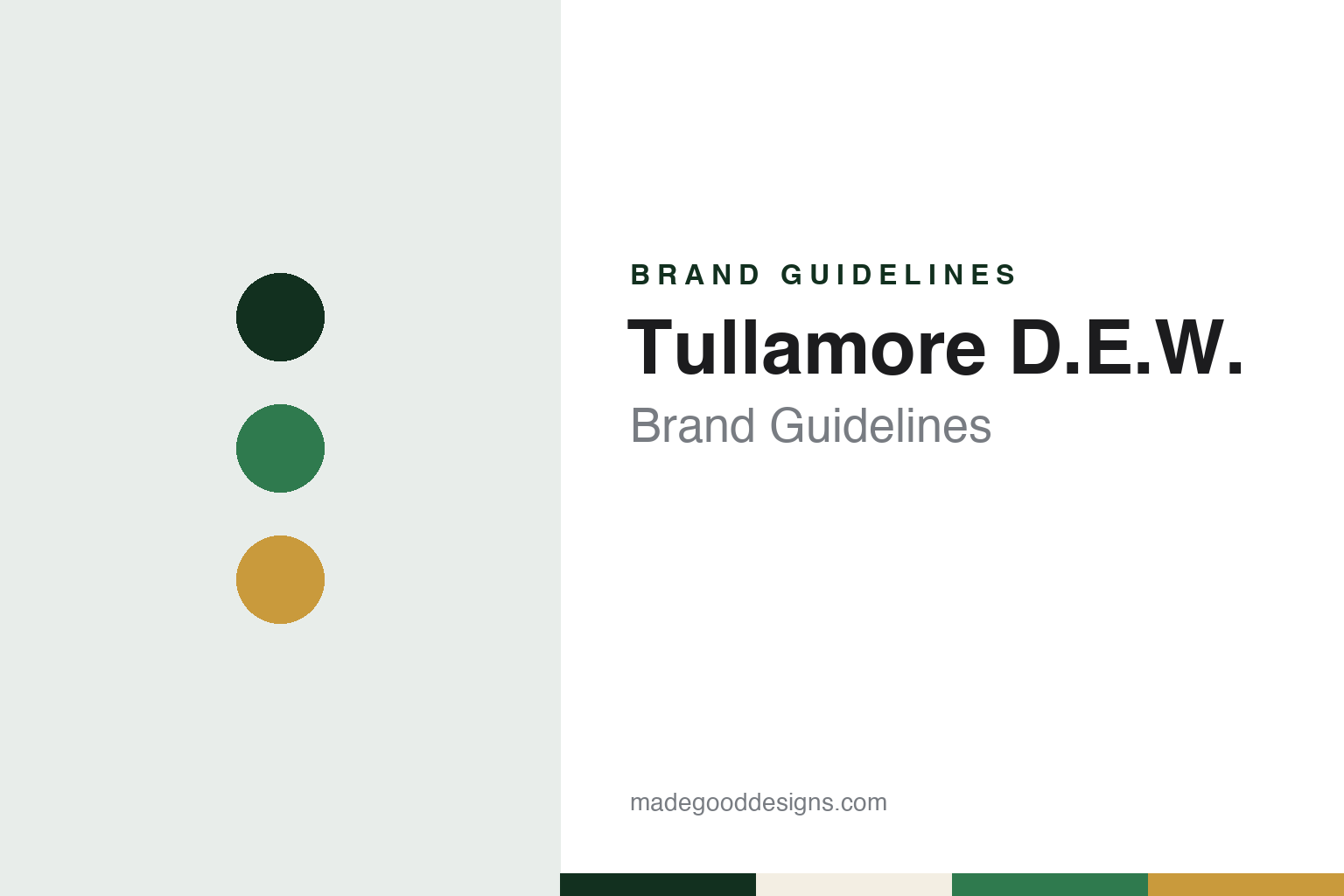
Tullamore D.E.W. Brand Guidelines
The Irish whiskey named for a midlands town and Daniel E. Williams.
Aa
Two constants: a deep green, Offaly green and pot-still gold palette and a transitional serif register. Abstract homage — not a Tullamore D.E.W. product or mark; no bottle, label, wolfhound or logo is reproduced.
A town and a set of initials
A midlands distillery, a nephew and a manager who rose from the stables.
Tullamore D.E.W. takes its name from a town and a man. The town is Tullamore, in County Offaly in the Irish midlands, where a distillery was established in 1829 by Michael Molloy, according to Brian Townsend’s The Lost Distilleries of Ireland (1999), as cited by English Wikipedia. The distillery later passed to Molloy’s nephew, Bernard Daly, who appointed Daniel Edmund Williams as general manager; Williams later became the owner. The company says Williams started at the distillery as a stable boy at the age of 15 and was its manager by 25. The drinks site VinePair reported in 2023 that the whiskey was first sold as Daly’s whiskey, mainly in Britain and Australia, and that Williams helped bring electricity to Tullamore in 1893, along with its first telephone line.
The man supplied the brand name. D.E.W. are Williams’s initials. The Dictionary of Irish Biography says he took over the Tullamore distillery and created the Tullamore Dew whiskey brand, while also building a regional network of general stores and moving into malting, bottling and wholesaling. On labels the name is usually written Tullamore D.E.W., and English Wikipedia notes that most of the branding plays down the full stops between the letters through colour and type size.
The best-known image in the brand’s history came from the family too. The company says Daniel E. Williams was a dog lover, and that his grandson Desmond Williams, wanting something other than the shields and coats of arms typical of whiskey brands, commissioned what the company calls its original drawing of an Irish wolfhound. The company presents the wolfhound as a symbol of the whiskey and of its home town: friendly and loyal, but determined.
Colour
Closure, Midleton and a lighter bottle.
The original distillery closed in 1954, hit, like many Irish distilleries at the time, by falling sales after American Prohibition, the Anglo-Irish trade war and high taxes, Wikipedia says. With whiskey stocks running low, the family chose not to restart distilling. In 1965, the Dictionary of Irish Biography says, Daniel’s grandson Edmund Williams, then managing director of the family’s Williams Group, sold the Tullamore Dew brand to John Powers & Son of Dublin, which agreed to supply whiskey for the family’s Irish Mist liqueur. In 1966 Powers merged with two other distillers to form Irish Distillers, and in the 1970s production moved to the group’s new distillery at Midleton, County Cork. In 1994 Irish Distillers, then concentrating its international effort on Jameson, sold the brand to the C&C Group, Wikipedia says, citing The Irish Times; the whiskey went on being made at Midleton under licence.
The whiskey is a blend of all three styles of Irish whiskey: pot still, malt and grain. The company calls Tullamore D.E.W. the world’s original triple-distilled, triple-blended and triple-cask-finished Irish whiskey. Beside the flagship Original, Wikipedia lists a 12 Year Old Special Reserve, 14 and 18 Year Old single malts and an Old Bonded Warehouse Release sold only at the visitor centre.
The latest redesign arrived in early 2024. The new pack was developed with the design agency Here Design over four years, William Grant & Sons said, and was rolled out in phases across markets from February 2024, the whiskey site Potstilled reported. Every variant received a new label. The bottle has a curved, embossed body meant to improve grip when pouring, carries a “Tullamore Heart of Ireland” emboss and uses 27% less glass, which the brand says cuts emissions from production and transport. The wolfhound and the town of Tullamore returned to the branding, with the wolfhound placed front and centre on the label. “Tullamore is not just a name – it’s our home,” said Kate Webb, the brand’s global innovation manager. The launch line was “New Look, Same Great Whiskey.”
Typography
Design and documentation.
The seven brands in this group are all whisky names from Ireland and Scotland: Bushmills, Tullamore D.E.W., Glenfiddich, The Glenlivet, The Macallan, Chivas Regal and The Famous Grouse. Irish and Scotch whisky brands in general sit at many different points in the trade, from names that still carry a founder’s or a place’s name to names that now belong to much larger drinks groups, and a single brand can be sold everywhere from a local bar to an airport shop.
A whisky brand’s identity is usually carried less by a single bottle than by a label, a name and the place it promises, because the company behind the name may have changed hands, moved its production or grown far beyond the place where it started. That makes the questions behind each name worth asking plainly: who started it, who owns it now, and where its whisky is actually made and bottled.
Each guide separates what independent sources record from what the company says about itself — its founding story, its owners over time, where its whisky is made and how its packaging has changed — and marks plainly what rests only on the company’s own word.
Aa
A transitional serif for a whiskey named after a town and a man. (Specimen set in Libre Baskerville, a serif STAND-IN; NOT the Tullamore D.E.W. logo.)
Tullamore D.E.W.
A Scottish family distiller brings the whiskey home.
The brand’s owner since 2010 is William Grant & Sons, the family-owned Scottish distiller that also makes Glenfiddich. It bought C&C’s spirits and liqueurs business, including Tullamore D.E.W., that year, The Drinks Business reported in May 2010. Because supplies still depended on Midleton, William Grant chose to build its own distillery on the outskirts of Tullamore rather than rely on outside production, Wikipedia says, citing the planning documents. The first phase opened in 2014, bringing production back to the town after sixty years, Drinks Industry Ireland reported in September 2014. It can make malt and pot still whiskey; the grain component of the blend was to keep coming from Midleton until a later phase, Wikipedia says. Two years earlier, in 2012, a visitor centre had opened in a refurbished bonded warehouse of the original distillery at Bury Quay in the town centre.
Sales grew alongside the move. They roughly doubled between 2005 and 2015 to about 950,000 cases a year, the Irish food and drink site TheTaste reported in 2015, and by 2020 they had passed 1.5 million cases, making Tullamore D.E.W. the second-largest-selling Irish whiskey in the world, The Irish Times reported. The company today calls it the number two brand in the world and uses the line “Be More Tullamore,” presenting the town as a close-knit community where everyone knows everyone.
For a design guide, Tullamore D.E.W. shows how a whiskey can turn a founder’s initials and a home town into an identity, then return to an old drawing of a dog when it redesigns. Compare Bushmills, the County Antrim whiskey that leads with its dates, and Glenfiddich, the William Grant & Sons single malt from Speyside. For this guide we use a deep green, an Offaly green and a pot-still gold with a transitional serif, an unofficial interpretation; no product or logo is reproduced.
Explore & save
Keep Tullamore D.E.W.’s identity on hand — save it to a board in the Made Good inspiration library.
Tullamore D.E.W. identity set
Pin the Tullamore D.E.W. deep green, Offaly green and pot-still gold palette and the transitional serif register to your own board.