Nikka Brand Guidelines
Masataka Taketsuru’s Yoichi whisky maker, founded 1934.
Aa
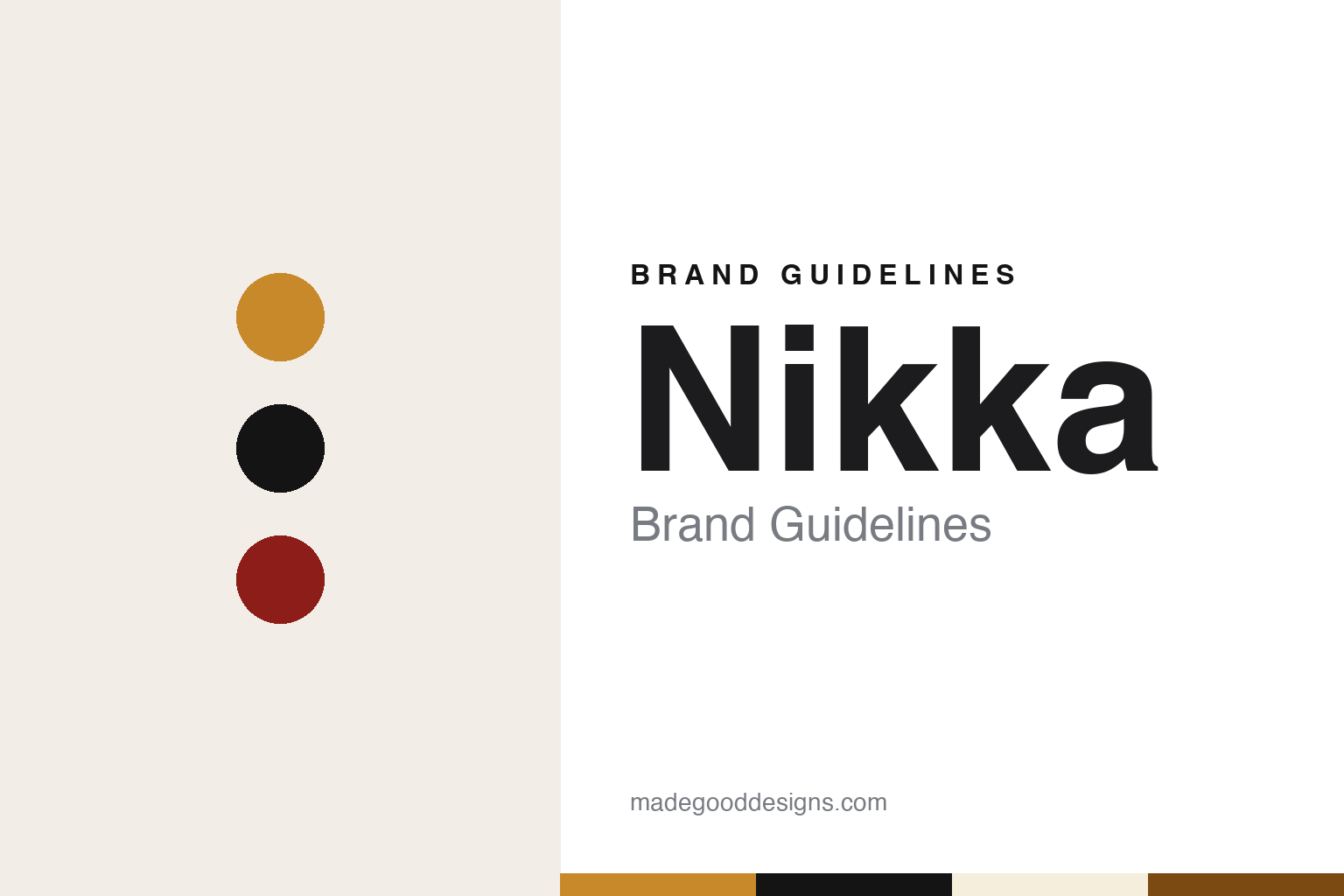
Two constants: a malt amber, cask brown and label black palette and a Victorian label serif register. Abstract homage — not a Nikka product or mark; no label, logo or bottle is reproduced.
A chemist from Takehara
From a Glasgow classroom to a fruit-juice company in Hokkaido.
Nikka is the whisky company founded by Masataka Taketsuru, who came from Takehara in Hiroshima Prefecture. English Wikipedia says he travelled to Scotland in 1918, studied organic chemistry at the University of Glasgow and learned malt whisky production at the Hazelburn distillery in Campbeltown. There he married Jessie Roberta “Rita” Cowan, a Glasgow doctor’s daughter, and the couple returned to Japan in 1920. In 1923 Taketsuru joined Kotobukiya, the company that became Suntory, and helped it establish a distillery before he left to start a business of his own.
That business was not called Nikka at first. Japanese Wikipedia, citing the company’s official 80-year history published in 2015, says Dai Nippon Kaju — roughly “Great Japan Juice” — was founded on 2 July 1934, with its plant at Yoichi on the coast of Hokkaido. The company says Taketsuru chose Yoichi for a cool climate, clean air and water that reminded him of Scotland. Because whisky takes years to mature, the young firm first sold apple juice made from local fruit, launched in April 1935, and later brandy and apple wine. Whisky distilling began in 1939, and the first bottles reached the market in 1940 under the name Nikka Whisky, the Yomiuri Shimbun reported in 2015.
The brand name comes from the company name. “Nikka” is the katakana reading of 日果, the short form of Dai Nippon Kaju, and in 1952 the company took the name Nikka Whisky itself. The Japanese spelling uses an old-fashioned kana, ヰ, for the “wi” of whisky; Japanese Wikipedia, citing a 2015 report on withnews, says the company had wanted the character for “well,” as water is central to whisky, but could not register a name mixing kanji and katakana.
Colour
A blender with a glass, and an emblem drawn from Japan.
The most familiar face of the brand is the King of Blenders: a bearded man holding ears of barley in one hand and a tasting glass in the other. Japanese Wikipedia, citing the company history, calls him Nikka’s de facto icon. A pre-war version existed, and a revised figure appeared on the box of Kakubin Nikka in 1963, on a pocket bottle in 1964 and on the label of the new Black Nikka in 1965. The design is attributed to the designer Otaka Shigeharu, whose hand-drawn labels and posters were shown at a gallery in Kunitachi in 2014, the local news site Asacoco reported. Enthusiasts call the figure “Lord Raleigh,” but Nikka says the model is W. P. Lowrie, a nineteenth-century Glasgow whisky blender. Since 2014 the figure has also spoken for the brand on its official Twitter account.
The crest on the labels looks British but, the company history says, draws on Japan. Taketsuru designed it after seeing emblems on whisky made for the royal household in Scotland; the company describes its two komainu guardian lions, a samurai helmet linked to Yamanaka Shikanosuke, and ichimatsu checks around the name. Packaging for other lines has come from outside designers: Japanese Wikipedia credits Kanome Hisashi with Nikka Brandy V.S.O.P. and the Kingsland whisky.
Products have moved the brand forward in steps. Black Nikka was first launched in 1956, Super Nikka in 1962 and Hi Nikka in 1964. Japanese Wikipedia, citing the company history, says From the Barrel followed in October 1985 and that in 1989 Nikka released single malts named after Yoichi and Miyagikyo. In 1962 the company bought a Coffey still from Britain; it was installed at Nishinomiya and moved to Miyagikyo in 1999. In 2015 the International Spirits Challenge named Nikka Distiller of the Year, Asahi Breweries announced in July that year.
Typography
Design and documentation.
The seven brands in this group are all Indian and Japanese spirits names: Old Monk, McDowell’s, Royal Stag, Officer’s Choice, Blenders Pride, Hibiki and Nikka. Spirits brands in general sit at many different points in the trade, from houses that still carry a founder’s name to labels that now belong to much larger drinks groups, and a single brand can be sold everywhere from a corner shop to a hotel bar.
A spirits brand’s identity is usually carried less by a single bottle than by a label, a name and the story it tells, because the company behind the name may have changed hands, moved its production or grown far beyond the place where it started. That makes the questions behind each name worth asking plainly: who started it, who owns it now, and where its whisky or rum is actually distilled, blended and bottled.
Each guide separates what independent sources record from what the company says about itself — its founding story, its owners over time, where its spirits are made and how its labels have changed — and marks plainly what rests only on the company’s own word.
Aa
A Victorian label serif for a whisky house built on Scottish models. (Specimen set in Playfair Display, a serif STAND-IN; NOT the Nikka logo.)
Nikka
Two distilleries in the north, and a brewer behind them.
Ownership changed in two stages. Japanese Wikipedia, citing the company history and Asahi Breweries’ 2001 securities report, says the brewer Asahi Breweries took a stake in 1954, when the main shareholder Kaga Shotaro sold his holding, and acquired all of Nikka’s shares in 2001, after which sales passed to Asahi and Nikka concentrated on production. Nikka was listed on the Tokyo Stock Exchange from 1989 until 2001. Since 2011 it has sat under Asahi Group Holdings, the group behind the Asahi beer brand. In 2022 Nikka moved its head office to the Asahi building in Sumida, Tokyo, and its registered head office to Yoichi, the Hokkaido Shimbun reported.
Where the whisky is made is documented in some detail. Malt whisky is distilled at Yoichi, where the stills are heated directly with coal, and at Miyagikyo near Sendai, opened in 1969, which also makes grain whisky in the Coffey still. Japanese Wikipedia says blending and bottling take place at the Kashiwa plant in Chiba, with grain whisky matured at a plant in Tochigi. Since 1989 Nikka has also owned the Ben Nevis distillery at Fort William in Scotland. Ten buildings at Yoichi were designated a national Important Cultural Property in February 2022, and the 2014 NHK morning drama Massan was modelled on Taketsuru and Rita.
J-CAST News reported in June 2015 that stock shortages after Massan led Nikka to end its age-stated Yoichi single malts that August; a Yoichi 10-year-old returned in 2022 with a new label. Recognition abroad came earlier, as Yoichi 20 Year Old was named best single malt at the World Whiskies Awards in 2008, The Japan Times reported.
For a design guide, Nikka shows how a bearded blender, a crest and a company name shortened from “Great Japan Juice” can carry a Japanese whisky house from a 1934 apple-juice plant in Hokkaido to international whisky awards. Compare Hibiki, Suntory’s blended whisky, and Suntory, where Taketsuru first worked. For this guide we use malt amber, cask brown and label black with a serif, an unofficial interpretation; no product or logo is reproduced.
Explore & save
Keep Nikka’s identity on hand — save it to a board in the Made Good inspiration library.
Nikka identity set
Pin the Nikka malt amber, cask brown and label black palette and the Victorian label serif register to your own board.