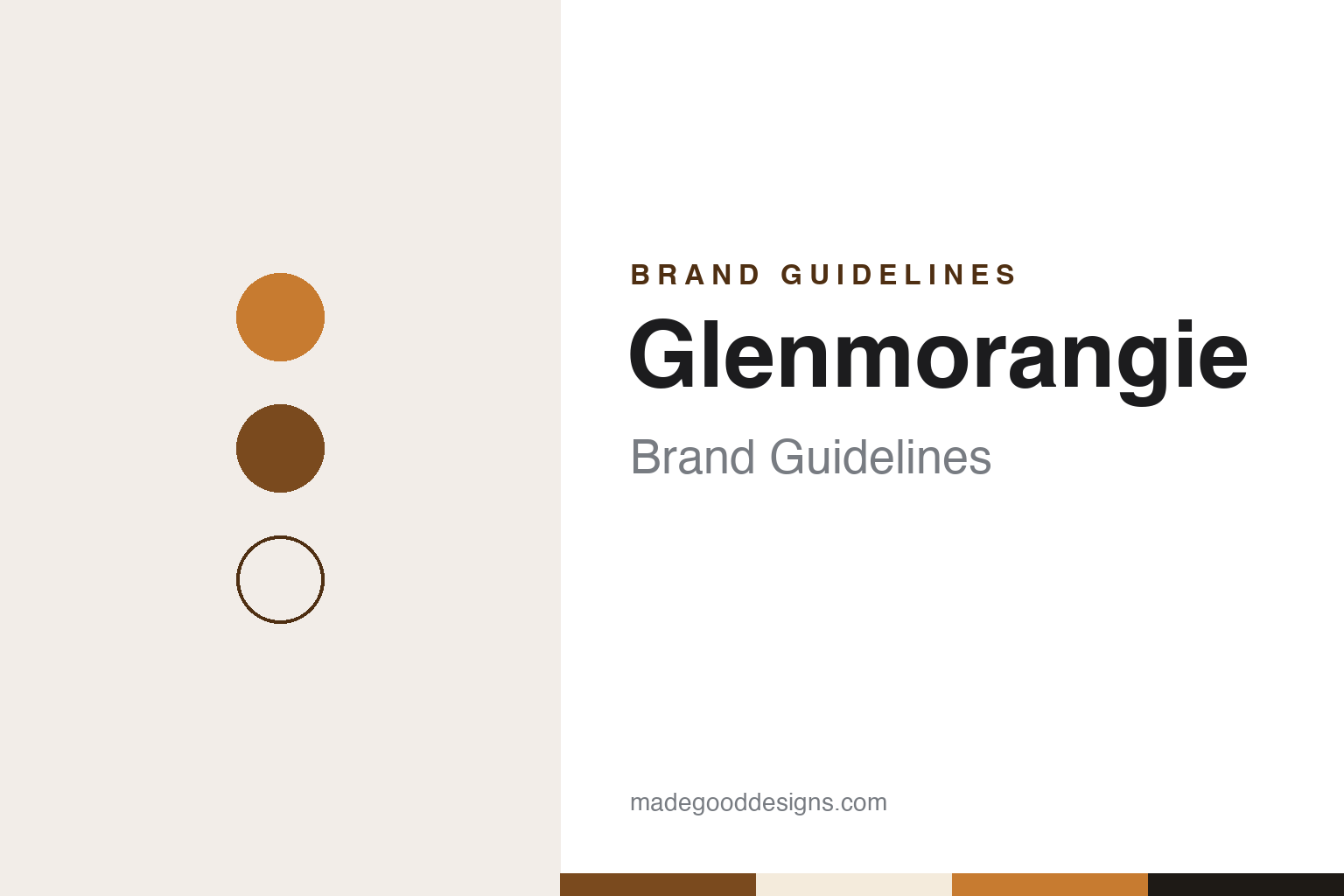
Glenmorangie Brand Guidelines
The Tain distillery with Scotland’s tallest stills, founded in 1843.
Aa
Two constants: a copper, amber and Tain cream palette and a classical book serif register. Abstract homage — not a Glenmorangie product or mark; no label, emblem or bottle is reproduced.
A farm brewery at Tain
Morangie Farm, the Tarlogie Spring and two second-hand gin stills.
Glenmorangie is a Highland single malt Scotch whisky made at Tain, in Ross-shire, on the shore of the Dornoch Firth. The name is pronounced with the stress on the second syllable, “glen-MOR-angie,” rhyming with “orangey,” English Wikipedia says, and is thought to come from Gaelic words meaning either “vale of tranquillity” or “vale of big meadows.”
The site was a farm before it was a distillery. The Glenmorangie Company says the earliest record of alcohol being made at Morangie Farm dates from 1703, and English Wikipedia says a brewery was built there in the 1730s, drawing on the same water as the farm, the Tarlogie Spring. In 1843 William Matheson, a former manager at the nearby Balblair distillery, acquired the farm and converted the brewery into a distillery, English Wikipedia says. He equipped it with two second-hand gin stills and later gave it the name Glenmorangie.
In 1918 the distillery was bought by its main customer, the Leith firm Macdonald & Muir, and the Macdonald family kept control for almost ninety years, English Wikipedia says. The interwar years and the Second World War were hard on the trade: the distillery was effectively mothballed from 1931 to 1936 and again from 1941 to 1944, then ran at full capacity by 1948. The stillhouse grew in stages, from two stills to four in 1977, to eight in 1990 and to twelve in 2009. In the 1980s the company bought the land around the Tarlogie Springs to protect its water supply, English Wikipedia says, an area of roughly 600 acres.
Colour
Tall stills, the Men of Tain and an American forest.
The fact most often attached to Glenmorangie is the height of its stills. English Wikipedia says they are the tallest in Scotland, at 8.00 metres (26 ft 3 in), with necks of about 5.1 metres, and that the company claims they give its spirit an especially light character. For decades the distilling was done by a crew of sixteen known as “The Sixteen Men of Tain,” a phrase that appeared on bottles; after expansion from 2008 the team grew to 24 and is now referred to simply as “The Men of Tain,” English Wikipedia says. The jazz guitarist Allan Holdsworth borrowed the old phrase for an album title in 2000.
Wood is the other part of the story. English Wikipedia says Glenmorangie’s casks are made from white oak grown in the company’s own forest in the Ozark Mountains of Missouri; the new barrels are air-dried, then leased to the bourbon makers Jack Daniel’s and Heaven Hill before they come back to Scotland for whisky. The core Original is matured in ex-bourbon casks, while the Extra Matured bottlings are finished in casks that once held wine, port or sherry. Whisky creation is overseen by Dr Bill Lumsden, the company’s Director of Distilling, Whisky Creation and Whisky Stocks. An annual Private Edition series ran from Sonnalta PX in 2010 to Allta in 2019.
Glenmorangie sits in the same group as the Islay distillery Ardbeg, which Glenmorangie plc bought and reopened in 1997, English Wikipedia says. Both brands are bottled at The Glenmorangie Company’s plant at The Alba Campus in Livingston, West Lothian. Among its awards, the International Wine & Spirit Competition named The Glenmorangie Company Distiller of the Year in 2012, English Wikipedia says.
Typography
Design and documentation.
The seven brands in this group are all Scotch single malts: Glenmorangie, Laphroaig, Lagavulin, Talisker, Ardbeg, The Dalmore and Highland Park. Single malt brands in general sit at many different points in the trade, from distilleries that still carry a founder’s name to labels that now belong to much larger drinks groups, and a single brand can be sold everywhere from a corner shop to a hotel bar.
A single malt brand’s identity is usually carried less by a single bottle than by a label, a name and the place it promises, because the company behind the name may have changed hands, rebuilt its distillery or grown far beyond the place where it started. That makes the questions behind each name worth asking plainly: who started it, who owns it now, and where its whisky is actually distilled, matured and bottled.
Each guide separates what independent sources record from what the company says about itself — its founding story, its owners over time, where its whisky is made and how its labels have changed — and marks plainly what rests only on the company’s own word.
Aa
A classical book serif for a Highland distillery founded in 1843. (Specimen set in Cormorant Garamond, a serif STAND-IN; NOT the Glenmorangie logo.)
Glenmorangie
A Pictish emblem and a luxury-group owner.
The brand’s emblem comes from a carved stone found near the distillery. The Hilton of Cadboll Stone is a Pictish cross-slab whose upper part is now in the National Museum of Scotland; English Wikipedia says the scrollwork of triskeles on its lower panel has been adopted by the neighbouring Glenmorangie distillery as its logo. The company’s own material calls the motif its Signet, a name it also gave to one of its prestige bottlings. The base of the stone was found in 2001, which let researchers reconstruct the centre of that panel.
Ownership changed in 2004, when the Macdonald family sold the company to the French group LVMH Moët Hennessy Louis Vuitton; English Wikipedia, in its article on Ardbeg, dates the acquisition to 28 December 2004. The Glenmorangie Company now sits within Moët Hennessy, LVMH’s wine and spirits arm. English Wikipedia says the range was then repositioned for the international luxury market with a new, more curved bottle, and the wood-finish whiskies were renamed Quinta Ruban, Nectar d’Or and Lasanta. Professor Paul Freathy of the University of Stirling’s Institute of Retail Studies called the French-sounding names “a brave strategy,” since whisky is valued for its tie to Scotland, English Wikipedia reports. In 2009 the company sold the Glen Moray brand and stopped supplying whisky for supermarket own-label blends.
The name has a place in film, too: in Highlander (1986), Christopher Lambert’s character orders a double Glenmorangie, English Wikipedia notes. For more on the lettering, see our note on the Glenmorangie font.
For a design guide, Glenmorangie shows how a single physical fact, a stillhouse of unusually tall stills, and an emblem lifted from a local Pictish carving can anchor a brand through a change from family firm to luxury group. Compare Ardbeg, its Islay sister distillery, and Moët & Chandon, the Champagne house in the same Moët Hennessy group. For this guide we use copper, amber and Tain cream with a classical serif, an unofficial interpretation; no product or logo is reproduced.
Explore & save
Keep Glenmorangie’s identity on hand — save it to a board in the Made Good inspiration library.
Glenmorangie identity set
Pin the Glenmorangie copper, amber and Tain cream palette and the classical book serif register to your own board.