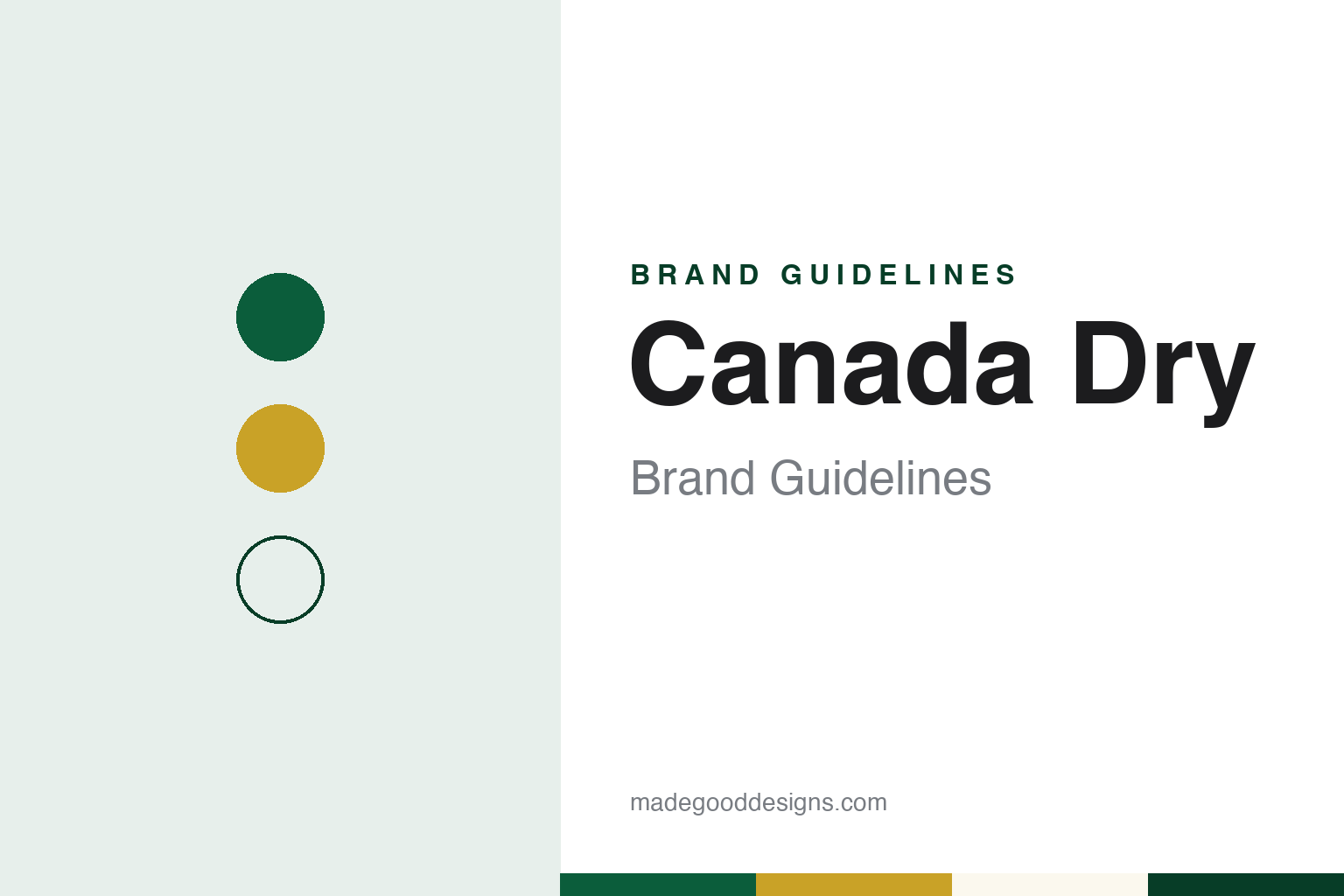
Canada Dry Brand Guidelines
John J. McLaughlin’s 1904 Toronto ginger ale and its crown shield.
Aa
Two constants: a shield green, crown gold and cream palette and a classic display serif register. Abstract homage — not a Canada Dry product or mark; no label, logo or bottle is reproduced.
A pharmacist’s dry ginger ale
From a Toronto soda-water plant to the best-selling ginger ale of 1930.
Canada Dry began with John J. McLaughlin, a Canadian pharmacist and chemist. English Wikipedia, citing a 1995 family history by Heather Robertson, says he was the eldest son of Robert McLaughlin, the founder of the McLaughlin carriage company, and that in the late 1880s he managed a pharmacy in Brooklyn, New York, where he saw how popular carbonated drinks had become. In 1890 he returned to Canada, settled in Toronto and opened McLaughlin Manufacturing Chemists and a carbonated-water plant, according to a brand history once published by Cadbury.
The drink that became the brand came in 1904. Jamie Bradburn, writing in the 2021 book Packaged Toronto, dates “McLaughlin’s Pale Dry Style Ginger Ale” to that year and its registration as “Canada Dry Pale Ginger Ale” to 1905. The word “dry” was borrowed from wine: Evan Morris explains in From Altoids to Zima (2004) that McLaughlin’s ginger ale was much less sweet than the others then on sale, so he called it dry. The slogan “The Champagne of Ginger Ales” is credited by Bradburn to McLaughlin’s wife, Maud.
McLaughlin shipped his ginger ale to New York, where it sold well, but he resisted selling the formula to American bottlers, Bradburn writes. In 1914 the business passed to his brothers George and Sam, who opened a bottling plant in New York City in 1922. In 1923 the McLaughlin family sold the company to P. D. Saylor and Associates, which formed Canada Dry Ginger Ale, Inc. as a public company, according to the Cadbury brand history.
Prohibition made the brand. English Wikipedia, citing the 1998 book Soda Pop! by Michael Karl Witzel and Gyvel Young-Witzel, says Canada Dry became a popular mixer in the United States during Prohibition because its flavour helped hide the taste of homemade liquor. Bradburn writes that annual sales grew from two million to ten million bottles by 1930, making it the best-selling ginger ale in the world, and English Wikipedia says the brand expanded worldwide during the 1930s.
Colour
A map, a beaver that became a crown, and a word borrowed from wine.
The label tells the brand’s origin story in pictures. English Wikipedia says a map of Canada was introduced on the label in 1907, together with a beaver. Citing Canada Firsts (1992) by Ralph Nader, Nadia Milleron and Duff Conacher, it says the beaver was later dropped and replaced by a crown after the company received a royal appointment to the Viceregal Household of the Governor General of Canada, and that this formed the long-lasting shield logo.
The shield has been redrawn several times since. English Wikipedia illustrates a version in use from 2010 to 2022 and shows a new United States logo from 2024 in its infobox.
Canada Dry also tried early forms of brand publishing. French Wikipedia, citing Arie Kaplan’s From Krakow to Krypton (2008), says Canada Dry was one of the first brands to give away comic books as a promotional premium, in 1934.
In France the name has entered everyday speech. French Wikipedia says the long-running French slogan described the drink as golden like alcohol, with a name that sounds like alcohol, but not alcohol, and that “Canada Dry” became a French expression for something that looks like the real thing without being it, a use the same article says does not exist in Canada.
A label claim led to court. In 2019 Canada Dry faced false-advertising suits over the words “made from real ginger”; the National Post reported in January 2019 that the brand had agreed in a US settlement to stop using the claim there, while a British Columbia class action, Cardoso v. Canada Dry Mott’s Inc., was settled in 2020 without a change to Canadian labels, CBC reported.
Typography
Design and documentation.
The seven brands in this group are all mixer and alcohol-free names: Canada Dry, Q Mixers, Thomas Henry, Franklin & Sons, London Essence, Double Dutch and Clausthaler. Mixer and alcohol-free brands in general sit at many different points in the trade, from small companies that still carry a founder’s name to labels that now belong to much larger drinks groups, and a single brand can be sold everywhere from a corner shop to a cocktail bar.
A mixer or alcohol-free brand’s identity is usually carried less by a single bottle than by a label, a name and the promise it makes, because the company behind the name may have changed hands, moved its production or grown far beyond the place where it started. That makes the questions behind each name worth asking plainly: who started it, who owns it now, and where its drinks are actually made and bottled.
Each guide separates what independent sources record from what the company says about itself — its founding story, its owners over time, where its drinks are made and how its labels have changed — and marks plainly what rests only on the company’s own word.
Aa
A classic display serif for a crown-and-shield ginger ale. (Specimen set in Playfair Display, a serif STAND-IN; NOT the Canada Dry logo.)
Canada Dry
One name, several owners, depending on the market.
Ownership passed through a long chain of American companies. English Wikipedia says Norton Simon took an interest in 1964 and merged Canada Dry with McCall and Hunt Foods to form Norton Simon Inc. The New York Times reported in September 1981 that Dr Pepper would acquire Canada Dry, and in February 1982 that the sale had gone through. The Los Angeles Times reported in 1986 that RJR Nabisco, which had bought the brand in 1984 through its Del Monte unit, sold its soft-drink business to Cadbury Schweppes.
The brand then split by territory. Coca-Cola’s annual report for 1999, filed with the US Securities and Exchange Commission, says that in July 1999 it completed the purchase of Cadbury Schweppes beverage brands, including Canada Dry, in 155 countries; CNN reported in July 1999 that the United States, France, South Africa and most of the European Union were excluded and that the deal for Canada and Mexico was postponed. In the United States the brand stayed with Cadbury Schweppes until 2008, when its American drinks business was spun off as Dr Pepper Snapple Group, now Keurig Dr Pepper; English Wikipedia names Keurig Dr Pepper Canada as the brand’s owner in its home country. Elsewhere the owner varies: Coca-Cola Japan sells Canada Dry Ginger Ale and Canada Dry Tonic Water on its own site, and French Wikipedia says the brand is run in France by Orangina Suntory France.
Some buildings outlived the bottles. The US Historic American Engineering Record documents former Canada Dry bottling plants in Silver Spring, Maryland, and Portland, Oregon. The name needs care online: canadadry.com is the US site and canadadry.ca the Canadian one.
For a design guide, Canada Dry shows how a map, a crown and one borrowed word can carry a ginger ale from a Toronto soda plant to shelves on several continents under different owners. Compare Vernors, the Detroit ginger ale that is also a Keurig Dr Pepper brand, and Fever-Tree, the London premium mixer brand. For this guide we use shield green, crown gold and cream with a serif, an unofficial interpretation; no product or logo is reproduced.
Explore & save
Keep Canada Dry’s identity on hand — save it to a board in the Made Good inspiration library.
Canada Dry identity set
Pin the Canada Dry shield green, crown gold and cream palette and the classic display serif register to your own board.