Natural Light Brand Guidelines
Anheuser-Busch’s 1977 light lager, back in a 1979-style can.
Aa
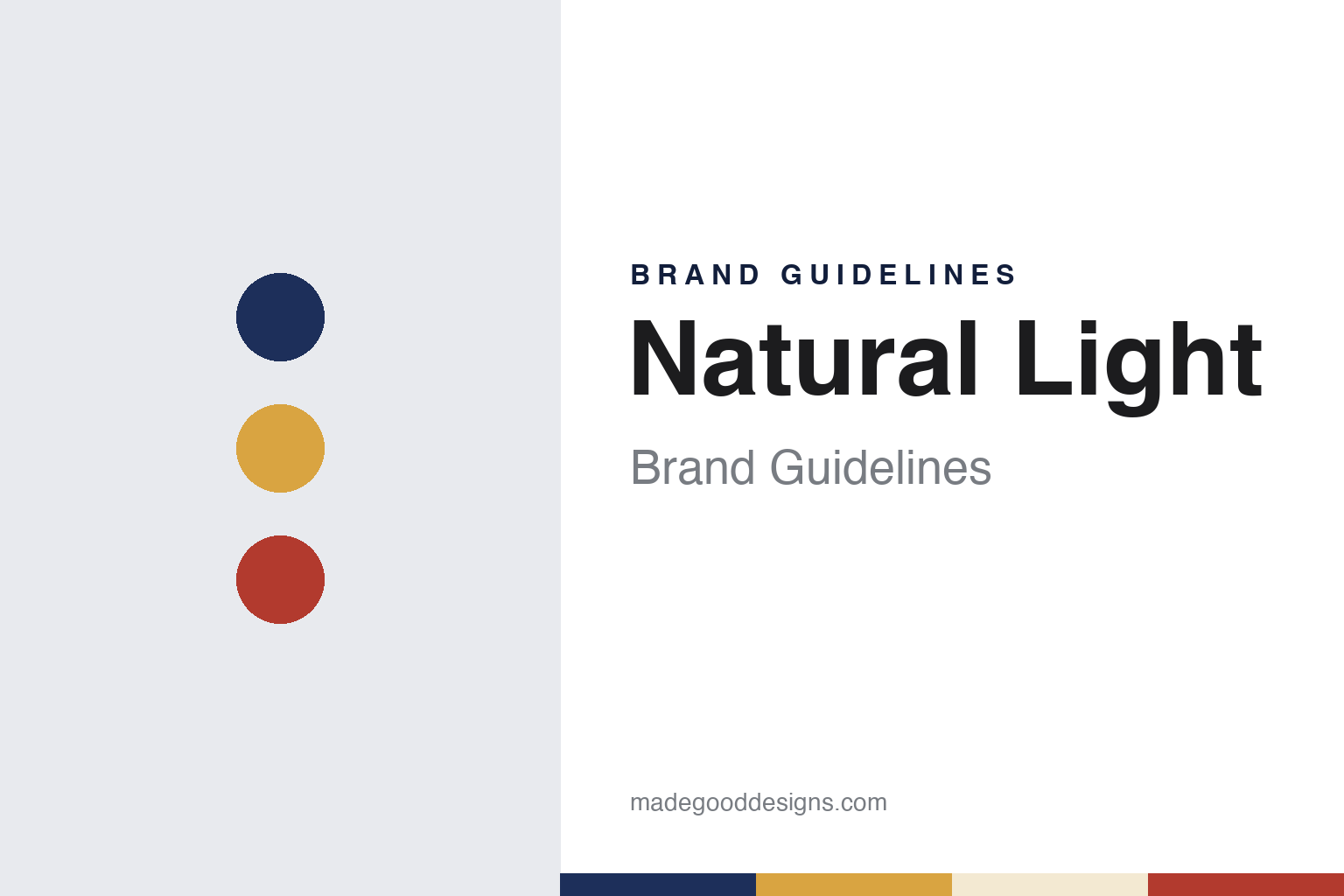
Two constants: a retro navy, harvest gold and cream palette and a soft 1970s display serif register. Abstract homage — not a Natural Light product or mark; no label, logo or can is reproduced.
Anheuser-Busch’s first answer to light beer
A 1977 launch in a category its rival had just opened.
Natural Light is a light lager brewed by Anheuser-Busch, the St. Louis brewer founded on the Bavarian Brewery that Eberhard Anheuser and his son-in-law Adolphus Busch built up from the 1860s. English Wikipedia says the beer was introduced on 31 July 1977 under the full name “Anheuser-Busch Natural Light,” and that it was launched to compete with Miller Lite, the light beer of its rival Miller. It was Anheuser-Busch’s first entry in the category: English Wikipedia places Michelob Light in 1978 and Bud Light, first sold as Budweiser Light, in the early 1980s. The brand’s own history page describes the 1977 launch in the same terms — Anheuser-Busch’s first light beer — and gives its launch slogan as “And the world rejoices.”
The long original name did not last. English Wikipedia says it was later shortened to Natural Light, and that the brand’s early television advertising made a joke of the mouthful. The comedian Norm Crosby urged viewers to “Just say Natural,” and the comedian Bill Saluga appeared in some commercials as his character Raymond J. Johnson Jr., an officious character.
English Wikipedia lists the beer at 4.2% alcohol by volume and records that The Wall Street Journal listed it in 2009 as the fifth-best-selling beer in the United States. Along the way the brand picked up the nickname by which many drinkers know it, “Natty Light,” or simply “Natty,” a name the company has since used on its own products.
Colour
From the 1979 can to the 2023 can.
The brand’s most deliberate design move looked backwards. VinePair reported in January 2023, in a story by Nicolette Baker, that Natural Light was moving permanently to a vintage-inspired can, with new packaging rolling out from February. The change was purely visual and the recipe stayed the same. The brand described the design as “an ode to one of the first Natural Light can designs from 1979,” and VinePair noted a throwback logo, a crest, a vintage-inspired typeface and what the brand called a classic colour scheme. English Wikipedia describes the 2023 overhaul as a return to the logo and can design of the late 1970s, aimed at broadening the brand’s appeal beyond college-age drinkers.
The decision had been tested first. According to VinePair, the same retro cans had been sold as limited releases in select markets in 2021 and 2022 before the brand made them permanent, and the brand said the new look was “now here to stay.” Alongside the packaging, Natural Light refocused its long-running “Act Natural” advertising, with spots that leaned on the easygoing character of the Carolinas and the southern East Coast, which the brand described as core to its identity.
Pack size has been part of the brand’s image too. English Wikipedia notes that the beer is commonly sold in 30-can cases, and in 2018 the brand sold a one-off 77-pack in College Park, Maryland, Fox 5 DC and The Post of Athens, Ohio, reported in October that year. In September 2026 Anheuser-Busch announced a campaign in which Natural Light set out to be “the official sponsor of your garage.”
Typography
Design and documentation.
The seven brands in this group are all American beer names: Busch, Natural Light, Keystone Light, Rolling Rock, Bell’s, Deschutes and Allagash. American beer brands in general sit at many different points in the trade, from independent breweries that still carry a founder’s name to labels that now belong to much larger brewing groups, and a single brand can be sold everywhere from a corner shop to a stadium bar.
A beer brand’s identity is usually carried less by a single bottle or can than by a label, a name and the place it promises, because the company behind the name may have changed hands, moved its brewing or grown far beyond the town where it started. That makes the questions behind each name worth asking plainly: who started it, who owns it now, and where its beer is actually brewed and packaged.
Each guide separates what independent sources record from what the company says about itself — its founding story, its owners over time, where its beer is brewed and how its labels have changed — and marks plainly what rests only on the company’s own word.
Aa
A soft 1970s display serif for a light lager in a retro can. (Specimen set in Fraunces, a serif STAND-IN; NOT the Natural Light logo.)
Natural Light
A family of Natty spin-offs inside AB InBev.
Natural Light has grown into a small family. English Wikipedia lists Natural Ice, an ice beer introduced in 1995, which the company says went on to become the best-selling ice beer in the United States; Natty Daddy, a stronger malt liquor added in 2012; and Naturdays, a fruit-flavoured line released in 2019 whose flavours have included strawberry lemonade and pineapple lemonade, and which the company calls the leading beer innovation of that year. The brand’s timeline also records a simpler slogan, “Naturally,” which it lists for 1999 and again for 2008. The parent company changed in 2008: English Wikipedia says InBev’s takeover of Anheuser-Busch was completed on 18 November 2008, creating Anheuser-Busch InBev, with Anheuser-Busch continuing as a wholly owned subsidiary based in St. Louis and Natural Light among the American brands it produces, alongside Busch.
Critical opinion has been divided. Natural Light won a bronze medal in the American-style light lager category at the 2008 World Beer Cup, English Wikipedia records, and Consumer Reports ranked it second among light beers in 2001, Modern Brewery Age reported; the beer-rating site RateBeer, by contrast, has placed it on its list of the worst beers in the world.
The name needs care in a search bar: “natural light” is also an everyday phrase in photography, architecture and interior design. The beer’s own site, naturallight.com, carries the shortened “Natty” name in its header alongside Naturdays, Natural Ice and Natty Daddy, and runs garage-themed giveaways under the Natty Light name.
For a design guide, Natural Light shows how a mass-market brand can find a sharper identity by reviving its own archive — taking a 1979 can, testing it in limited runs, then adopting it for good — rather than inventing a new look. Compare Miller Lite, the light beer it was launched to rival, and Keystone Light, another American light lager in a can. For this guide we use retro navy, harvest gold and cream with a soft display serif, an unofficial interpretation; no product or logo is reproduced.
Explore & save
Keep Natural Light’s identity on hand — save it to a board in the Made Good inspiration library.
Natural Light identity set
Pin the Natural Light retro navy, harvest gold and cream palette and the soft 1970s display serif register to your own board.