Montes Brand Guidelines
The Apalta winery of the angel labels, founded in 1988.
Aa
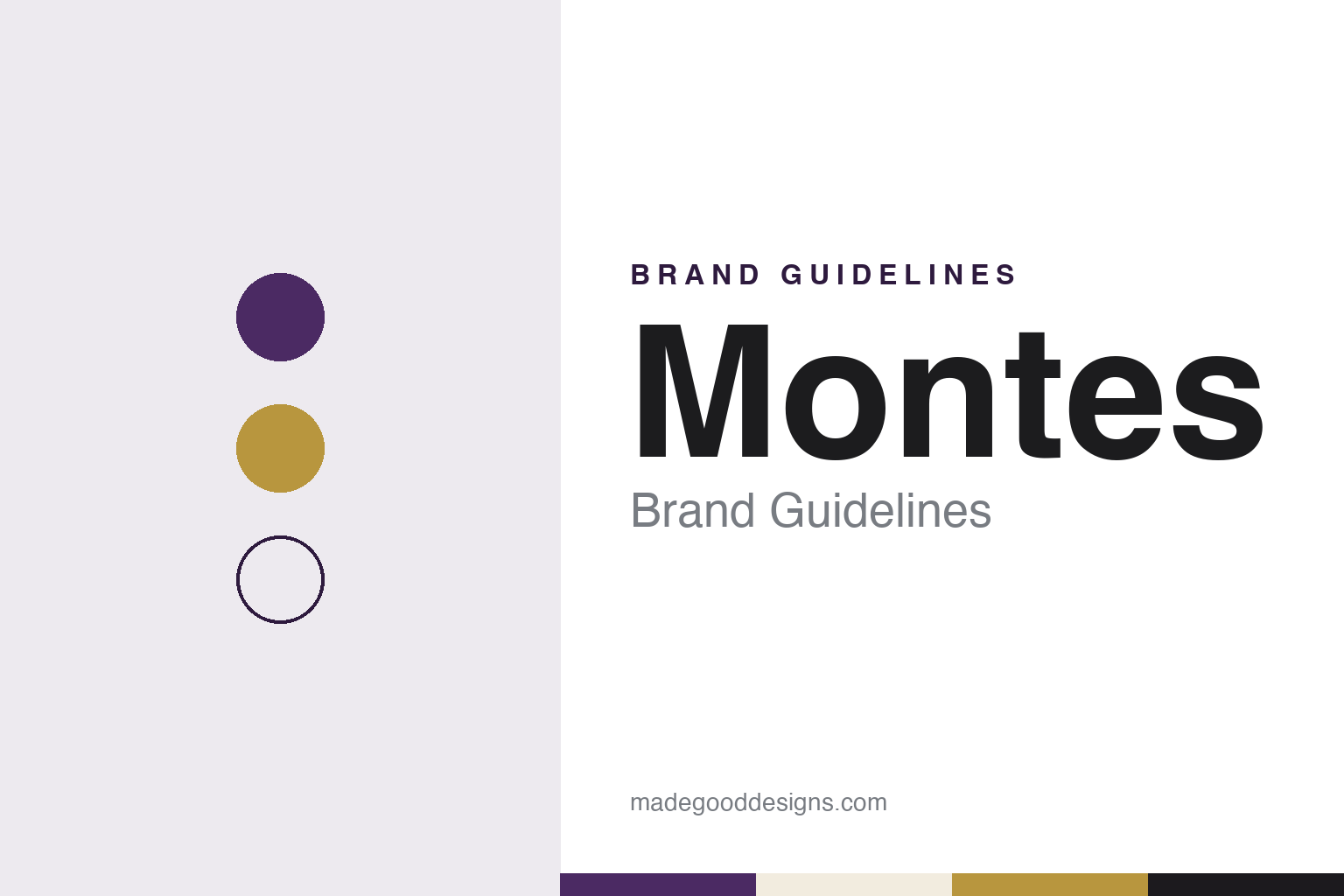
Two constants: an angel purple, halo gold and parchment palette and a calm book serif register. Abstract homage — not a Montes product or mark; no label, logo or bottle is reproduced.
Discover Wines
Four partners, one harvest and a company with another name.
Montes began with a harvest before it had a name. The company’s own timeline says that in 1987 the winemaker Aurelio Montes and Douglas Murray harvested the first crop of what became Montes Alpha Cabernet Sauvignon, and that the winery was founded in 1988 under the name Discover Wines, sending its first shipment of Montes Alpha to the United States that year. Wine Spectator reported in July 2010 that four partners founded Discover Wines in 1988 — Murray, Montes, Alfredo Vidaurre and Pedro Grand — and that it soon became Viña Montes.
The partners came from the trade. Murray, Wine Spectator reported, had studied economics and business in the United States and led the wine division of the Spanish group Rumasa for 14 years before returning to Chile in 1982 to oversee Viña San Pedro, where he met Montes in 1984. Montes had studied enology at the Catholic University, graduating in 1971, and had worked at Undurraga and at San Pedro; a change of ownership at San Pedro in 1988 left him without a job, the magazine reported in 2014.
The work was divided four ways. According to Wine Spectator’s 2014 profile, Montes made the wine, Vidaurre ran the finances, Murray handled marketing and Grand looked after the technical side until the early 2000s. The same profile says the business was first established in the Curicó district; the company’s estates today lie mainly in Colchagua. Murray died in Santiago in 2010, Wine Spectator reported that July, describing Montes as one of Chile’s most prominent wineries.
Colour
An angel on every label, and a range in tiers.
The angel on Montes labels is Murray’s legacy. Wine Spectator wrote in 2010 that Murray often spoke of angels watching over the winery and its team, and that an angel appears on every label; its 2014 profile said he settled on the motif after surviving a series of car crashes, and that a large carved wooden angel stands in the foyer of the Apalta winery. The angel runs through the names too: Purple Angel, Sparkling Angel and Montes Cherub all appear in the company’s current list.
The range grew in tiers. Montes Alpha came first, and an Alpha Chardonnay followed in 1994, the company says. It calls Montes Alpha M, launched in 1996, “Chile’s first iconic wine”; Montes Folly, launched in 2000, its first icon Syrah, made from the highest slopes of its Apalta estate; and Purple Angel, launched in 2003, “Chile’s first iconic Carmenère.” The company also says it introduced the Syrah grape to Chile in 1993. Those are the company’s own descriptions. Carmenère, it notes, was rediscovered in Chile in 1994 after being considered extinct since phylloxera devastated Bordeaux.
Newer wines have kept the pattern of a short, memorable name. Taita, a Cabernet Sauvignon from Marchigüe, had its first harvest in 2007, by the company’s timeline, and Wine Spectator reported its release in late 2013. Sparkling Angel, the first Montes sparkling wine, followed in 2015; Montes Muse in 2022, distributed through the Bordeaux trading system known as La Place de Bordeaux; and Montes Wings in 2023, the company says.
Aurelio Montes’s own business card, Wine Spectator reported in 2014, reads simply “Guardian of the Spirit.” The next generation is in the business as well: the same article said his son Aurelio Montes Jr. makes the wine at Kaiken, the family’s winery in Argentina.
Typography
Design and documentation.
The seven brands in this group are all Argentine and Chilean wine names: Catena Zapata, Trapiche, Norton, Santa Rita, Montes, Errázuriz and Cono Sur. Wine brands in general sit at many different points in the trade, from family houses that still carry a founder’s name to labels that now belong to much larger drinks groups, and a single brand can be sold everywhere from a corner shop to a restaurant list.
A wine brand’s identity is usually carried less by a single bottle than by a label, a name and the place it promises, because the company behind the name may have changed hands, moved its production or grown far beyond the place where it started. That makes the questions behind each name worth asking plainly: who started it, who owns it now, and where its wine is actually made and bottled.
Each guide separates what independent sources record from what the company says about itself — its founding story, its owners over time, where its wine is made and how its labels have changed — and marks plainly what rests only on the company’s own word.
Aa
A calm book serif for a winery of angels. (Specimen set in EB Garamond, a serif STAND-IN; NOT the Montes logo.)
Montes
Apalta, feng shui and Gregorian chant.
Montes is a Colchagua winery. The company says it acquired its Apalta estate in 1995; Wine Spectator reported in 2014 that Montes first bought land in Apalta in 1991 and was a pioneer of hillside planting there. It added a property at Marchigüe, in Colchagua closer to the Pacific, in 2001, and planted its first vineyards at Zapallar, 11 kilometres from the ocean on the northern edge of the Aconcagua Costa region, in 2006, by its own account. Its website lists vineyards in valleys from Aconcagua Costa and Maipo to Curicó, Itata and Chiloé, where it says it planted on Mechuque Island in 2018.
The top wines are made at the Apalta winery, which the company says was inaugurated in December 2004. Wine Spectator reported in 2014 that the icon wines and the Alpha line are made there, and that the building partly reflects Murray’s vision. Its design follows feng shui: the company describes a wooden walkway over a small lagoon at the entrance, with water flowing toward the building, and a fountain beneath a lily-shaped skylight at its centre. Grapes and wine move by gravity rather than by pumps, it says, and in the semicircular barrel room more than 800 French oak barrels age to recordings of Gregorian chant, played all year.
The company behind the brand is Montes S.A., with its winery at Millahue de Apalta, near Santa Cruz, and commercial offices in Santiago, according to its website. It also reaches beyond Chile: it founded Bodega Kaiken in Mendoza in 2002 as its Argentine branch, it says, and Wine Spectator reported in 2014 on a California project called Napa Angel. In 2024, the company says, Viña Montes joined the B Corporation movement.
For a design guide, Montes shows how one symbol — a guardian angel adopted by a co-founder — can carry a whole range, from the labels to the name of an icon wine. Compare Concha y Toro, the Chilean wine house founded in 1883, and Cono Sur, another Chilean winery. For this guide we use an angel purple, a halo gold and parchment with a serif, an unofficial interpretation; no product or logo is reproduced.
Explore & save
Keep Montes’s identity on hand — save it to a board in the Made Good inspiration library.
Montes identity set
Pin the Montes angel purple, halo gold and parchment palette and the calm book serif register to your own board.