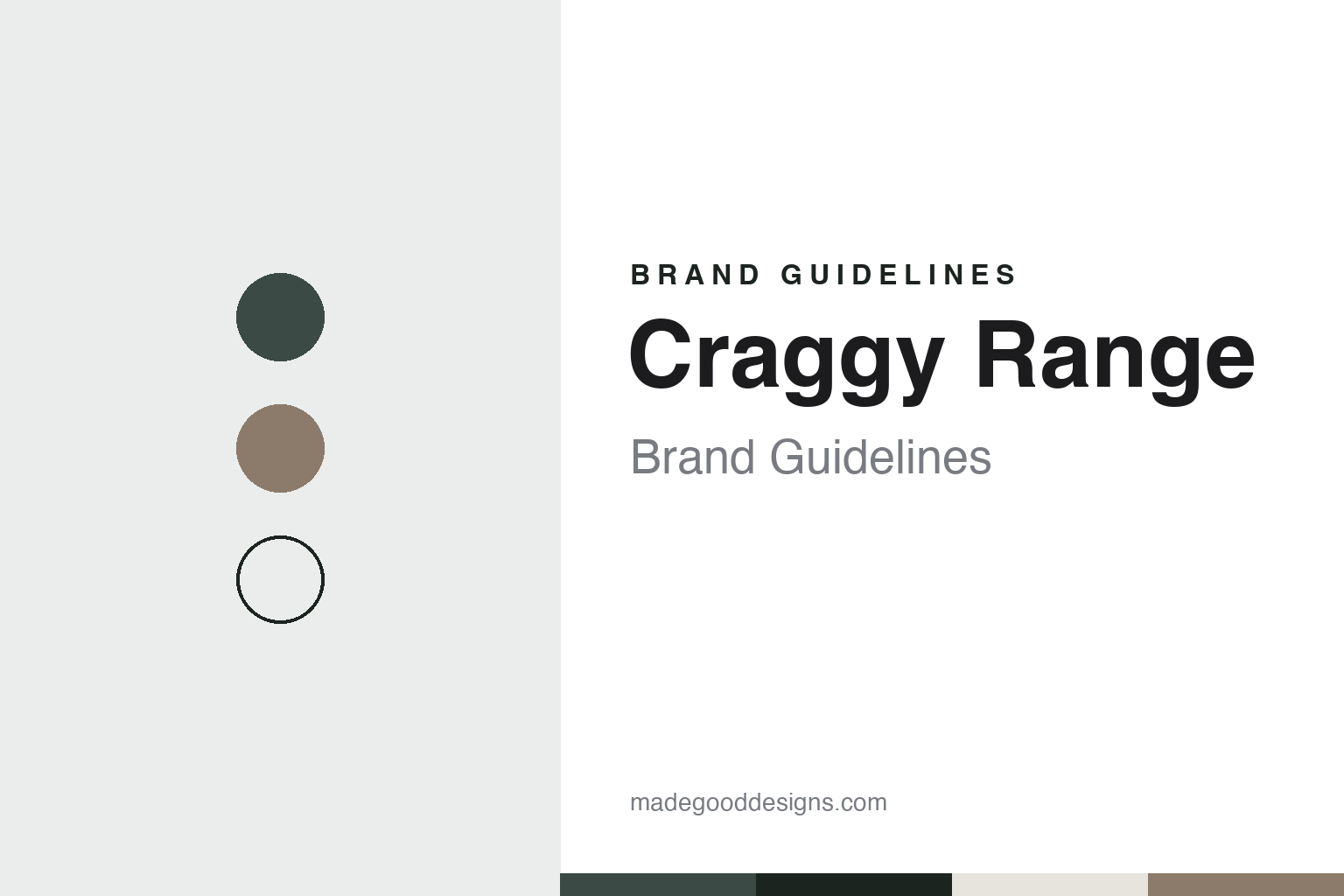
Craggy Range Brand Guidelines
The Peabody family’s Hawke’s Bay estate, founded 1998.
Aa
Two constants: a peak green, gravel taupe and limestone palette and a geometric sans register. Abstract homage — not a Craggy Range product or mark; no label, logo or bottle is reproduced.
A long search for bare ground
An Australian family, a New Zealand viticulturist and two sites.
Craggy Range is a family-owned winery in Hawke’s Bay, on the east coast of New Zealand’s North Island. The company dates its founding to 1998, and the idea behind it to 1993, when it says Terry and Mary Peabody set out to create a wine estate that could be handed down through generations. The company also credits Mary-Jeanne Peabody, now a director, with sharing that vision with Terry in 1993.
The Peabodys did not start in New Zealand. Their search, the company says, took them through France, the Americas and Australia before they settled on two pieces of ground: the gravelly soils of the Gimblett Gravels in Hawke’s Bay and the terraces of Te Muna, near Martinborough in the Wairarapa, at the southern end of the North Island.
The other founding figure is a viticulturist. In December 2021, when New Zealand Winegrowers named Steve Smith one of its fellows, NZ Winegrower reported that Terry Peabody had called on Smith in 1998 to help establish Craggy Range, and that Smith had co-founded the winery and steered it for sixteen years. Smith had spent about ten years as viticulturist at Villa Maria, and in 1996 became the first viticulturist in the world to earn the title Master of Wine, the same report said. After stepping back from Craggy Range, as the Peabody family took a greater part in running it, he went on to found Smith & Sheth with Brian Sheth.
The company says the first Craggy Range vintage, in 1999, was completed by David A. Peabody Sr, a member of the family who is now a director.
Colour
Gimblett Gravels, Te Muna Road and the Giants Estate.
Craggy Range grows its grapes in two regions. Its Gimblett Gravels Estate in Hawke’s Bay is planted, the company says, with Syrah, Cabernet Sauvignon, Merlot, Chardonnay, Cabernet Franc and Petit Verdot, on raw gravel soils in a warm, sheltered spot. Its Te Muna Road Estate in Martinborough, on alluvial soils with wide swings between day and night temperatures, grows Sauvignon Blanc and Pinot Noir.
The wine is made in Hawke’s Bay, at two wineries the company describes on its own site. Most Craggy Range wines are made at the Gimblett Gravels Winery, in the Gimblett Gravels winegrowing district, which has its own receiving area for sorting, crushing and pressing, two cellars of small fermentation vessels in stainless steel, ceramic, amphora, concrete and oak, and two barrel halls. Smaller parcels and the company’s prestige wines are made at the Giants Estate Winery on Waimarama Road in Havelock North, beneath Te Mata Peak. There a circular fermentation cellar named Sophia, fitted with large French oak vats, makes the wine of the same name, and a barrel cellar below it, The Quarry, ages the Sophia blend for its final twelve months, the company says.
The Giants Estate is also the public face of the business. The company describes it as the heart of Craggy Range, with a cellar door, a restaurant, organic and biodynamic kitchen gardens, and boutique accommodation. In December 2017 1News reported that the winery there had opened in 2003, when the local iwi, Ngāti Kahungunu, blessed the site.
The peak above it has also been the site of a public dispute. In the same December 2017 report, 1News said Craggy Range had decided to remove a 2.4-kilometre walking track it had cut on land it owned on the eastern slopes of Te Mata Peak, after objections from Ngāti Kahungunu, and to restore the land.
Typography
Design and documentation.
The seven brands in this group are all wine estates from Spain, New Zealand and Germany’s Mosel: Dominio de Pingus, Álvaro Palacios, CVNE, López de Heredia, Emilio Moro, Craggy Range and Markus Molitor. Wine estates in general sit at many different points in the trade, from family houses that still carry a founder’s name to names that now belong to larger groups, and a single estate can be known everywhere from a local wine shop to a restaurant list.
A wine estate’s identity is usually carried less by a single bottle than by a label, a name and the place it promises, because the company behind the name may have changed hands, bought new vineyards or grown far beyond the place where it started. That makes the questions behind each name worth asking plainly: who started it, who owns it now, and where its wine is actually made and bottled.
Each guide separates what independent sources record from what the estate says about itself — its founding story, its owners over time, where its wine is made and how its labels have changed — and marks plainly what rests only on the estate’s own word.
Aa
A clean geometric sans for an estate name. (Specimen set in Jost, a sans-serif STAND-IN; NOT the Craggy Range logo.)
Craggy Range
A family estate held in a 1,000-year trust.
Craggy Range remains owned by the family that founded it. The company describes itself as family-owned and “governed by a 1,000-year family trust,” a structure it presents as a commitment to long-term thinking, and says three generations of the family now work together in the business.
The company names the people involved on its own site. Terry Peabody is listed as owner and chairman, and Mary Peabody as owner, with a particular focus on the restaurant. David T. Peabody, of the third generation, became executive director in November 2024, the company says. Day-to-day leadership sits with a chief executive, Craig Sims, and with chief winemaker Ben Tombs, who joined in 2021 and took the senior winemaking role in November 2023. The company says the 2024 vintage was its twenty-fifth harvest and the first guided by Tombs.
The vineyards have their own manager. The company’s people page names Jonathan Hamlet as national vineyard manager, and says he joined in 2020 after working as Hawke’s Bay regional viticulturist for Villa Maria, the winery where Steve Smith had also spent a decade before Craggy Range.
The winery’s own site is craggyrange.com.
For a design guide, Craggy Range shows how a long-term family structure, two named vineyard regions and an estate set beneath a landmark peak can carry a New Zealand winery founded in 1998 through a quarter-century of harvests. Compare Villa Maria and Cloudy Bay, two other New Zealand wineries. For this guide we use peak green, gravel taupe and limestone with a sans, an unofficial interpretation; no product or logo is reproduced.
Explore & save
Keep Craggy Range’s identity on hand — save it to a board in the Made Good inspiration library.
Craggy Range identity set
Pin the Craggy Range peak green, gravel taupe and limestone palette and the geometric sans register to your own board.