Markus Molitor Brand Guidelines
The Mosel Riesling estate that codes its wines by capsule colour.
Aa
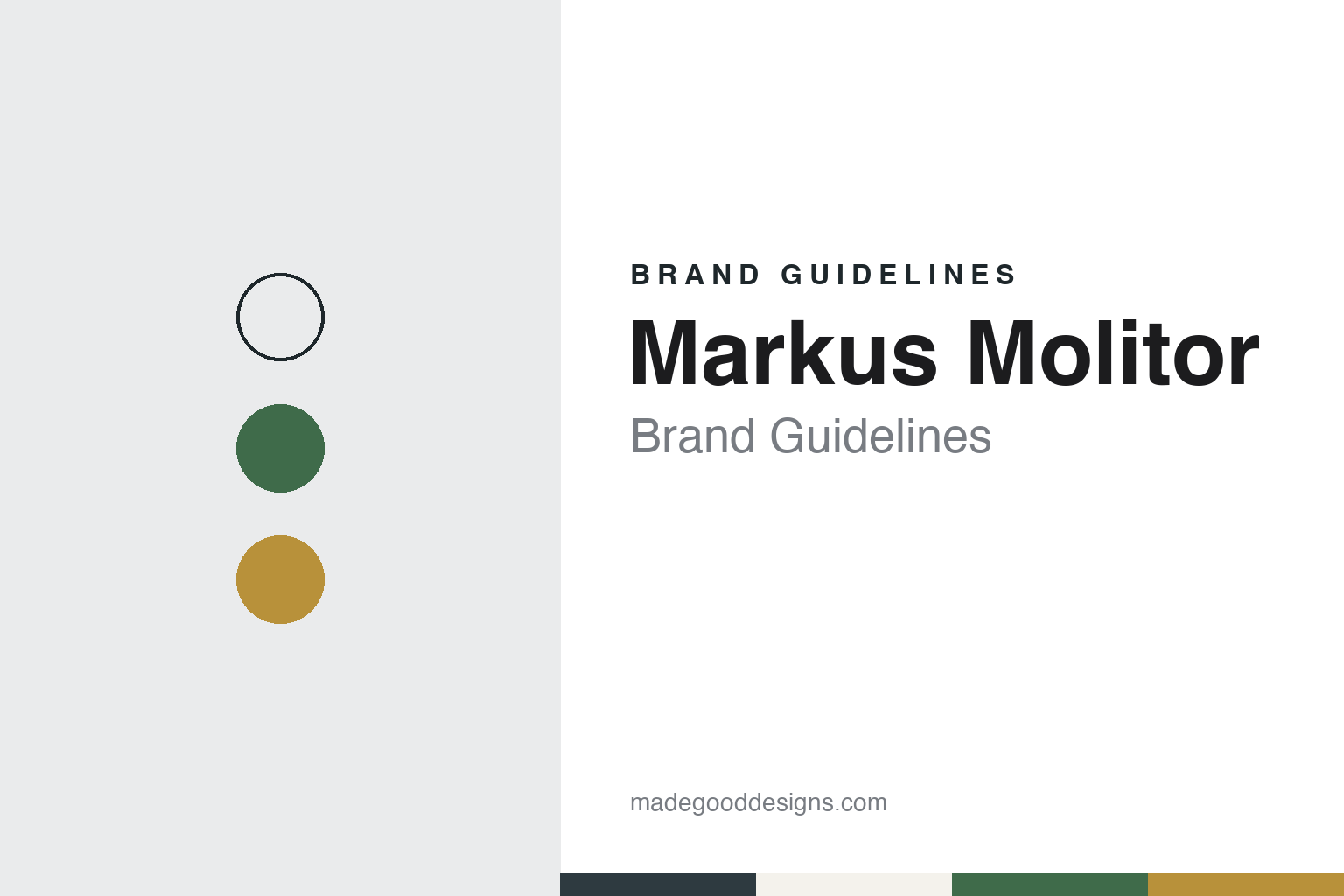
Two constants: a slate, capsule white, green and gold palette and a classical serif register. Abstract homage — not a Markus Molitor product or mark; no label, logo or bottle is reproduced.
Eight generations at Wehlen
A family estate and a house above the Mosel.
Weingut Markus Molitor is a family wine estate on the Middle Mosel in Germany, named after the winemaker who runs it. German Wikipedia describes Markus Molitor as a German winemaker from Bernkastel-Wehlen, on the Mosel, and the estate’s own website tells the story in his words: in the mid-1980s, he says, he took over his father’s estate, in the eighth generation of the family, with the aim of making wines that were strongly marked by their sites, built to age, and linked back to what he calls the golden age of Mosel Riesling. His stated maxim is meticulous, uncompromising handwork in the vineyard and the cellar.
The estate’s home is Haus Klosterberg. German Wikipedia says the building, in the Wehlener Klosterberg vineyard, was put up as a wine estate at the end of the nineteenth century and was acquired by Markus Molitor in 1984, after he had taken over the business; it cites an archived 2015 version of the estate’s website. The estate calls the Wehlener Klosterberg its house vineyard, directly adjoining the winery: a steep, south-facing slope of about 24 hectares, it says, on stony Devonian slate with a notable iron content and woodland along its upper edge. Haus Klosterberg also houses the estate’s shop and tasting room, which the website says offers around 40 different wines to taste.
The business is a family company. The imprint on the estate’s website names it as Weingut Markus Molitor GmbH & Co. KG, with its registered seat in Bernkastel-Kues, and the London merchant Berry Bros. & Rudd describes Markus Molitor on its producer page as the present owner and winemaker.
Colour
Steep slate from Brauneberg to the Saar.
The wines come from a long run of named vineyards. German Wikipedia, citing a 2015 report on Wine-Searcher, puts the estate at 65 hectares spread across 15 sites, about 90 per cent Riesling with small amounts of Spätburgunder, or Pinot Noir; the undated producer page at Berry Bros. & Rudd gives a smaller figure of 22 hectares. The estate says its vineyards run from Brauneberg to Traben-Trarbach along the Middle Mosel and, since 2001, also on the Saar, where its site list includes the Ockfener Bockstein and the Saarburger Rausch.
The estate’s own map of its vineyards leans on history. Its site page reproduces part of what it calls the oldest official vineyard classification in the world: an assessment of the sites of the Mosel, Saar and Ruwer carried out between 1816 and 1832 and published by the Prussian tax authorities in 1868. The estate says it shows the original eight classes simplified into three shades of red, and that wines under the Molitor name come only from sites in the two darkest shades. Its list includes famous Middle Mosel names — the Wehlener Sonnenuhr, the Graacher Domprobst, the Ürziger Würzgarten with its rare red slate, and a parcel of just 0.13 hectares in the Bernkasteler Doctor, a vineyard of about 3.2 hectares. In the Zeltinger Sonnenuhr, it says, many of the old vines are ungrafted, growing on their own roots. Its Spätburgunder comes from sites including the Trarbacher Schlossberg and the Brauneberger Mandelgraben.
In the cellar the estate describes a slow, low-intervention method. Grapes are picked only by hand, in several passes, it says, and selected again in the cellar; most wines are fermented spontaneously and aged in wooden casks, without fining agents, enzymes or cultured yeasts, in an old three-storey vaulted cellar cut into the slate, before resting for months on their fine lees. On the Saar, German Wikipedia adds, citing the Trierischer Volksfreund, Markus Molitor has worked with Roman Niewodniczanski of the Van Volxem estate to bring the Geisberg vineyard at Schoden back into cultivation.
Typography
Estates, regions and labels.
The seven brands in this group are all wine estates from Spain, New Zealand and Germany’s Mosel: Dominio de Pingus, Álvaro Palacios, CVNE, López de Heredia, Emilio Moro, Craggy Range and Markus Molitor. Wine estates in general sit at many different points in the trade, from family houses that still carry a founder’s name to names that now belong to larger groups, and a single estate can be known everywhere from a local wine shop to a restaurant list.
A wine estate’s identity is usually carried less by a single bottle than by a label, a name and the place it promises, because the company behind the name may have changed hands, bought new vineyards or grown far beyond the place where it started. That makes the questions behind each name worth asking plainly: who started it, who owns it now, and where its wine is actually made and bottled.
Each guide separates what independent sources record from what the estate says about itself — its founding story, its owners over time, where its wine is made and how its labels have changed — and marks plainly what rests only on the estate’s own word.
Aa
A classical serif — a family name above a single grape. (Specimen set in EB Garamond, a serif STAND-IN; NOT the Markus Molitor logo.)
The capsule code
White, green and gold instead of a word on the label.
The estate’s most distinctive design decision sits on top of the bottle. German wine law, the estate explains on its website, places a Riesling in the “trocken,” or dry, category purely on laboratory figures for residual sugar and total acidity. The estate says it judges a wine instead by its balance and taste, since a vintage with high acidity can carry a little more sugar and still taste dry — and so the word “trocken” does not appear on its labels. In its place, the colour of the capsule that closes the bottle tells the drinker the style.
The code has three colours, according to the estate. A white capsule marks its classically fermented wines; for these, the back label carries a scale running from dry on the left to sweet on the right, with the letters “MM” marking where the estate places the wine. A green capsule marks the feinherb Rieslings — feinherb, the estate says, being the historically handed-down term for the classic style of Mosel Riesling. A gold capsule marks the fruity-sweet and nobly sweet Rieslings, whose flavour, it says, rests on the natural sweetness of the grapes. Merchants such as Berry Bros. & Rudd carry the capsule in the names of the wines they list, with labels such as “Gold Cap” and “Goldkapsel.”
The estate presents its range as broad. Its philosophy page says every wine — white or red, dry, feinherb or fruity-sweet, from a quality wine to the top Prädikat levels — should reflect the potential of its site and vintage, and it points to a series of Beerenauslese and Trockenbeerenauslese wines that, it says, now spans more than four decades.
For a design guide, Markus Molitor shows how a single colour code can do the work that words usually do on a wine label, turning the capsule into a signal of style that can be read before the label is. Compare Dr. Loosen, another Mosel Riesling family estate in Bernkastel, and Schloss Johannisberg, the Rheingau Riesling estate. For this guide we use slate, capsule white, feinherb green and capsule gold with a serif, an unofficial interpretation; no product or logo is reproduced.
Explore & save
Keep Markus Molitor’s identity on hand — save it to a board in the Made Good inspiration library.
Markus Molitor identity set
Pin the Markus Molitor slate, white, green and gold palette and the classical serif register to your own board.