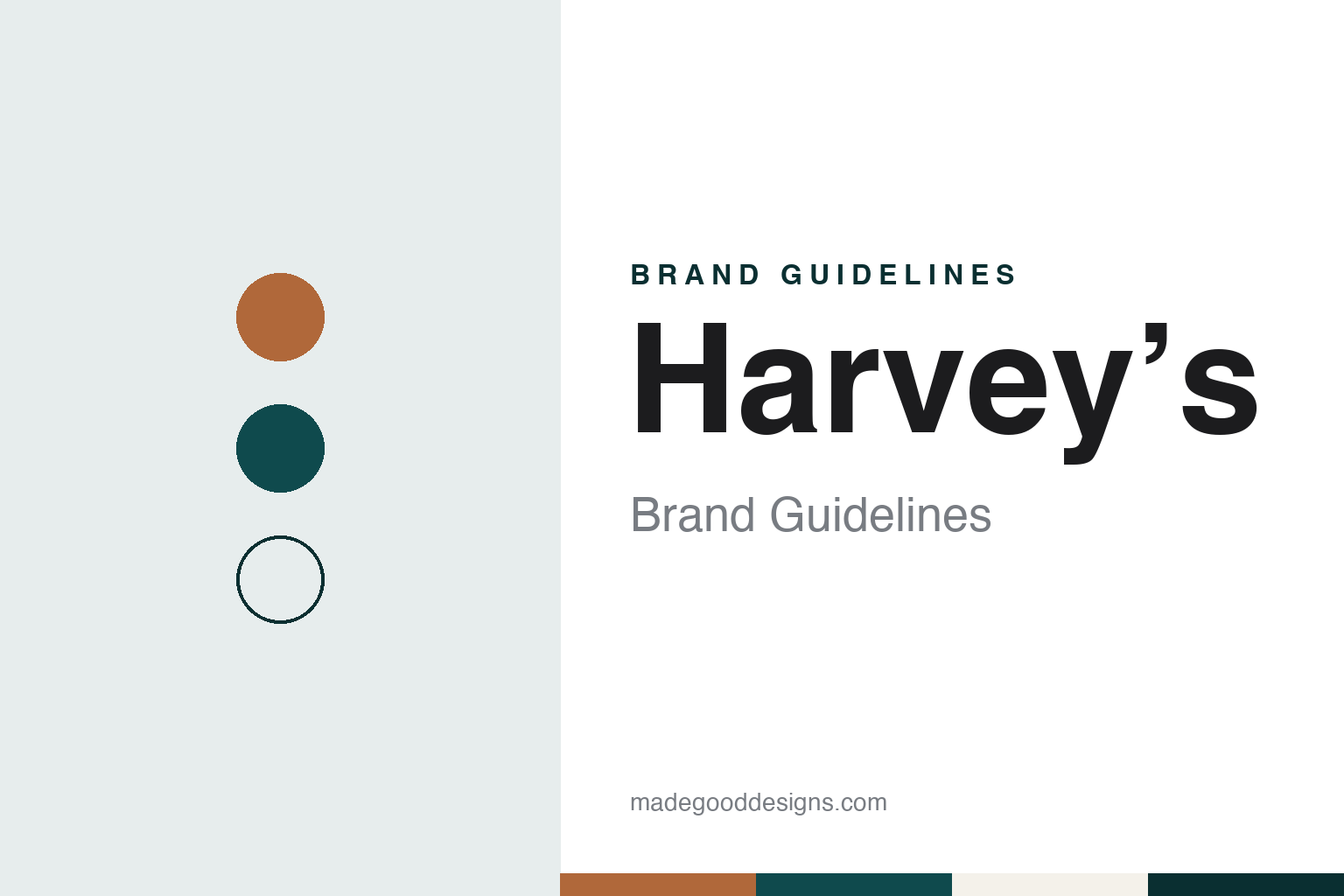
Harvey’s Brand Guidelines
The Lewes family brewer dating itself to 1790.
Aa
Two constants: a copper, Sussex teal and chalk white palette and a classic book serif register. Abstract homage — not a Harvey’s product or mark; no pump clip, label or logo is reproduced.
Bridge Wharf
A wine merchant’s name, a riverside wharf and a Victorian tower.
Harvey’s Brewery stands on the bank of the River Ouse in Lewes, the county town of East Sussex, and its company name is Harvey & Son (Lewes) Ltd. English Wikipedia says it was founded in 1790 by John Harvey, and the company dates itself to that year. Its own history is more precise about what happened when. The Harvey name, the company says, was first associated with wines and spirits in Sussex, with records from the 1790s of port, sherry and claret delivered around Lewes; John Harvey started brewing as a seasonal sideline in Bear Yard, opposite the present brewery, by about 1820.
In 1838, the company says, John Harvey and his sons bought the Bridge Wharf site — then a coal wharf, a timber yard and some houses — and built a brewhouse there. His sons Henry, Edwin and William developed the business as Harvey & Son, and by 1859, according to the company, Henry was brewing porters, stouts and strong mild ales for 17 family-owned pubs, most of them around Eastbourne and Hailsham. In the 1860s William Harvey, who was not a brewer, brought in Henry Titlow-Barrett from Wethered’s brewery in Marlow to run production, the company says.
The building that gives the brand its face came next. The brewery was rebuilt in 1881, the company says, by the Lewes builders Card & Son to designs by the brewery architect William Bradford; English Wikipedia dates the rebuilding of the tower and brewhouse to 1880 and describes their style as rustic neo-Gothic. Wikipedia, citing the National Heritage List for England, records the building as Grade II* listed. During the work, the company says, builders unearthed a weather vane dated 1621 that now sits on top of the tower. A smaller second tower, built in 1985 in the style of the original to add capacity, according to the company.
Colour
Daughters, a brewer from outside and seven generations.
Harvey’s describes itself as a family business that has been in the custodianship of John Harvey’s descendants since 1790, a privately owned limited company with no shares offered to outside investors. Its own account of how that happened runs largely through the women of the family. The company was incorporated in 1928, when three of John Maxfield-Smith’s daughters — Alice, Elsie and Nora — were running it, and Alice May Harvey-Smith became its first chairperson in 1929, the company says. In the late 1930s the sisters hired a newly qualified brewer, Anthony Jenner.
After the Second World War, according to the company, Eric Rundle, a nephew of the sisters, became chairman, with Jenner as head brewer and then managing director. Around 1980 Jenner bought a shareholding — the company says he is the only person outside the Harvey family ever allowed to do so — and in the 1980s Rundle’s daughters Audrey, Eileen and Joan joined the board. Jenner’s son Miles Jenner joined the brewing room after training at Greene King, the company says; Audrey Elder became chairman in 2002, and her son Hamish Elder, a seventh-generation descendant of John Harvey, became chairman in 2008 and joint managing director alongside Miles Jenner. Members of the eighth generation now work at the brewery, the company says, including its marketing and design manager.
In August 2026 the brewery’s brewing team changed: a CAMRA branch website reported on 5 August 2026 that Miles Jenner, head brewer for forty years, had become production director while remaining joint managing director, and that Peter Yarlett, who joined Harvey’s in 1995 and became second brewer in 2010, had been appointed head brewer.
The brewery has had to rebuild more than once. The company records a flood in late 1960, a fire in July 1996 after which the brewery was restored in 1998, and a flood in October 2000. After the 2000 flood the abandoned brew was bottled as Ouse Booze and sold to raise money for the Lewes flood appeal; the company quotes The Argus of December 2000 on the name. In 2025 Harvey’s bought the intangible assets of the closed Brighton Bier brewery, and in July 2026 it announced it would brew Brighton Bier’s South Coast IPA again with the brand’s founder, Gary Sillence.
Typography
Design and documentation.
The seven brewers in this group are all English regional and family names: St Austell, Timothy Taylor, Marston’s, Wadworth, Hook Norton, Black Sheep and Harvey’s. Most of them are Victorian or older. John Marston set up in Burton upon Trent in 1834, English Wikipedia says; Hook Norton dates from 1849 in the Oxfordshire village of the same name; Walter Hicks founded what became St Austell Brewery in Cornwall in 1851; Timothy Taylor began brewing in Keighley in 1858 and moved to Knowle Spring in 1863, the company says; and Wadworth has brewed in Devizes since 1875. Harvey’s of Lewes dates itself to 1790. Black Sheep is the newcomer: English Wikipedia says Paul Theakston set it up in Masham in 1991, after his family’s brewery in the same town had been taken over.
Their ownership has gone in different directions. Several still describe themselves as family businesses: Timothy Taylor says the brewery remains in the Taylor family; Wadworth says it passed from Henry Wadworth to his founding partner John Smith Bartholomew and is now in the fifth generation of Bartholomew family ownership; Hook Norton’s managing director James Clarke is a fifth-generation descendant of the founder, John Harris, according to an interview with The Morning Advertiser that the brewery republishes; and Harvey’s says it has been in the custodianship of John Harvey’s descendants since 1790. St Austell says it was founded as a family-owned company, and on 1 July 2016 it bought Bath Ales, English Wikipedia says. Marston’s went the other way: in 2020 its brewing business joined Carlsberg’s UK arm in the Carlsberg Marston’s Brewing Company, Carlsberg bought out Marston’s remaining stake in July 2024, and since January 2025 the breweries have been part of Carlsberg Britvic, according to English Wikipedia. Black Sheep entered administration in May 2023 and was bought by the London investment firm Breal Capital, The Caterer reported on 31 May 2023; in January 2026 its owner, Keystone Brewing Group, was sold in a pre-pack deal to the newly formed Great British Drinks Company, The Caterer reported on 22 January 2026.
A brewer’s identity is usually carried less by a single bottle than by a pump clip, a name and the town it promises, because the company behind the name may have changed hands or changed how and where it brews. Each guide separates what independent sources record from what the brewery says about itself — its founding story, its owners over time, where its beer is brewed and how its pump clips and labels have changed — and marks plainly what rests only on the company’s own word.
Aa
A classic book serif for a brewer that kept its traditional lettering. (Specimen set in Libre Caslon Text, a serif STAND-IN; NOT the Harvey’s logo.)
Harvey’s
Copper, teal and a Sussex dialect motto.
The brewery’s flagship is Sussex Best Bitter, which Harvey’s says has been brewed since the 1950s from Maris Otter malt with a little crystal malt and a blend of four local hop varieties. The company says it draws its brewing water from its own artesian well beneath the brewery and uses whole hops from Sussex, Kent and Surrey, among them Fuggles and Goldings. English Wikipedia says its current yeast strain came from the Tadcaster Brewery, now John Smith’s, in 1957, and that in 2016 the brewery reintroduced a small keg range and released its first canned beer.
Even the name has a history. English Wikipedia notes that the pump badge for Sussex Best Bitter has carried an apostrophe since 2010, and that new branding adopted in August 2016 used the apostrophe consistently. Harvey’s unveiled that new look at the trade session of the Great British Beer Festival on 9 August 2016, according to its press release, which The Morning Advertiser reported the next day. The redesign covered the beers, point-of-sale material and glassware: pump clips for the core range carried clean, modern illustrations associated with each beer, an image of the brewery building appeared on pump handles, and the seasonal range was illustrated by the local artist Malcolm Trollope-Davis, known for his map of Lewes. The release also said Harvey’s, which had historically sold only within about 60 miles of the brewery, planned to sell across the UK.
Harvey’s credits the design consultancy WPA Pinfold and a range of local artists. In its case study, WPA Pinfold says it redrew the brewery icon in copper, kept classic typography, and took a teal blue from the Sussex coast and white from the local chalk cliffs; it credits the Lewes artist Susan Lynch with artwork for the craft range. The same launch introduced the strapline “We wunt be druv,” a Sussex dialect phrase meaning “we will not be driven,” which the brewery calls the county’s unofficial motto.
The name needs a little care. Harvey’s of Lewes is unrelated to Harveys Bristol Cream, the sherry; the brewery’s own site is harveys.org.uk.
For a design guide, Harvey’s shows how a Victorian brewery building, a copper icon and a dialect motto can carry a family brewer’s identity from the pump handle to the can. Compare Shepherd Neame, the family brewer of Faversham in neighbouring Kent, and Adnams, the Southwold brewer on the Suffolk coast. For this guide we use copper, Sussex teal and chalk white with a serif, an unofficial interpretation; no product or logo is reproduced.
Explore & save
Keep Harvey’s’s identity on hand — save it to a board in the Made Good inspiration library.
Harvey’s identity set
Pin the Harvey’s copper, Sussex teal and chalk white palette and the classic book serif register to your own board.


