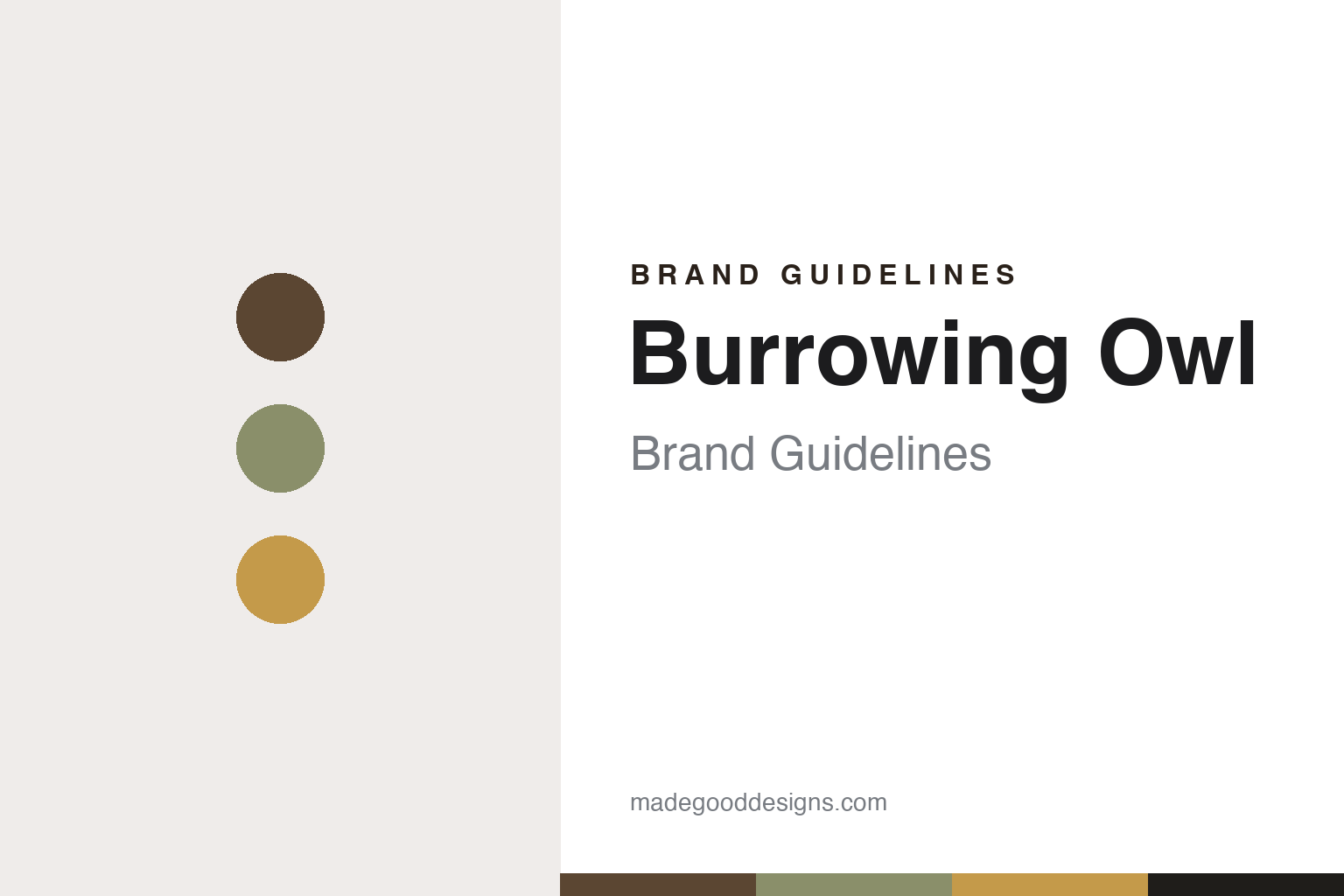
Burrowing Owl Brand Guidelines
The Wyse family’s desert winery, named for an endangered owl.
Aa
Two constants: a Burrowing Owl umber, sage and ochre palette and a bookish serif register. Abstract homage — not a Burrowing Owl product or mark; no label, logo or bird illustration is reproduced.
Black Sage Bench
A developer, an abandoned vineyard and a late decision to make wine.
Burrowing Owl Estate Winery sits off Black Sage Road south of Oliver, in British Columbia’s South Okanagan; English Wikipedia puts it about fifteen kilometres south of the town. It began in 1993, when Jim Wyse, a Vancouver property developer, bought abandoned vineyard land there. The company’s family biography says he was introduced to the land while finishing a development project in Vernon, and that it became the first 100 acres of Burrowing Owl Vineyards. English Wikipedia, citing guidebooks by Christina Melander (2007) and Cole Danehower (2010), says the first plantings were Chardonnay, Pinot Gris, Merlot and Cabernet Sauvignon.
A winery was not part of the original plan, the company says: Wyse first grew grapes, and only after wines made from them were well received did the family decide to build, obtaining a winery licence in 1997. The first vintage, 1997, was processed at another winery, Wikipedia says; construction of Burrowing Owl’s own building began in early 1998 and was finished just before that year’s harvest, according to the company, which describes a gravity-flow winery with extensive underground cellars. Cabernet Franc was added in 1998, Pinot Noir in 1999 and Syrah in 2000, the company says.
The company’s own account of Wyse’s role is modest. Knowing little about grapes or wine, it says, he hired experienced people to run the vineyard and to make and market the wine, and saw his own job as monitoring costs, arranging financing and making sure it all made sense as a business.
Colour
Named for a bird that had disappeared from the province.
The name is the brand’s story. The burrowing owl was declared extirpated in British Columbia in 1980, the company says. In the early 1990s Jim and his wife Midge Wyse learned from a roadside sign of a failed government attempt to re-establish the owl in the area, and decided to name their new vineyard after it. A few weeks later, the company says, they read a front-page story in the Vancouver Sun about the bird’s plight, contacted Mike Mackintosh, then director of the Stanley Park Zoo, who was raising money for a captive-breeding programme, and became volunteers.
The Wyses have been members and supporters of the Burrowing Owl Conservation Society of British Columbia since 1993, the winery says, and visitors to its wine shop are asked for a donation that goes to the society. The company quotes Mackintosh, as the society’s president, describing the winery as its “lifeblood.”
The theme carries into the vineyards. The company says they lie at the northern tip of the antelope-brush ecosystem, a semi-arid shrub-steppe, and describes more than 100 bluebird boxes, two bat nurseries and barriers that protect meadowlark nests from machinery. English Wikipedia, citing a federal energy-efficiency newsletter and Canadian Consulting Engineer, says the wine shop, restaurant, pool and guest accommodation are heated and cooled by a hybrid solar and geothermal system. The Sonora Room restaurant opened in 2003 and the guest rooms were completed in 2006, according to Wikipedia, citing The Globe and Mail and the Vancouver Sun.
Typography
Design and documentation.
The seven brands in this group are all Canadian wineries: Inniskillin, Jackson-Triggs, Peller Estates and Cave Spring from Ontario’s Niagara Peninsula, and Mission Hill, Quails’ Gate and Burrowing Owl from British Columbia’s Okanagan Valley. Some still carry a founding family’s name or are run by that family; others now sit inside much larger wine companies, and two of the Niagara names reach into the Okanagan as well.
Ownership is the clearest dividing line. Inniskillin, founded by Donald Ziraldo and Karl Kaiser with a first planting in 1974, and Jackson-Triggs, launched in 1993 by the company Donald Triggs and Allan Jackson built from the old Cartier wines, both passed through Vincor and Constellation Brands and today trade under Arterra Wines Canada, the name the business took in 2017 after Constellation sold its Canadian wine arm, English Wikipedia says. Peller Estates belongs to Andrew Peller Ltd of Grimsby, Ontario, which agreed in June 2026 to be taken private by Fairfax Financial Holdings, Canadian Grocer reported. In the Okanagan, Anthony von Mandl bought the Mission Hill estate in West Kelowna in 1981; Quails’ Gate grew from land the Stewart family began planting in 1956 and relaunched as a winery in 1989; and Burrowing Owl, near Oliver, began when Jim Wyse bought vineyard land in 1993, with the winery itself built in 1998, the company says. Cave Spring’s first vintage came in 1986, from vines the Pennachetti family planted in 1978.
A Canadian wine brand’s identity is usually carried by a label, a place name and a story about the land, because the company behind the name may have merged, been sold or grown far beyond its first vineyard. Each guide separates what independent sources record from what the winery says about itself — its founding story, its owners over time, where its wine is grown and made, and how its labels and buildings present it — and marks plainly what rests only on the company’s own word.
Aa
A bookish serif for a naturalist’s winery. (Specimen set in Libre Caslon Text, a serif STAND-IN; NOT the Burrowing Owl logo.)
Burrowing Owl
A family company that added a second winery.
Burrowing Owl remains a family business: the Wyse family has owned it since 1993. The company says Chris Wyse, the founders’ eldest son, joined in 2006 and became president in 2007, and that his sister Kerri Wyse-McNolty is vice-president, overseeing marketing, hospitality and the family’s charitable giving. Jim and Midge Wyse are still involved, the company says, and their grandchildren have held summer jobs in the wine shop and restaurant. The first winemaker was the Californian Bill Dyer, who stayed until 2005, when Jim Wyse’s son Stephen Wyse took over, according to Wikipedia, citing the wine writers Tony Aspler and John Schreiner; the South African Bertus Albertyn became senior winemaker in 2010. In 2010 the winery released Athene, a blend of Syrah and Cabernet Sauvignon, Wikipedia says, citing Schreiner. The company says it now farms 210 acres on three sites: the original Black Sage vineyard, a vineyard above Osoyoos Lake and a Sauvignon Blanc block near Keremeos in the Similkameen Valley.
The way it sells has changed too. Schreiner reported in July 2009 that its wines had been represented since 1997 by Grady Wine Marketing, which was bought by Calona Wines — itself acquired in 2005 by Andrew Peller Ltd, the company behind Peller Estates. Burrowing Owl moved to Appellation Wine Marketing, the new agency it set up with Quails’ Gate. In July 2021 Burrowing Owl Vineyards announced it had bought Wild Goose Vineyards & Winery in Okanagan Falls, a brand the Kruger family had built since 1984; the Wyse family has owned Wild Goose since 2021, and the announcement said members of the Kruger family would stay involved, with Roland Kruger, the youngest son of Wild Goose’s founder Adolf Kruger, overseeing the business and his nephew Nikolas Kruger as winemaker.
For a design guide, Burrowing Owl shows how a name taken from a local cause can become the centre of a brand, tying the wine to a bird and a conservation programme. Compare Quails’ Gate, its partner in Appellation, and Peller Estates, whose parent once owned its first sales agency. For this guide we use owl umber, sage and antelope-brush ochre with a serif, an unofficial interpretation; no product or logo is reproduced.
Explore & save
Keep Burrowing Owl’s identity on hand — save it to a board in the Made Good inspiration library.
Burrowing Owl identity set
Pin the Burrowing Owl umber, sage and ochre palette and the bookish serif register to your own board.


