Okanagan Spirits Brand Guidelines
Vernon’s fruit-and-grain distillery, making spirits since 2004.
Aa
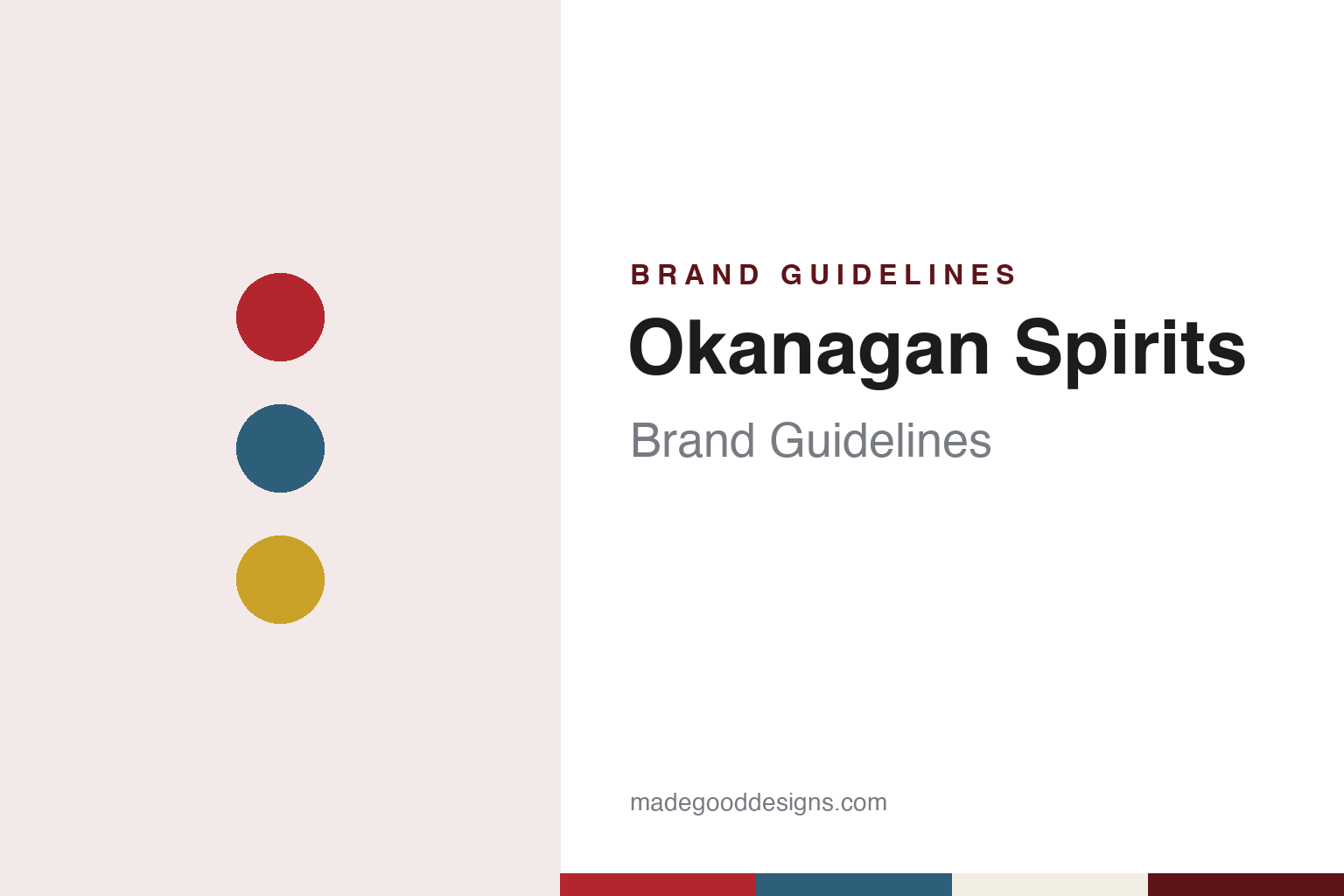
Two constants: an orchard red, lake blue and malt gold palette and a condensed poster sans register. Abstract homage — not an Okanagan Spirits product or mark; no label, logo or bottle is reproduced.
Fruit that the packing houses turned away
A Vernon distillery built on Okanagan orchards.
Okanagan Spirits Craft Distillery has been making spirits in Vernon, in British Columbia’s Okanagan Valley, since 2004. The company says the idea was to use the valley’s surplus fruit — perfectly good fruit discarded for cosmetic blemishes or size — on a European, Old World model in which farm by-products become fine spirits, and it describes itself as Western Canada’s original craft distillery.
Accounts of the founding differ. In July 2011 the Georgia Straight profiled the distillery’s “meister-distiller” Frank Deiter, a retired industrialist who had apprenticed at a German distillery and bought Okanagan fruit that others did not want. A 2023 profile by the Bartender Spirits Awards says Deiter founded the company in 2004 and resigned as its president and master distiller in 2011. Whisky Magazine, in a May 2022 article by Blair Phillips and Davin de Kergommeaux, wrote instead that in 2004 the Dyck family, fifth-generation Okanagan residents, established the distillery to make fruit spirits and build up whisky stocks.
By 2014 the Dycks were in charge. Food & Wine Trails magazine pictured Tony Dyck as owner and president in July 2014, and Whisky Magazine named his son Tyler Dyck as chief executive in 2022. The company calls itself a family-run distillery and says Dyck family ancestors once worked in the valley’s Fruit Union packinghouse.
Colour
Packinghouse beams, a 1918 photograph and a whisky label copied from 1924.
The distillery tells its story through rooms as much as through bottles. The company says its Vernon production site, opened in a 2015 move to a 16,000-square-foot building — Food & Wine Trails reported the groundbreaking in 2014 — has a wall-sized 1918 photograph of a crew picking apples at the Coldstream Ranch, a “moonshiner shack” built from beams salvaged from the old Fruit Union packinghouse, and what it calls North America’s tallest copper pot still. Its second location, opened in downtown Kelowna on Bernard Avenue in 2011, is styled as a “Prohibition Edition” boutique distillery and lounge, built, the company says, with reclaimed wood from the Laurel and Gellatly Bay packing houses and a countertop of recycled glass. Whisky Magazine described the Kelowna site as a small demonstration distillery.
The best-known label borrows from history. The company says its Laird of Fintry single malt takes its name and its label from a private bottling of Scotch commissioned in the early 1900s by the original “Laird” of the Fintry Estate on the west shore of Okanagan Lake, and that every detail is fashioned after an unopened bottle from 1924 that it holds at the Vernon distillery. The whisky, first barrelled in 2008 according to the company, is sold by lottery; the first draw was in 2013, and Food & Wine Trails wrote the following year that the quantity had been so small that buyers had to win a lottery just for the right to purchase a bottle. The company says the annual draw now attracts thousands of entries. The company also says the whisky is finished in French oak barrels from Quails’ Gate, the West Kelowna winery.
Other names point to the range’s breadth. The Georgia Straight reported in 2011 on Taboo absinthe, aquavit, eaux de vie and a sea-buckthorn liqueur, noting that the distillery had released more than 20 products in its first seven years and that a malt whisky and an Okanagan gin were on the way. The company dates Taboo to 2007 and calls it Canada’s first genuine absinthe. Its bourbon-style corn whisky, which Whisky Magazine described as matured in virgin oak, is spelled without vowels as BRBN, with a cask-strength BLK BRBN alongside.
Typography
Design and documentation.
The six brands in this group are all Canadian whisky names: Pike Creek, Shelter Point, Still Waters, Dillon’s, Okanagan Spirits and Canadian Mist. They range from labels that belong to large international drinks groups to independent distilleries in Ontario and British Columbia, and a single bottle can be sold everywhere from a provincial liquor store to a bar rail on the other side of the border.
A whisky brand’s identity is usually carried less by the spirit itself than by a label, a name and the place it promises, because the company behind the name may have changed hands, the distillery may have changed owners, and the bottling may happen somewhere other than where the whisky was made. That makes the questions behind each name worth asking plainly: who started it, who owns it now, and where its whisky is actually distilled, aged and bottled.
Each guide separates what independent sources record from what the company says about itself — its founding story, its owners over time, where its whisky is made and how its labels have changed — and marks plainly what rests only on the company’s own word.
Aa
A condensed poster sans for a brand that leans on packinghouse and Prohibition-era history. (Specimen set in Oswald, a sans-serif STAND-IN; NOT the Okanagan Spirits logo.)
Okanagan Spirits
A craft distillery measured against the national industry.
The range kept widening. Food & Wine Trails reported in 2014 that the distillery had 25 products, all made with British Columbia ingredients, and had just released a hopped whisky, aged five years in barrel, as part of a “Final Proof Master Distiller Series.” The company now says it uses only B.C. grain and fruit, ferments and distils on site, and does not chill-filter its whisky, so that wisps can appear in the bottle when it is cold. It also runs a members’ whisky club and makes private-label whisky for companies and events, and it sells whisky casks directly to customers.
National recognition followed. The Canadian Whisky Awards announced in January 2022 that Okanagan Spirits, of Vernon, had earned notice as Artisanal Distillery of the Year; the same release named Diageo’s Gimli plant in Manitoba, the home of Crown Royal, as 2022 Distillery of the Year. Whisky Magazine included the distillery that year in a tour of what it called Canada’s Okanagan whisky trail.
For a design guide, Okanagan Spirits shows how a regional distillery can build its identity from local history — orchard fruit, packinghouse timber, a 1918 harvest photograph and a whisky label modelled on a 1924 bottle — and keep it consistent from the Vernon still house to the Kelowna lounge. Compare Quails’ Gate, the winery whose barrels finish the Laird of Fintry, and Crown Royal, the Gimli-made Canadian whisky. For this guide we use orchard red, lake blue and malt gold with a condensed sans, an unofficial interpretation; no product or logo is reproduced.
Explore & save
Keep Okanagan Spirits’s identity on hand — save it to a board in the Made Good inspiration library.
Okanagan Spirits identity set
Pin the Okanagan Spirits orchard red, lake blue and malt gold palette and the condensed poster sans register to your own board.