Minnesota Timberwolves Brand Guidelines
A wolf, a tree line and a star for the north woods.
Aa
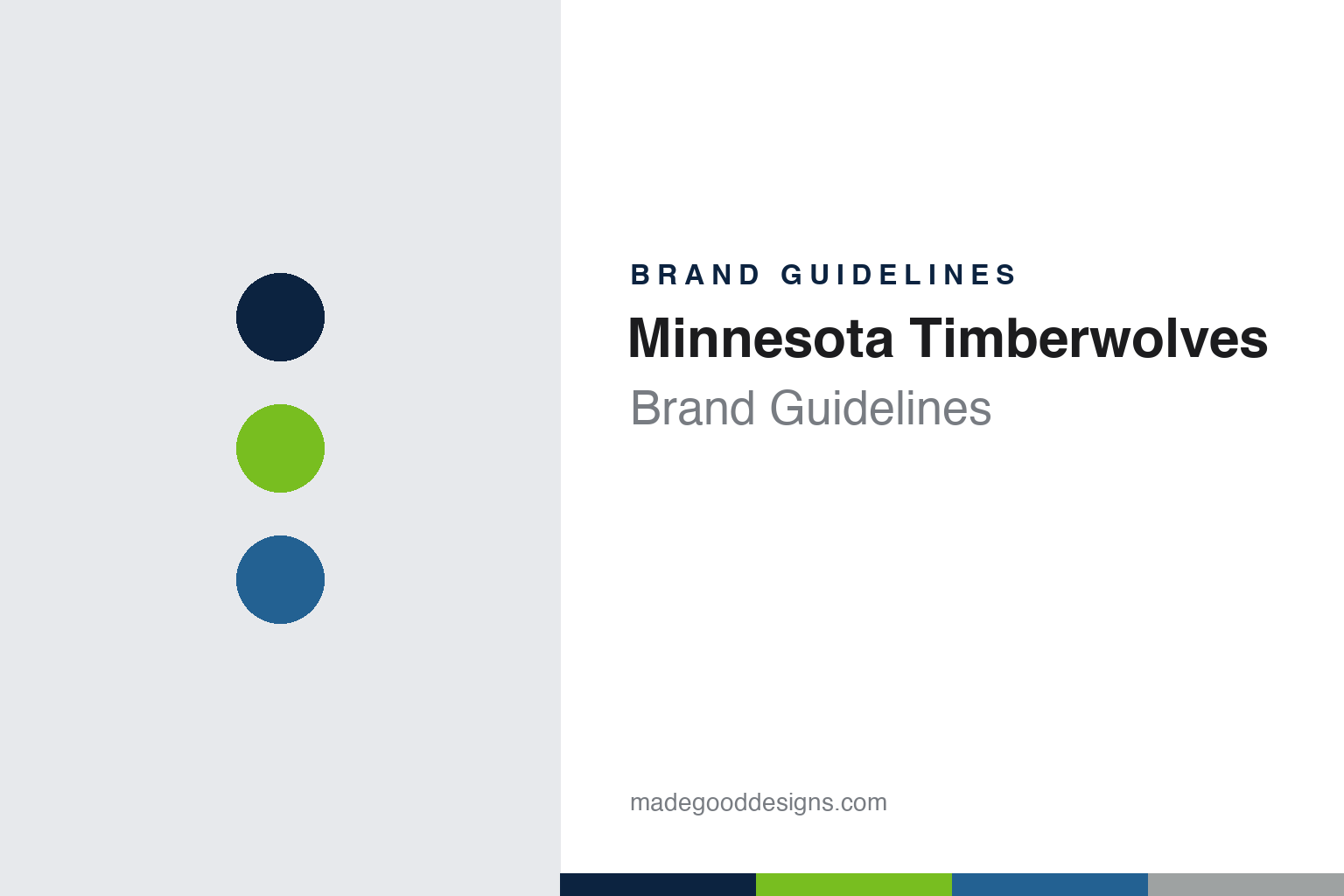
Two constants: a midnight blue, aurora green and lake blue palette and a condensed northern sans register. Abstract homage — not a Minnesota Timberwolves mark; no logo, jersey or wordmark is reproduced.
A name from the north woods
A state-wide contest, two finalists and 842 city councils.
Professional basketball had been away from the Twin Cities for almost three decades when the Minnesota Timberwolves arrived. English Wikipedia says the Minneapolis Lakers left for Los Angeles in 1960, and that two short-lived American Basketball Association clubs, the Minnesota Muskies and the Minnesota Pipers, filled part of the gap in the late 1960s. The NBA granted one of its new expansion franchises to Harvey Ratner and Marv Wolfenson on 22 April 1987, with play to begin in the 1989–90 season.
The name came before the franchise. A team history page on the Timberwolves’ website, preserved by the Wayback Machine, describes a “Name the Team” contest that drew suggestions from fans across Minnesota and beyond, sorted into categories that ran from animals and fish to outer space. Two finalists emerged, Timberwolves and Polars, and the club handed the final choice to the 842 city councils around the state. Wikipedia dates the finalists to December 1986 and says the club was officially named the Minnesota Timberwolves on 23 January 1987, a few months before the league confirmed the franchise. The animal was a local choice, the grey wolf of the state’s northern forests.
The club played its debut season in 1989 at the Hubert H. Humphrey Metrodome, Wikipedia says, before moving in 1990 into Target Center in downtown Minneapolis, which has been its home since. The early look was simple and bright. Wikipedia says the inaugural uniforms read “Wolves” across the chest, with blue road jerseys carrying green lettering and white home jerseys carrying blue lettering outlined in green, and that the work was led by the head designer Brian Mulligan. A green alternate was planned and dropped. The club said in 2017 that its new palette kept this heritage of blues and greens.
The founding owners did not stay long. Wikipedia says Ratner and Wolfenson came close to selling the team to a group in New Orleans in 1994 before the move was rejected by NBA owners. Glen Taylor then led the group that bought the club. Writing for ESPN on 2 April 2025, Shams Charania and Brian Windhorst confirmed that Taylor had bought the Wolves in 1994, keeping the team from a possible relocation to New Orleans. The club’s mascot is Crunch the Wolf; the team’s own website tells a story of a wolf from the northern wilderness who migrated south to the Twin Cities to follow the new club.
Colour
Black, a snarling wolf and a forest of pines.
A bigger redesign arrived in the mid-1990s. Wikipedia says that in 1996 the club changed its logo and colour scheme, adding black to the palette and replacing the original mark with one showing a snarling wolf looming over a field of trees. The jerseys switched from “Wolves” to the full name “Timberwolves” in a different typeface, the blue darkened, and grey joined the scheme. The same season brought a parquet floor to Target Center. A black alternate uniform followed for 1997–98, and Wikipedia says the set stayed in use until 2007–08. Wikipedia says the black tree-patterned set returned as a “Classic” uniform in 2018–19 and again in a later season, paired with an updated version of the 1996–2008 parquet court.
The tree line was refined rather than replaced in 2008. A team release dated 25 June 2008, preserved by the Wayback Machine, said the primary logo, “featuring the wolf’s head amidst the tree line,” had been given a facelift for the club’s 20th season, together with a redesigned secondary logo. The release credited the adidas design group, which added white to the wolf’s head and gave the tree line and the “Minnesota Timberwolves” script a cleaner, sleeker shape, and it said the aim was to let the familiar logo evolve rather than replace it. Wikipedia says the matching uniforms put “Minnesota” on the road jersey and “Wolves” on the home jersey, echoing the early years, and made their debut at a preseason game in Chicago on 14 October 2008. A modified set in 2010 removed green from the collar, jersey and shorts, and a black alternate returned that November.
The club also leaned on its anniversaries and its city. Wikipedia says the original blue uniforms came back for the 2009–10 season to mark the franchise’s 20th year, and that the Timberwolves have worn throwbacks honouring the Muskies and Pipers. When the Nike era began, the “City” editions became a running series about Minnesota. Writing for NBC Sports’ ProBasketballTalk on 20 November 2019, Dan Feldman reported that the Timberwolves’ new sky blue alternate uniforms looked very much like those of the old Minneapolis Lakers, whose history now belongs to the Los Angeles franchise. Wikipedia says the club described that set as a nod to the waters of the Mississippi River and the Twin Cities.
Other City designs followed the same idea of place. Wikipedia lists a dark purple 2018 uniform inspired by Prince’s 1984 album Purple Rain, brought back for 2025–26; a 2020–21 set built around the North Star, with a midnight black base, aurora green trim and “MINN” across the chest; a 2021–22 mashup that combined the royal blue of 1989, the tree accents of 1996 and both the original and current logos on the shorts; and later sets drawn from Minnesota’s summer lakes and frozen winter landscape.
Typography
Design and documentation.
A team name is often the first piece of a basketball identity to be settled, and some clubs hand that choice to the public. A name-the-team contest or regional vote gives residents a sense of ownership before a game is played, and the shortlist usually leans on local wildlife, weather, landscape or industry so the name can be drawn as well as spoken. Once chosen, the name sets the direction for everything that follows: the animal or symbol in the primary logo, the colours and the tone of the wordmark.
Rebrands tend to arrive in cycles. A club may simplify an older, more illustrated mark into a flatter emblem that reproduces cleanly on screens, shorts and court paint, then add alternate logos, monograms and secondary badges that can stand in where space is tight. Arena names add another layer, because naming rights change hands over the years and the building’s signage, centre-court graphics and ticketing all have to follow. Colours and typefaces often stay steadier than either, carrying the identity from one logo and one arena name to the next.
Aa
A condensed northern sans — the register of a trail sign and a lake-country map. (Specimen set in Oswald, a condensed sans STAND-IN; NOT the Minnesota Timberwolves logo or wordmark.)
Minnesota Timberwolves
A howling wolf, a new palette and a change of owner.
The current primary logo dates from 11 April 2017. A team release issued that night, preserved by the Wayback Machine, said the mark was unveiled at halftime of the season’s final home game, against Oklahoma City, and would be used from the 2017–18 season. The release said it had been developed over the previous year by Timberwolves ownership, team executives, the NBA and the Mississippi-based designer Rodney Richardson of RARE Design. It described a wolf head shown howling, explaining that the howl keeps a pack together, and a North Star standing for Minnesota and for a team following true north. The new palette kept the club’s heritage of blues and greens with fresh names: midnight blue, aurora green, lake blue, moonlight grey and frost white. Richardson, quoted in the release, linked those shades to the Northern Lights, a midnight forest and a frozen northern city.
Uniforms followed under the league’s new Nike supply deal. Wikipedia says the four 2017–18 designs all used “Wolves” for the team name: a white Association uniform and a navy Icon uniform revealed on 10 August 2017, a neon green Statement uniform revealed on 15 September and a grey City uniform revealed on 27 December. A dark grey Statement set with the full name “Timberwolves” replaced the neon green in 2022–23, with the green kept as trim. Wikipedia says that before the 2026–27 season the club introduced new logos and uniforms that revisited the late-1990s era, basing its white and blue uniforms loosely on the 1989–1996 set, drawing a black Statement uniform from the tree-patterned black alternate, and adjusting the logo to the classic blue and green with a tree motif.
Ownership has changed in the same years. Wikipedia says Taylor agreed in April 2021 to sell the club, together with the WNBA’s Minnesota Lynx, to the entrepreneur Marc Lore and the former baseball player Alex Rodriguez in stages. ESPN reported on 2 April 2025 that, after Taylor called off the sale in March 2024 and an arbitration panel ruled for the Lore–Rodriguez group in February 2025, Taylor had agreed to the group acquiring the whole of both teams and would not appeal; Wikipedia says the NBA Board of Governors approved the sale in June 2025. Lore and Rodriguez have owned the Timberwolves since 2025.
For a design guide, the Minnesota Timberwolves show how a club can keep one colour idea, blue and green, while redrawing the animal and the landscape around it every decade or so. Compare the Minnesota Vikings, who share the state’s market, and the NBA, which granted the franchise in 1987. For this guide we use midnight blue, aurora green and lake blue with a condensed sans, an unofficial interpretation; no product or logo is reproduced.
Explore & save
Keep Minnesota Timberwolves’s identity on hand — save it to a board in the Made Good inspiration library.
Minnesota Timberwolves identity set
Pin the Minnesota Timberwolves midnight blue, aurora green and lake blue palette and the condensed northern sans register to your own board.