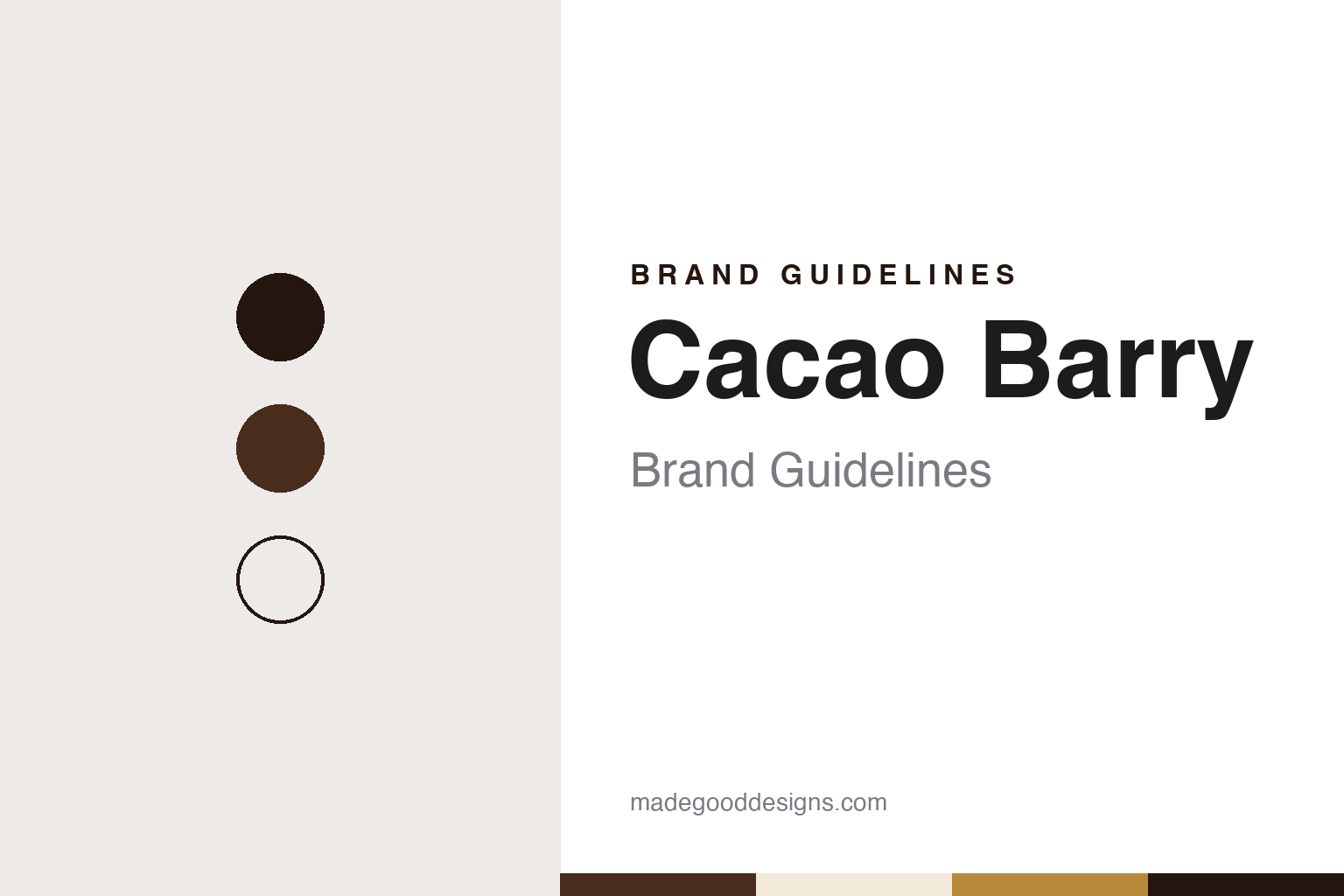
Cacao Barry Brand Guidelines
The 1842 French couverture brand built for the pastry kitchen.
Aa
Two constants: a Cacao Barry cocoa, gold and cream palette and a Pâtisserie serif register. Abstract homage — not a Cacao Barry product or mark; no packaging, logo or wordmark is reproduced.
Charles Barry
A tea and coffee merchant with an eye on cacao.
Cacao Barry dates itself to 1842 and to Charles Barry, whom French and English Wikipedia describe as an Englishman. The company says Barry started in business with tea and coffee, travelled to Africa “to seek out a selection of cacao beans,” and founded the business in Paris; French Wikipedia instead says that after a journey to Africa he conceived a chocolate for connoisseurs in London. The accounts agree on the date and the founder but not on the city, so we give both.
The brand’s industrial home came later. French Wikipedia’s article on Hardricourt, a small town on the Seine north-west of Paris, says the first Cacao Barry chocolate factory was set up there in 1920, and that the plant, by then belonging to the Swiss group Barry Callebaut, employed 110 people in 2017. The company’s own timeline records an acquisition by the Lacarré family in 1923, after which, it says, Cacao Barry was “catapulted into the international arena” and invested in cocoa plantations and factories in Africa and South America. It dates its first couverture chocolates — the high-cocoa-butter chocolate that professionals melt and temper — to 1952, with a range “exclusively dedicated to craftsmen.”
Ownership changed again before the merger that defines the brand today. French Wikipedia says the Sucres et Denrées group took a stake in 1982, and English Wikipedia says the holding company Société Centrale d’Investissement gained control in 1992, passing 49% of the capital to an investment company in the group of the financier Albert Frère. French Wikipedia also records a second French factory at Louviers, in Normandy, and a plant at Pennsauken, New Jersey, in the United States.
Colour
Built for the pastry kitchen.
Cacao Barry sells mainly to professionals — pastry chefs, chocolatiers and bakers — rather than to shoppers, and its timeline reads as a list of tools for them. The company says it set up its “Centres de Perfectionnement,” the forerunner of today’s Chocolate Academy training centres, in 1973; launched a co-branded range with the pâtissier Gaston Lenôtre in 1974; and in 1976 became “the first brand to introduce moulds for craftsmen.”
Its best-known format is the Pistoles, small discs of couverture that can be weighed and melted without chopping a block. The company dates them to 1988 and calls Cacao Barry the first brand to offer chocolate in that shape; French Wikipedia gives 1990. Other products it lists with dates include Pailleté Feuilletine, the crisp wafer flakes used in pastry, from 1989; the Origines range of single-country chocolates from 1994; Mycryo, a powdered cocoa butter used for tempering, from 2003; a single-plantation range from 2006; and Or Noir, a service that lets chefs develop a chocolate under their own name, from 2007.
More recent entries move from products toward cocoa itself. The company says it identified ferments in plantation environments in 2013, leading to a process it calls Q-Fermentation; joined the group’s Cocoa Horizons sustainability programme in 2020; launched Evocao, which it describes as chocolate “made with 100% pure cacaofruit,” in 2021; and in 2025 introduced Matsiro, a chocolate from Madagascar made with three ingredients. In 2022 it began a ranking of pastry shops with La Liste, the French restaurant guide. It also names the World Chocolate Masters, a competition for professionals, among its creations, dating it to 2005.
Typography
Couverture and the professional kitchen.
The seven brands in this group all make chocolate, and they come from three countries: Cacao Barry from France, Callebaut from Belgium, and Venchi, Caffarel, Majani, Guido Gobino and Slitti from Italy. They stand on either side of one of the oldest divides in the chocolate trade: between the chocolate that other people work with and the chocolate that is sold finished.
On one side is industrial couverture, chocolate made with enough cocoa butter to melt, temper and coat well, and sold in blocks, callets and pistoles to pastry chefs, chocolatiers, bakers and food manufacturers. A couverture brand often reaches the public second-hand, through a dessert, a bonbon or a filled biscuit, and its identity has to work on a sack in a professional kitchen as much as on a shelf. On the other side are confectionery houses, the Italian ones especially, whose names are on the box itself: pralines, gianduja, hazelnut spreads and filled bars, sold in their own shops and in fine-food stores, where the wrapper, the shop and the family name carry the brand.
Each guide separates what independent sources record from what the company says about itself — who founded it, who owns it now, where its beans come from and where its chocolate is made — and marks plainly what rests only on the company’s own word.
Aa
A pâtisserie serif — French, classical and warm. (Specimen set in Playfair Display, a serif STAND-IN; NOT the Cacao Barry logo.)
Cacao Barry
A French brand inside a Swiss group.
Since 1996 Cacao Barry has belonged to Barry Callebaut, the company formed that year when it merged with the Belgian couverture maker Callebaut. The group is based in Zürich and has been listed on the SIX Swiss Exchange since 1998; English Wikipedia says that in May 2024 its largest shareholder was Jacobs Holding, with 30.1%. German Wikipedia names Cacao Barry, Callebaut and Carma among the group’s best-known brands.
Where the chocolate is made is stated less plainly than for its Belgian sister brand. Cacao Barry presents itself as French — its website carries the line “Fondée en 1842” and says it shares “the French know-how” — and French Wikipedia ties it to the Hardricourt factory, which it credits with between 60,000 and 70,000 tonnes of chocolate a year, depending on the article. On the pages we checked, the company does not say which of the group’s plants makes each product, so we do not attribute every item to France.
The company says it launched new packaging in 2015 “to ensure the protection of cacao flavours and highlight cacao knowledge”; we found no published account of who designed it. The same year it started CacaoCollective, an online community for chefs, and in 2019 it published The Pastry Alphabet, a collection of recipes it roots in French pastry. It sums up its purpose in three words: “Create. Share. Grow.”
For a design guide, Cacao Barry shows how a supplier to professionals can build a brand from formats, training and a founding date rather than from a shop-shelf bar. Compare Callebaut, its sister brand in the same group, and Valrhona, another French couverture house. For this guide we use cocoa brown, gold and cream with a serif, an unofficial interpretation; no product or logo is reproduced.
Explore & save
Keep Cacao Barry’s identity on hand — save it to a board in the Made Good inspiration library.
Cacao Barry identity set
Pin the Cacao Barry cocoa, gold and cream palette and the Pâtisserie serif register to your own board.