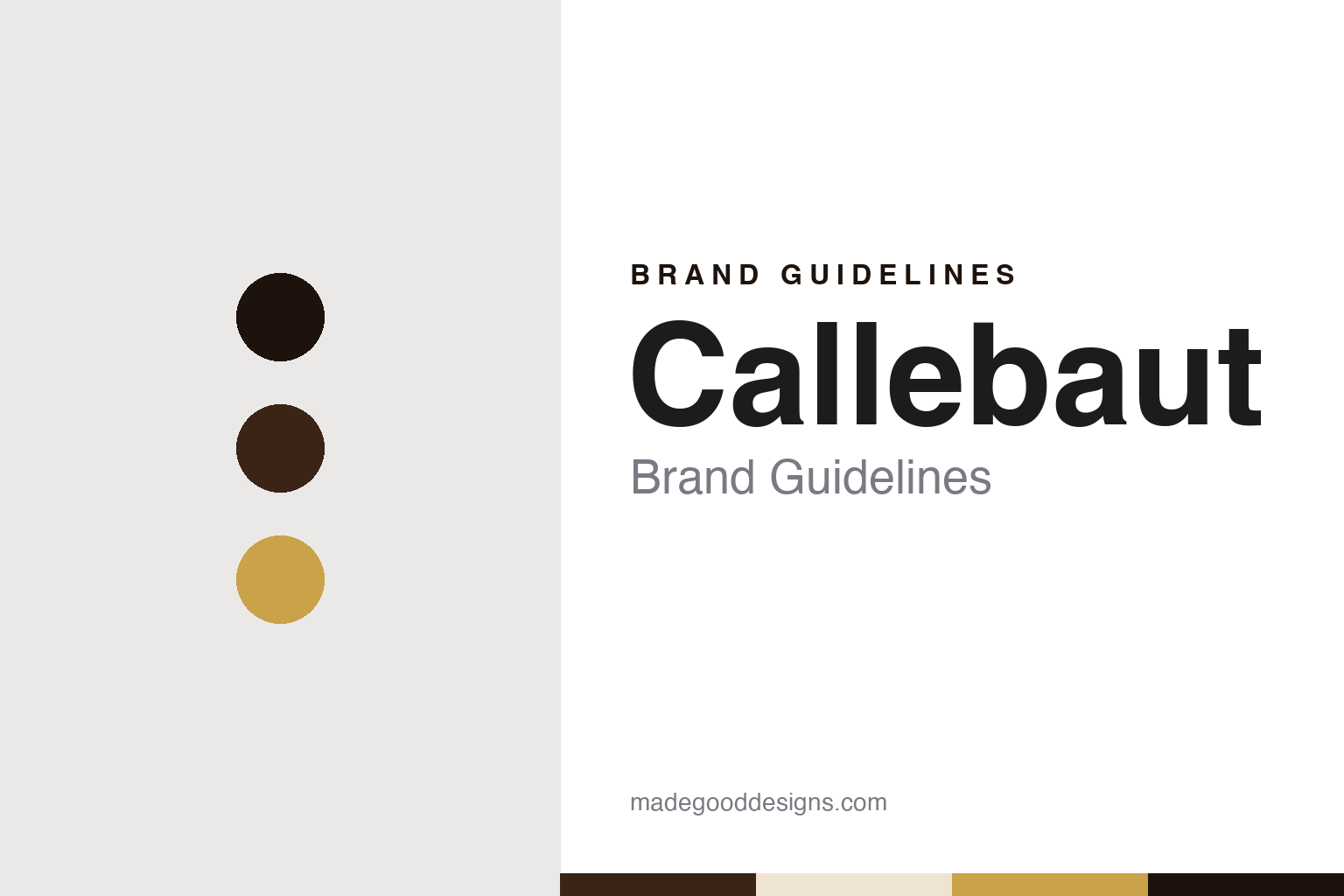
Callebaut Brand Guidelines
The Wieze couverture maker that turned a recipe number into a signature.
Aa
Two constants: a Callebaut dark chocolate, gold and cream palette and a Workshop sans register. Abstract homage — not a Callebaut product or mark; no packaging, logo or wordmark is reproduced.
Wieze
A brewing family’s village in East Flanders.
Callebaut comes from Wieze, a village in the Dender valley between Aalst and Dendermonde in East Flanders, Belgium, which has been part of the municipality of Lebbeke since 1977. English Wikipedia says the business began as a brewery founded there by Eugenius Callebaut in 1850. The family was prominent locally: Dutch Wikipedia’s list of the village’s mayors includes three Callebauts between 1848 and 1932.
The chocolate side dates from 1911. The company says Octaaf Callebaut, “grandson of a brewer,” worked on his first recipe in secret, and that the first chocolate was sold in the surrounding villages under the Salvator name, after the patron saint of Wieze. It says the recipes known today as 811, 823 and W2 were refined from 1918, and that a handwritten sheet from 1935 records milk chocolate recipe no. 845 — numbers the brand still uses to name its products.
The turn to couverture — chocolate made for professionals to melt, temper and mould — came early, though sources disagree on the year. The company says the family decided after the First World War to concentrate on couvertures for Belgian chocolatiers, and dates that to 1920; English and German Wikipedia give 1925, and Dutch Wikipedia 1952. English Wikipedia says Octaaf’s daughter Marie and his nephew Charles took over the company in 1945. The company credits Charles Callebaut with a method, in 1958, of delivering chocolate in liquid form to manufacturers, saving them from re-melting blocks, and dates its first exports to 1965.
Colour
Callets, the College and ruby.
Callebaut sells largely in bulk, to chefs, chocolatiers and food makers. Its signature format is the Callets, small drops of couverture introduced in 1988, which the company calls the world’s first; in the same year it opened the Callebaut College, a training school it describes as the predecessor of its Chocolate Academy centres. A flagship academy opened in Wieze in 2014.
The range widened after the merger. Its core range is sold as “Finest Belgian Chocolate,” and in 2012, the company says, it launched Growing Great Chocolate, a programme under which part of the proceeds of each pack goes to sustainable cocoa farming and community projects in West Africa. The company dates its first origin couvertures, named after cocoa regions such as Arriba, Java and São Tomé, to 2006, and marked its centenary in 2011. In 2019, it says, it reworked its main recipes and began making its cocoa liquor from “traceable and 100% sustainable cocoa beans,” bought through cooperatives in Côte d’Ivoire, Ghana and Ecuador that take part in the group’s Cocoa Horizons programme; in 2021 it launched NXT, a dairy-free range. We give those as the company’s claims.
The best-documented product of recent years came from the group. English Wikipedia says Barry Callebaut introduced ruby chocolate, pink without added colouring according to the company, on 5 September 2017, after beginning development in 2004; the group calls it a fourth type of chocolate after dark, milk and white, a description English Wikipedia says industry experts have debated. Callebaut’s own timeline dates ruby’s arrival in its range to 2018, the year, English Wikipedia says, that Nestlé’s Japanese arm used it in a KitKat — the first global brand to do so.
Typography
Couverture and the professional kitchen.
The seven brands in this group all make chocolate, and they come from three countries: Cacao Barry from France, Callebaut from Belgium, and Venchi, Caffarel, Majani, Guido Gobino and Slitti from Italy. They stand on either side of one of the oldest divides in the chocolate trade: between the chocolate that other people work with and the chocolate that is sold finished.
On one side is industrial couverture, chocolate made with enough cocoa butter to melt, temper and coat well, and sold in blocks, callets and pistoles to pastry chefs, chocolatiers, bakers and food manufacturers. A couverture brand often reaches the public second-hand, through a dessert, a bonbon or a filled biscuit, and its identity has to work on a sack in a professional kitchen as much as on a shelf. On the other side are confectionery houses, the Italian ones especially, whose names are on the box itself: pralines, gianduja, hazelnut spreads and filled bars, sold in their own shops and in fine-food stores, where the wrapper, the shop and the family name carry the brand.
Each guide separates what independent sources record from what the company says about itself — who founded it, who owns it now, where its beans come from and where its chocolate is made — and marks plainly what rests only on the company’s own word.
Aa
A workshop sans — sturdy, numeric, practical. (Specimen set in Archivo, a sans STAND-IN; NOT the Callebaut logo.)
Callebaut
A Belgian brand in a Zürich group.
The family did not keep the business. English and German Wikipedia say Callebaut was bought in 1981 by Interfood, part of the Swiss Tobler-Suchard confectionery business, which the entrepreneur Klaus Jacobs brought under his full control in 1983; German Wikipedia says Jacobs kept Callebaut when his confectionery group merged into what became Kraft Jacobs Suchard. In 1996 Callebaut merged with the French Cacao Barry to form Barry Callebaut, based in Zürich and listed on the SIX Swiss Exchange since 1998. English Wikipedia says the group had 61 production sites in 2019 and that in May 2024 Jacobs Holding owned 30.1% of it. A separate business, Chocolaterie Bernard Callebaut in Calgary, Canada, was opened by a family heir, Bernard Callebaut, who moved there in 1982; Dutch Wikipedia notes that it has no connection with Barry Callebaut.
On where its chocolate is made, Callebaut is specific. It says it remains “a 100% Belgian brand – still crafting all its Finest Belgian Chocolate in Belgium from bean to bar.” English Wikipedia describes the group’s plant at Wieze as the largest chocolate factory in the world, producing around 350,000 tonnes a year. In June 2022 salmonella was found in a batch there, traced to a delivery of soy lecithin, and production stopped; English Wikipedia says it resumed gradually in August and returned to full capacity by October.
For a design guide, Callebaut shows how a brand can lean on a place and a number — Wieze and recipe 811 — to stand apart inside a large group. Compare Cacao Barry, its French sister brand, and Pierre Marcolini, a Belgian chocolatier. For this guide we use dark chocolate, gold and cream with a sans, an unofficial interpretation; no product or logo is reproduced.
Explore & save
Keep Callebaut’s identity on hand — save it to a board in the Made Good inspiration library.
Callebaut identity set
Pin the Callebaut dark chocolate, gold and cream palette and the Workshop sans register to your own board.