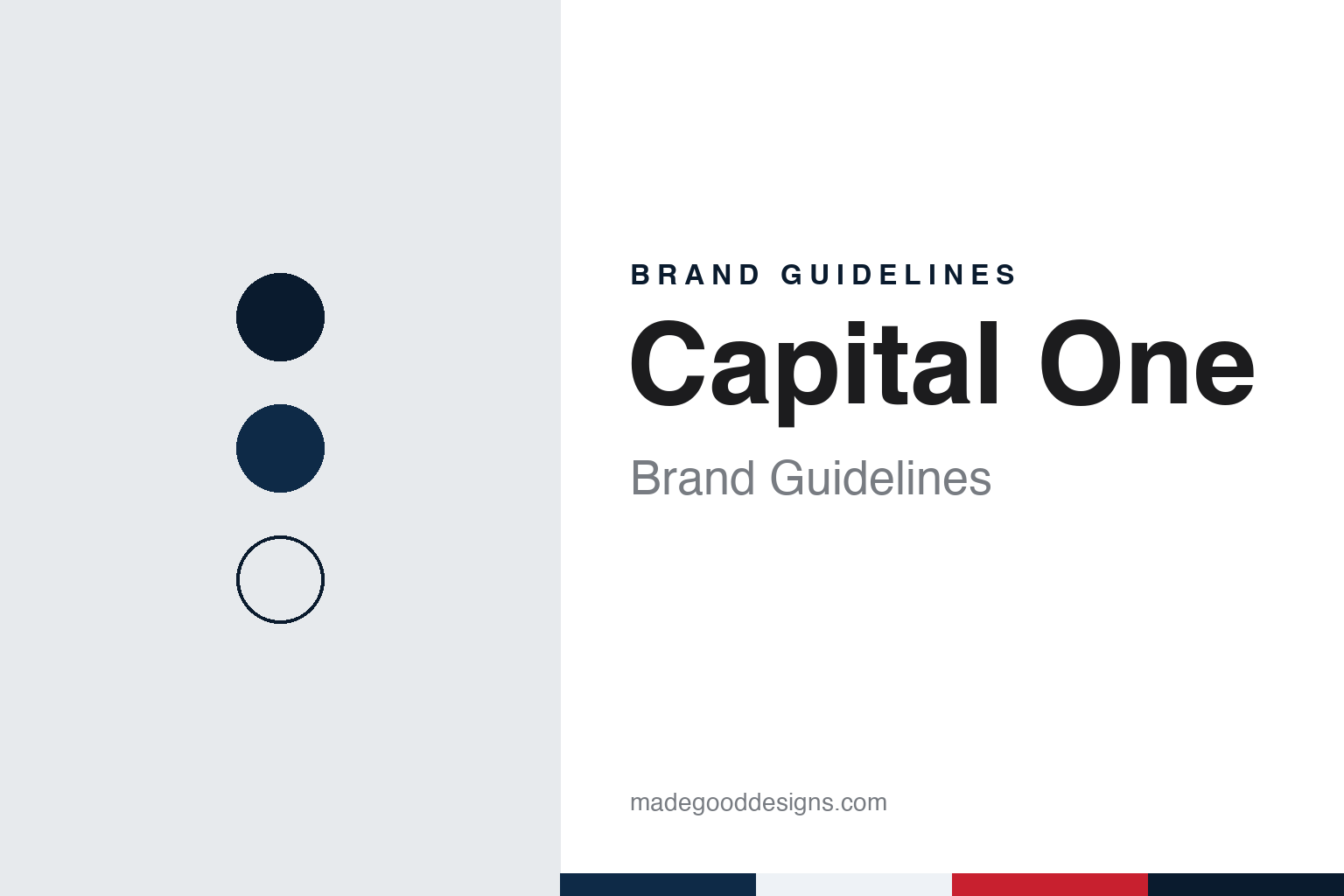
Capital One Brand Guidelines
The Signet spin-off that asked America what was in its wallet.
Aa
Two constants: a Capital One navy and red palette and a Clean sans register. Abstract homage — not a Capital One product or mark; no card, logo or sign is reproduced.
Inside Signet
Two consultants and a regional bank.
Capital One did not begin as a bank of its own. According to the International Directory of Company Histories (volume 52, published by St. James Press in 2003), Richard D. Fairbank and Nigel W. Morris began building it in 1988 inside Signet Bank, a regional bank based in Richmond, Virginia. The two had worked together as consultants at Strategic Planning Associates, later renamed Mercer Management Consulting.
Their idea, the same history says, was to treat credit cards as a problem of information: to tailor card offers and terms to individual customers by joining marketing, credit, risk, operations and technology in one decision-making structure. The directory says the pair pitched the plan to many national banks before Signet agreed to let them rebuild its card business, which dated back to the early 1950s. It records that the effort was nearly abandoned during the property-market troubles of the late 1980s, and that the balance-transfer offer, introduced in 1991, kept it alive.
The card unit then became a company in its own right. On July 28, 1994, The New York Times reported that the Signet Banking Corporation of Richmond had said it was spinning off its credit card business into a separate company, would sell a minority of the new company’s shares to the public and would distribute the rest to Signet’s stockholders, and that the new company would seek a New York Stock Exchange listing.
The first name chosen for it was not Capital One. The International Directory of Company Histories says the unit was called Oakstone Financial Corporation, with Fairbank as chairman and chief executive. A public offering followed in late 1994, and the separation from Signet was completed in February 1995, when the company was renamed Capital One Financial Corporation. English Wikipedia, citing the 1994 New York Times report, adds that Morris was named chief operating officer.
Colour
A slogan built to be remembered.
For its first years Capital One was known mostly through the post, as a sender of card offers. The International Directory of Company Histories says that by 1999 many customers did not know Capital One was a company separate from the Visa and Mastercard names printed on its cards, and that it began a concerted effort to build its own name in 2000.
That effort produced the line “What’s in your wallet?” The same history says the advertisements began appearing on television as part of the push to be seen as a national brand, alongside local promotions such as plastic cards handed to commuters in Chicago.
The campaign used well-known faces. English Wikipedia says the actor Alec Baldwin was the spokesperson for Capital One’s television advertising between 2010 and 2013, citing a HuffPost report.
The company also grew beyond cards. English Wikipedia records that it bought the New Orleans bank Hibernia National Bank in 2005, citing American Banker, and that ING Group announced the sale of its ING Direct business in the United States to Capital One in June 2011. The bank has also run branches in the form of cafés; English Wikipedia illustrates one, a Capital One Café in Chicago’s Hyde Park.
Its expansion abroad came early. The International Directory of Company Histories dates the start of the company’s business in Canada and the United Kingdom to 1996, and says that in mid-1996 it received federal approval to set up a savings institution, Capital One FSB, which, among other things, allowed it to keep deposits and lend them out. The same history records that analysts quoted by American Banker saw the company’s information-based approach as one it could apply to financial products beyond credit cards.
Its headquarters is in northern Virginia. The Federal Reserve Board, in an April 2025 announcement, described the company as Capital One Financial Corporation, of McLean, Virginia.
Typography
Banks, signs and symbols.
Bank identity lives in a narrow set of places, and each one sets its own constraints. Exterior signage has to read from a moving car or across a street, so marks are usually reduced to a short name or initials, a single colour field and a simple geometric symbol that can be lit from behind or cut from metal. Inside a branch, the same identity is translated into carpet, wall graphics, counter fronts, queue barriers and printed leaflets, where a strong brand colour is often used as an accent rather than a full flood.
Payment cards bring a different discipline. The design has to share a small rectangle with a chip, a card-network mark, embossed or printed numbers and a contactless symbol, so the bank’s own mark is often pushed to a corner or set as a quiet pattern. App icons compress the system further still: a rounded square a few millimetres wide, where a monogram or symbol on a flat colour has to stand out on a crowded phone screen. Reading a bank brand well means following one mark through all four of these settings and noticing what changes and what is kept constant.
Aa
A clean sans — “What’s in your wallet?” (Specimen set in Inter Tight, a sans STAND-IN; NOT the Capital One logo.)
Capital One
A swoosh over the name.
Capital One’s current mark pairs its name with a curved stroke. English Wikipedia says the company introduced its blue and red “swoosh” logo in 2008, together with a large marketing campaign, and, citing Bloomberg in 2017, notes that the logo resembled that of Credit One Bank, which had adopted a similar design in 2006, and that some consumers confused the two companies. The palette in this guide follows that pairing of a dark blue with a red.
The mark has also been played with. English Wikipedia, citing the Washington television station WJLA, says that when the Washington Capitals reached the 2018 Stanley Cup Final, Capital One temporarily replaced the word “Capital” in its logo with the hockey team’s own script.
In 2024 Capital One agreed to buy Discover Financial Services, the card company of Riverwoods, Illinois; the International Directory of Company Histories describes the Discover Card of the mid-1980s as a product of Sears, Roebuck and Co. On April 18, 2025, the Federal Reserve Board announced that it had approved Capital One’s application to merge with Discover and thereby acquire Discover Bank, of Greenwood, Delaware. On the same day the Board announced a consent order with Discover over interchange fees charged from 2007 through 2023, and said Capital One had committed to comply with that action. The approval brought a second card name, Discover, under the same owner as Capital One.
For a design guide, Capital One shows how a business that began as a unit inside another bank built a name through one memorable question, and then through a simple mark that it was willing to adapt for a local sports team. Compare Chase, whose octagon dates from 1961, and Citi, whose arc was drawn by Paula Scher; both show how a bank name can be carried by a single abstract shape. For this guide we use a navy, a red and a card white with a sans, an unofficial interpretation; no product or logo is reproduced.
Explore & save
Keep Capital One’s identity on hand — save it to a board in the Made Good inspiration library.
Capital One identity set
Pin the Capital One navy and red palette and the Clean sans register to your own board.