Corona Brand Guidelines
Colombia’s table chocolate from the Compañía Nacional de Chocolates.
Aa
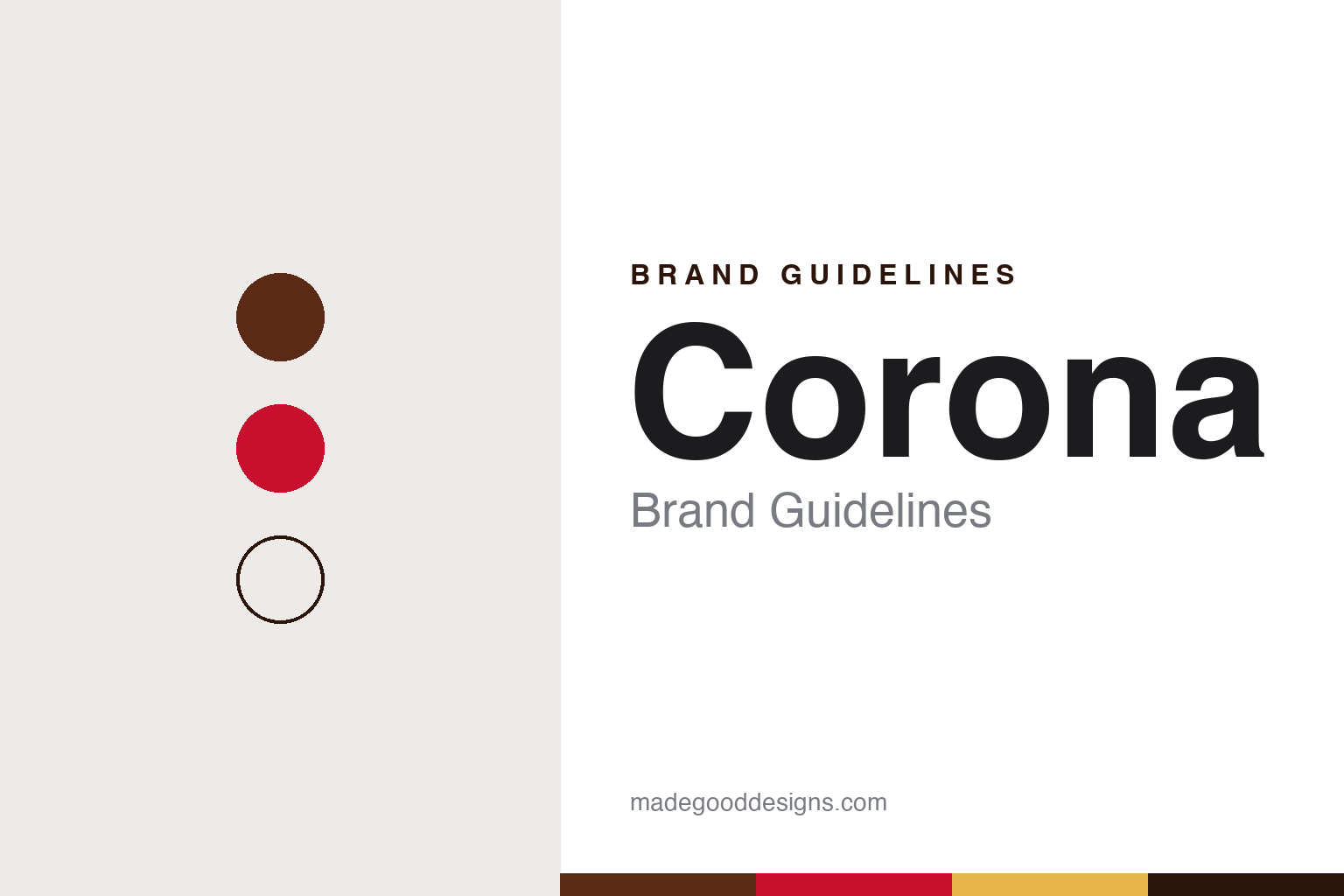
Two constants: a cacao brown, crown red and crown gold palette and a warm display serif register. Abstract homage — not a Corona product or mark; no pack, logo or bar is reproduced.
Cruz Roja to Nutresa
A Medellín chocolate company and the group it became.
Chocolate Corona is a Colombian table chocolate: chocolate sold in bars for making a hot drink. It is not a company in its own right. Its recent websites describe it as a brand of the Compañía Nacional de Chocolates, and give its home as Medellín. The Corona name is shared with unrelated products: it has nothing to do with Corona, the Mexican beer of Grupo Modelo, which English Wikipedia lists among the brands that Bavaria imports into Colombia, or with Chocolates La Corona, a Mexican confectioner that Spanish Wikipedia says Grupo Bimbo bought in 2005.
The company behind it was founded in Medellín on 12 April 1920, Spanish Wikipedia says, as the Compañía Nacional de Chocolates Cruz Roja; English Wikipedia adds that the name later became Compañía Nacional de Chocolates, S.A. In 1933 it bought a stake in the biscuit maker Noel and created the Sello Rojo coffee brand, according to Spanish Wikipedia, and from there it grew into a food group. Colcafé, a coffee company, followed in 1950 and the meat-products maker Zenú in 1962.
In 2003 the chocolate company and the Noel biscuit company were merged into Inversiones Nacional de Chocolates S.A., and in March 2011 the holding company took the name Grupo Nutresa, Spanish Wikipedia says. The Compañía Nacional de Chocolates kept its name as the group’s chocolate business, and it is that company whose name appears on the Corona website today.
Colour
A bar for the chocolate pot, and a range around it.
The core of Corona is the bar of sweetened table chocolate. The brand’s website, as archived in 2023, listed it in a Sabor Tradicional version, described as “the Corona chocolate of always,” and in flavoured versions with clove and cinnamon and with vanilla flavouring, as well as a 0% sugar bar and a reduced-sugar bar called Delicatto. Around those it listed an instant drink, a Cocoa Superior Corona cocoa powder, and a portable cup of chocolate packed with small toasts, to which, the site says, one only adds water.
Corona also reaches into baking. The same archived product pages show chocolate chips, milk and white coverture, a chocolate sauce, brownies, pancakes, ready-made cake mixes and chocolate coins for fondue, all under the Corona name. The site also sold a Chocotera, an electric pot for preparing the drink, and published recipes built around the brand, from a traditional cup with achiras and cheese to brownies and churros. Its slogan in those years was #JuntosHacemosBuenosMomentos, “together we make good moments,” and the home page told visitors that “each moment is an opportunity to enjoy and share with those we love.”
The company’s other table chocolates sit beside Corona rather than under it. An archived company page from 2004, hosted at the Corona web address, named Cruz and Tesalia as its bitter chocolates, Tesalia flavoured with essences of clove and cinnamon, and explained that sugared chocolates are made by adding sugar and flavourings to the cocoa mass before tempering, moulding, cooling and packing. The 2023 product list placed Cruz, a sugar-free chocolate sold in individual tablets, and a sugar-free Tesalia with clove and cinnamon among Corona’s “other products.”
Typography
Design and documentation.
The seven brands in this group all make food or drink, and all of them come from Colombia or Chile: Alpina, Zenú, Corona, Águila, Soprole, Colún and Watt’s. Colombian and Chilean food and drink brands in general sit at many different points in the trade, from family firms that still carry a founder’s surname to names that now belong to much larger food groups, and a single brand can be sold everywhere from a corner shop to a supermarket shelf.
A food or drink brand’s identity is usually carried less by a single product than by a pack, a name and the meal or moment it promises, because the company behind the name may have changed hands, moved its factory or grown far beyond the town where it started. That makes the questions behind each name worth asking plainly: who started it, who owns it now, and where its products are actually made and packed.
Each guide separates what independent sources record from what the company says about itself — its founding story, its owners over time, where its products are made and how its packaging has changed — and marks plainly what rests only on the company’s own word.
Aa
A warm display serif for a pantry brand built on a hot drink. (Specimen set in Fraunces, a serif STAND-IN; NOT the Corona logo.)
Corona
Two plants, trading cards and a new majority owner.
Where Corona is made is described only at company level. The 2004 company pages said the Compañía Nacional de Chocolates had two chocolate plants, in Rionegro, Antioquia, and in Bogotá, alongside four coffee plants run by its subsidiary Colcafé, and that its direct distribution network, complemented by those of its subsidiaries Industria Colombiana de Chocolates and Fábrica de Café La Bastilla, had more than three thousand workers and served more than 130,000 customers across Colombia. The Rionegro confectionery plant, a 7,000-square-metre building raised with the tilt-up method of precast concrete panels, won the company the Premio Excelencia en Concreto 2000 from Asoconcreto in the buildings category, the company said.
The same pages recalled one of the company’s oldest marketing habits. To promote its chocolate bars, and, it said, to educate, it began putting collectable trading cards into its packs, and it listed among the best-remembered albums of the early 1960s La conquista del espacio and Autos Jet, both of 1961, Banderas y Uniformes of 1963 and El Hombre y el Mar of 1964.
Ownership at the top has since changed. Spanish Wikipedia says Grupo Gilinski controlled about 84.5 per cent of Grupo Nutresa in 2023 and gives Jaime Gilinski Bacal as its president as of January 2025; English Wikipedia puts the Gilinski stake at 87 per cent. Corona remains a Compañía Nacional de Chocolates brand within that group, which Spanish Wikipedia describes as selling chocolates, biscuits, sausages, coffee, ice cream and pasta under more than seventy brands in about seventeen countries.
For a design guide, Corona shows how a single everyday ritual, the cup of hot chocolate, can carry a brand from the bar into cocoa, baking and even the pot used to make the drink. Compare Ibarra, the Guadalajara table chocolate, and Cacao Hunters, a Colombian fine-chocolate maker. For this guide we use a cacao brown, a crown red and a crown gold with a warm serif, an unofficial interpretation; no product or logo is reproduced.
Explore & save
Keep Corona’s identity on hand — save it to a board in the Made Good inspiration library.
Corona identity set
Pin the Corona cacao brown, crown red and crown gold palette and the warm display serif register to your own board.