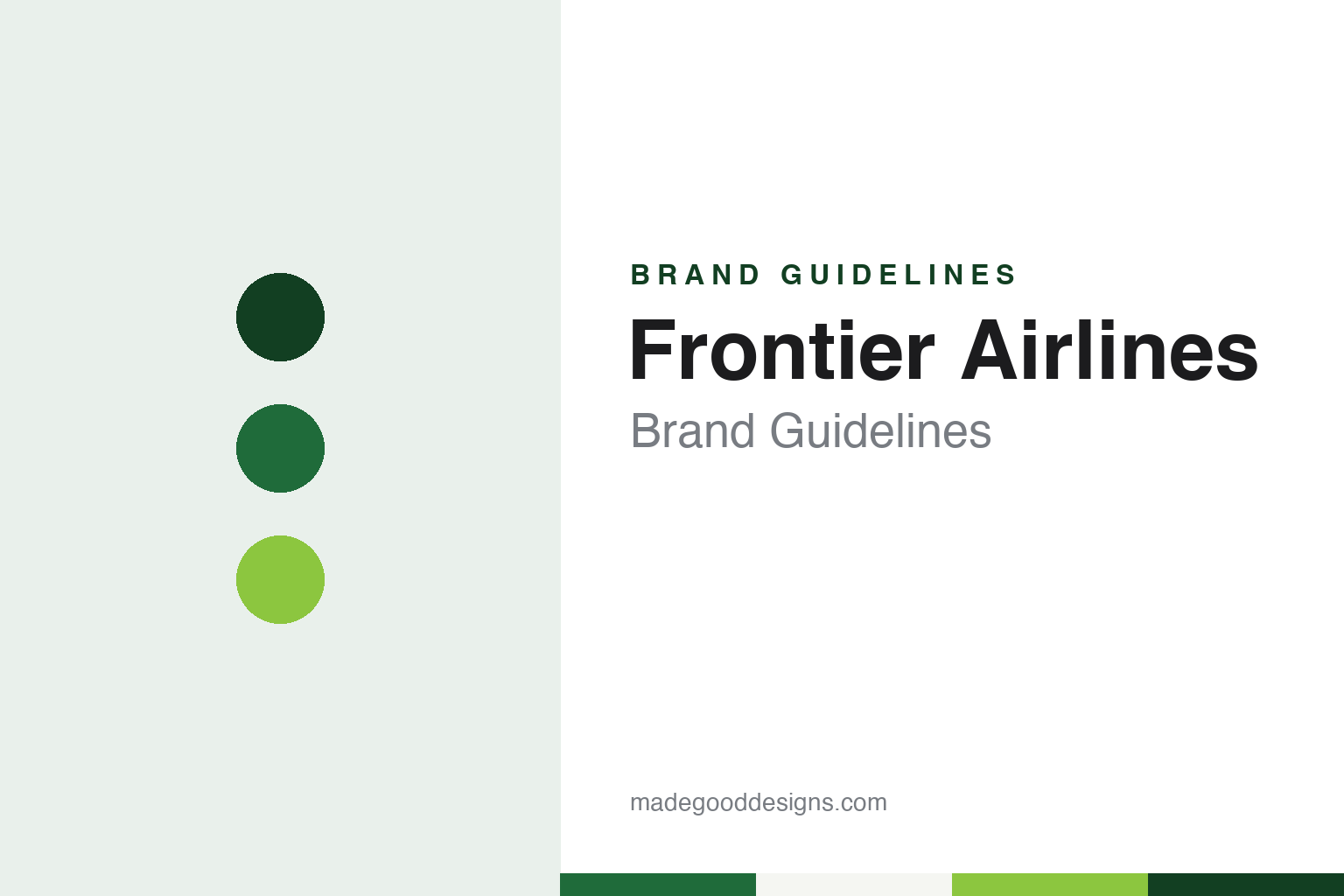
Frontier Airlines Brand Guidelines
The Denver airline that put an animal on every tail.
Aa
Two constants: a Frontier green, meadow and fuselage white palette and a wide titling sans register. Abstract homage — not a Frontier Airlines asset; no aircraft, animal or logo is reproduced.
A name revived
A Denver airline that borrowed an older name.
The Frontier Airlines flying today is the second airline to use the name. The first Frontier flew from Denver between 1950 and 1986, and English Wikipedia says the new company was created by Frederick W. “Rick” Brown, a United Airlines pilot, his wife Janice Brown, and Bob Schulman, the last two having worked at the original carrier. Wikipedia says the group first proposed a charter airline called AeroDenver Travel Services as Continental Airlines scaled back flying at Denver’s Stapleton airport, then turned to regional routes and took the Frontier name. The company was incorporated in February 1994.
The Deseret News, reporting on 4 July 1994, described the occasion as a rebirth. It said that Frontier Airlines would begin daily jet service from Denver to North Dakota that week, that most of the new airline’s employees had worked for the original Frontier, and that the chairman was M. C. “Hank” Lund, a former president and chief executive of the first company. The paper recalled that former employees had held a mock funeral when the original airline collapsed in 1986. Wikipedia dates the first scheduled flights to 5 July 1994, on Boeing 737-200 jets.
From the start the new airline leaned on the West. Wikipedia says that in its early years it used the slogan “The Spirit of the West”, painted above the windows just behind cursive “Frontier” lettering on the fuselage. Its route map spread from Denver across the Mountain West and then to both coasts, and in 2001 it took delivery of its first Airbus A319, launching a new livery at the same moment. Wikipedia says the airline became an all-Airbus operator in 2005.
The decade that followed brought a run of ownership changes. In April 2006 a holding company, Frontier Airlines Holdings, was created, with the headquarters staying in Colorado. The airline filed for Chapter 11 protection on 10 April 2008, and in 2009 Republic Airways Holdings of Indianapolis acquired it out of bankruptcy, completing the deal on 1 October 2009, according to Wikipedia. Republic was buying Midwest Airlines at the same time, and in 2010 the two brands were merged, with Frontier as the surviving name.
Colour
Indigo Partners and the Nasdaq listing.
The present owner arrived in 2013. The Denver Post reported on 3 December 2013 that Indigo Partners LLC, through an affiliate, had completed its purchase of Frontier from Indianapolis-based Republic Airways Holdings, and that the airline’s headquarters would remain in Denver. The paper quoted William Franke, Indigo’s co-founder and managing partner, and said the new owner planned to speed up the airline’s move to an ultra-low-cost model, a direction Frontier’s management had started on the year before. Indigo Partners has owned Frontier since 2013.
The shift changed what the brand promised. Wikipedia says that as an ultra-low-cost carrier Frontier charges separately for extras such as advance seat selection and bags, and sells food and drink on board. Before the change, the airline had offered DirecTV channels on seat-back screens, introduced with the A319 in 2001; Wikipedia says the screens were later removed. The company name visible to investors also changed: the parent became Frontier Group Holdings.
The listing came in 2021. CNBC reported on 1 April 2021 that the Denver-based airline had begun trading that day on the Nasdaq Global Select Market under the ticker ULCC, the initials of ultra-low-cost carrier.
Wikipedia records that in early 2022 Frontier agreed to combine with Spirit Airlines, and that Spirit’s board chose a rival offer from JetBlue in July 2022, ending the plan. Through these changes Frontier kept its headquarters in Denver. The Southwest Airlines and United Airlines guides cover two carriers it has long shared that airport with.
Typography
Design and documentation.
An airline brand is read in pieces rather than all at once. The livery is one of those pieces: a fuselage colour or cheatline, the name set along the crown, and the tail, which is often photographed from a terminal window or an apron. Tail art carries much of the identity on its own, whether it is a single mark, a band of colour or a painted image, and it has to read at a distance, in low sun and on a wet day.
Inside the aircraft the same system shrinks to small details: seat fabric and headrest covers, bulkhead panels, cabin lighting, the safety card, the cup, the napkin and the boarding pass. Each one asks the brand colours and type to work at a far smaller size than the tail, and often in print rather than paint.
On the ground the identity moves again, onto check-in desks, gate screens, wayfinding panels, uniforms and ground equipment. Airport signage is usually shared space, so an airline’s colours and lettering sit beside the airport’s own system and must stay legible within it. For designers, the useful lesson is how one set of choices is adapted from a tail fin down to a luggage tag.
Aa
A wide titling sans — the register of fuselage lettering read from a terminal window. (Specimen set in Archivo, a sans-serif STAND-IN; NOT the Frontier Airlines logo.)
Frontier Airlines
Animals on the tail, a Saul Bass F on the side.
Wikipedia says the livery used from 1994 to 2001 combined green script “Frontier” titles, a small “Spirit of the West” slogan and wildlife photography on the tail, with most Boeing 737s showing a different image on each side. The 2001 Airbus livery swapped the script for large silver “FRONTIER” titles and kept the animals, now one per aircraft, and the slogan later became “A whole different animal.” A version introduced in April 2013 replaced the name on the fuselage with the web address FLYFRONTIER.COM.
The animals also became characters. A company page archived in April 2015 said each aircraft carried “a unique spokesanimal” and introduced several by name, among them Grizwald the Bear and Jack the Rabbit. Wikipedia lists others that appeared in radio and television advertising, including Foxy the fox, Flip the dolphin, Larry the lynx, Hector the sea otter and Sal the cougar, and says Polly the parrot joined after an animal “audition” in 2012. Each aircraft carries the name of its tail animal near the nose.
The 2014 livery looked back to the first Frontier. On 9 September 2014 the airline introduced an updated design, and Skift, writing on 10 September 2014, noted that its logo went back to Saul Bass, the designer of United’s former tulip symbol and an earlier Continental mark. Wikipedia says the new livery brought back green “FRONTIER” titles built around the stylised F that Bass had drawn for the original airline’s 1978 livery. World Airline News, also on 9 September 2014, pointed out that the scheme revived the arrow that the original Frontier had painted on its Douglas DC-3s in the 1950s. Wikipedia adds that the animals were given larger roles at the same time.
The 2014 livery combines lettering and an arrow drawn for an airline that closed in 1986 with tail animals that differ from one aircraft to the next.
For a design guide, Frontier Airlines shows how a fixed wordmark can carry a rotating set of images, so that every tail is different while the side of the aircraft stays the same. Compare it with United Airlines, whose Saul Bass tulip came from the same designer, and Southwest Airlines, another carrier with a large Denver presence. For this guide we use Frontier green, meadow and fuselage white with a sans, an unofficial interpretation; no product or logo is reproduced.
Explore & save
Keep Frontier Airlines’s identity on hand — save it to a board in the Made Good inspiration library.
Frontier Airlines identity set
Pin the Frontier Airlines green, meadow and fuselage white palette and the wide titling sans register to your own board.