New York Jets Brand Guidelines
A name from the flight path, a plane in the wordmark, and a green that keeps changing shade.
Aa
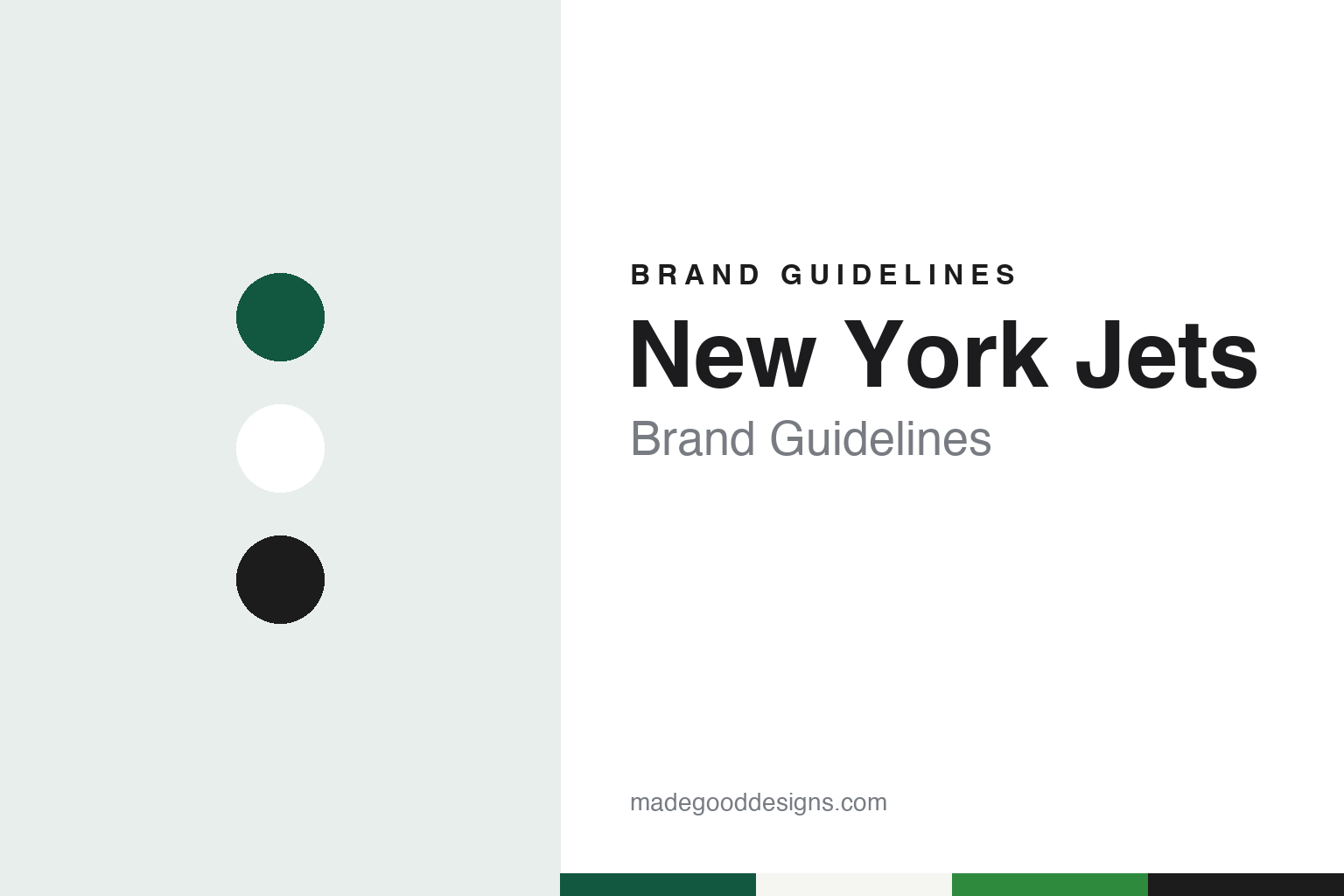
Two constants: a legacy green, white and jet black palette and an angular italic sans register. Abstract homage — not a New York Jets product or mark; no helmet, uniform or logo is reproduced.
From Titans to Jets
A broadcaster’s Titans, a showman’s Jets, and a name chosen for a flight path.
The New York Jets began life under another name. English Wikipedia says the franchise was founded in 1959 as the Titans of New York, a charter member of the new American Football League, and that the club began play in 1960 at the Polo Grounds in upper Manhattan, the former home of the football and baseball Giants. The charter franchise went to Harry Wismer, a former broadcaster who had earlier held a stake in the Washington club. The Titans’ look was navy and gold: Wikipedia describes navy blue jerseys with old gold numerals, gold trousers with blue stripes and navy helmets with a single gold stripe and no logo decal, with UCLA-style shoulder stripes added in 1961.
The money ran short within a few seasons. In February 1963, Wikipedia says, the franchise was sold to a five-man syndicate headed by Sonny Werblin of the Gotham Football Club. Werblin had run the television division of the Music Corporation of America, and Wikipedia says his early moves were to change the team’s name and its jerseys.
The new name pointed at the sky over Queens. Writing for ESPN’s NFL Nation in a guide to the origins of every league team name published on 2 February 2022, the Jets reporter Rich Cimini said the club changed its name to Jets in 1963 because its new home, Shea Stadium, sat near LaGuardia Airport, and that the owners also liked that the word rhymed with the Mets, the baseball club that played at Shea. Wikipedia says the Titans had shared the Polo Grounds with the then-new Mets for two years before both teams moved to Shea in 1964.
With the name came new colours. Wikipedia says navy and gold were dropped in 1963 in favour of kelly green and white. The helmet was white with a green centre stripe, and the side decal was a green silhouette of a jet airplane with “JETS” in thick white italic sans-serif letters along the fuselage.
Colour
From Werblin to Hess to Johnson, and from Queens to the Meadowlands.
Werblin did not stay long. Wikipedia says his partners in the syndicate, among them Leon Hess of the Hess oil company, fell out with him over how the team was run, and that Werblin agreed to be bought out in 1968. Hess became majority stockholder in 1973 and, after buying out the remaining partners in steps through the early 1980s, took sole control. Under Hess the team left Queens: Wikipedia says the Jets played their last game at Shea in December 1983 and moved to the Meadowlands Sports Complex in New Jersey for 1984, sharing Giants Stadium with the New York Giants.
The present ownership dates from 2000. An Associated Press report carried by ESPN on 12 January 2000 said Robert Wood Johnson IV, known as Woody Johnson, an heir to the Johnson & Johnson fortune, had bought the Jets from the estate of Leon Hess, pending approval by the league’s owners, after the league’s finance committee backed his bid over that of the Cablevision chairman Charles Dolan. Johnson has owned the club since. Wikipedia says that while Woody Johnson served as US ambassador to the United Kingdom from 2017, his brother Christopher Johnson ran the team, and that Woody resumed those duties in 2021.
Home and headquarters have both moved within New Jersey. Wikipedia says the training base at Hofstra University on Long Island gave way in 2008 to the Atlantic Health Jets Training Center in Florham Park, now the team’s headquarters. The Jets and Giants built MetLife Stadium as a joint venture, Wikipedia says, and it opened in April 2010; the stadium is lit in different colours depending on which team is hosting. Wikipedia says that at Giants Stadium, by contrast, the grounds crew had hung green banners and placed the Jets logo over the Giants’ on Jets game days.
Throwbacks have kept the Titans in view. Wikipedia says that in 2007 the Jets introduced a throwback evoking the original Titans of New York, with navy helmets and jerseys, old gold numerals and gold trousers, worn again in several later seasons.
Typography
Design and documentation.
A professional football identity is built from a small set of parts that have to work together at very different sizes. The helmet decal is a compressed version of the identity: a mark that sits on a curved shell, is seen from the side at a distance and has to read in a single colour against a painted surface. Many clubs keep the helmet mark separate from the primary logo used on print and screens, and the two are often redrawn on different schedules.
Colour names are part of the system. Clubs and their uniform suppliers give their tones proper names, and those names travel from style guides onto merchandise labels and broadcast graphics, which helps keep a shade consistent across fabric, paint and pixels.
Throwback uniforms let a club revisit an earlier set without retiring the current one, so an older wordmark, numeral style or helmet colour can return for a single season or a few games. Stadium naming adds another layer: when naming rights change, the building’s signage, tickets and wayfinding are rebranded while the team’s own marks stay the same.
Aa
An angular italic sans — the register of a helmet wordmark and a stadium banner. (Specimen set in Saira Condensed, a sans-serif STAND-IN; NOT the New York Jets logo or wordmark.)
A football, a wordmark and four greens
Kelly, hunter, Gotham and Legacy: the green has never stood still.
The football-shaped badge arrived early. Wikipedia says that in 1964 the jet-plane decal gave way to a white football shape outlined in green, with “JETS” in thick green italic sans-serif letters in front of “NY” in outlined serif lettering, and that because the decal was hard to see from a distance or on television the colours were reversed and the decal enlarged in 1965. That design stayed largely unchanged through 1977.
The 1978 season brought a new wordmark. Wikipedia describes solid green helmets with white facemasks and a stylised “JETS” wordmark in white, with angular lettering and the silhouette of a modern jet airplane extending to the right from the top of the “J” above the “ETS”. In 1990 the team added thin black outlines to the numerals, stripes and helmet decal. In 1998, Wikipedia says, the Jets returned to an updated version of the 1965 set, with a darker hunter green in place of kelly green and an oval primary logo with starker lines.
Two recent rebrands came five years apart. In 2019, Wikipedia says, the club introduced a medium shade it called “Gotham Green”, brought black back as a trim colour, returned to green helmets with a metallic finish, and set “NEW YORK” in italic sans-serif letters above a revised “JETS” on a football-shaped logo, with a black alternate uniform; a matte-black alternate helmet followed in 2022. Then, on 15 April 2024, CBS New York reported that the Jets had revealed their “Legacy Collection” in white, green and black, a throwback to the Sack Exchange era of the late 1970s and 1980s, with a new primary logo that modernised the “JETS” wordmark used from 1978 to 1997. The station quoted Woody Johnson: “We work for the fans. They have consistently asked for us to return to our roots and we heard them.” Wikipedia says the revived wordmark tightened the letter spacing, widened the tail and streamlined the nose of the plane, and that the Gotham Green shade was kept and renamed Legacy Green.
For a design guide, the New York Jets show how a name taken from an airport’s flight path can become the drawing itself, with the plane folded into the letters, and how a club can return to an older mark while keeping a newer colour. Compare it with New York Mets, the Shea Stadium neighbours whose name the Jets rhymed with, and NFL. For this guide we use legacy green, white and jet black with a condensed sans, an unofficial interpretation; no product or logo is reproduced.
Explore & save
Keep New York Jets’s identity on hand — save it to a board in the Made Good inspiration library.
New York Jets identity set
Pin the New York Jets legacy green, white and jet black palette and the angular italic sans register to your own board.