Printful Brand Guidelines
From a poster shop’s T-shirts to a fulfilment network.
Aa
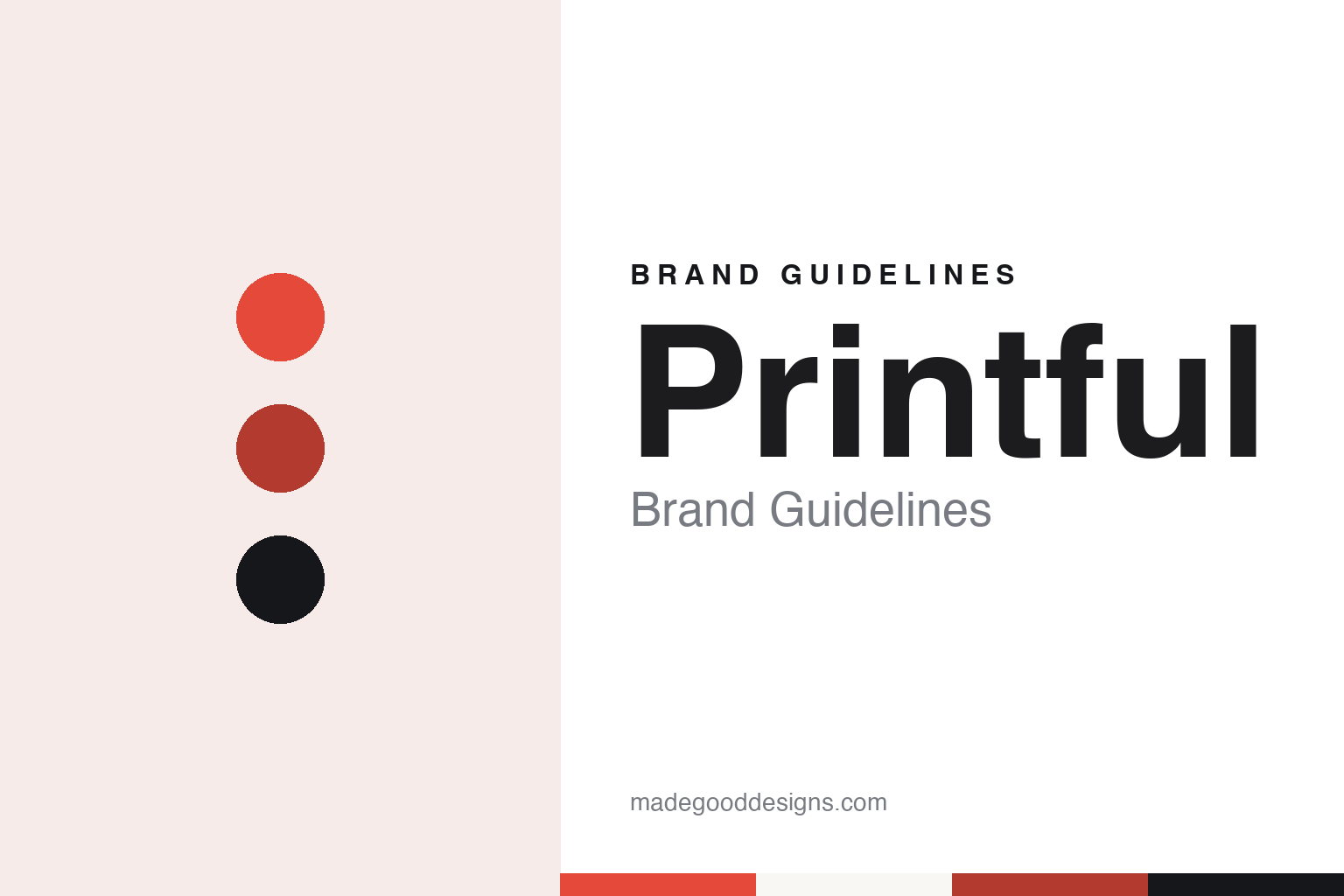
Two constants: a mockup red, ink brick and garment black palette and a geometric grotesque sans register. Abstract homage — not a Printful asset or mark; no logo, icon or wordmark is reproduced.
A poster business that needed T-shirts
California and Riga, 2013 to 2017.
Printful grew out of a problem in another business. The British magazine Management Today reported on 27 June 2022 that the company was conceived when Startup Vitamins, an on-demand poster design business run by Lauris Liberts, branched out into clothes, specifically T-shirts. According to the magazine, the business could only source from family-run print shops that struggled with volumes and timelines and did not offer an API, the software connection an online store needs to send orders automatically. The answer was to start a printing company of its own.
Wikipedia says Printful was founded in California in 2013 and co-founded by Liberts and Davis Siksnans, and that it originated within the Draugiem Group incubator in Latvia, an organisation that supports and develops new business ideas. Management Today described Siksnans as the Latvian co-founder and chief executive in 2022, and said Liberts remained on the board.
Wikipedia says Printful launched on 16 July 2013 with three products: posters, canvases and T-shirts. Later the same year it built an integration with Shopify, so that a shop owner could list a design and have each order passed straight to Printful for printing and shipping.
LSM, Latvian Public Broadcasting’s English-language news site, explained on 8 January 2025 that Printful automatically receives, produces and delivers personalised products on behalf of online stores. Wikipedia describes it as an on-demand printing and fulfilment company that prints, packages and ships clothing, accessories and home items directly to customers on behalf of online business owners.
Software tools followed the integrations. Wikipedia says Printful introduced the Design Maker in 2015, a tool that lets online sellers make designs without design skills. In 2017, it says, the company opened a fulfilment centre in Riga, launched integrations with Amazon and Etsy, and moved from its earlier web address, theprintful.com, to printful.com.
Colour
From a Riga floor to a merger.
The production network spread across continents. Wikipedia lists fulfilment centres opened in Mexico in 2018, in Spain and Canada in 2020, and in Dallas, Texas, and the United Kingdom in 2021, alongside partner facilities in Brazil, Japan and Australia. LSM listed Printful’s manufacturing facilities in 2025 as being in the US, Mexico, Canada, the UK, Barcelona and Latvia. Management Today quoted Siksnans in 2022 naming vertical integration, owning the printing itself, as the company’s competitive advantage.
Wikipedia says Printful took a non-control investment from the private equity firm Bregal Sagemount in 2021, appointed Alex Saltonstall as chief executive in 2022 and acquired Snow Commerce in 2023. It also says Printful prints with technology from Kornit Digital and has partnered with Coloreel on embroidery.
The company has two centres of gravity. Wikipedia says its EU headquarters is in Riga, with fulfilment centres in Barcelona, Riga, Birmingham, Toronto, Charlotte, Dallas and Tijuana. The promotional products trade publication ASI reported on 6 November 2024 that Printful was headquartered in North Carolina.
The same ASI report said the print-on-demand platforms Printful and Printify had merged, with the support of shareholders and the approval of regulators, and that the two would keep their own brand identities. It quoted Saltonstall, then chief executive of Printful, describing a natural fit between the two companies, and named Liberts as Printful’s co-founder and chairman. ASI said Printify had been founded in Riga and later headquartered in San Francisco.
LSM reported in January 2025 that the merger had been finalised and that the new management team had begun integration. It said Printify had been founded in 2015 by Jānis Berdigans, Artis Kehris and Gatis Dukurs, and that both platforms would continue to operate under the merged company as their own brands. LSM described the two companies as long-standing rivals.
Typography
A brand that ships in other people’s names.
For a print-service brand, the identity is not confined to a logo on a homepage. It is carried through a sequence of moments that a customer passes through, often without noticing that each one has been designed. The order flow is the first of these: the upload screen, the template picker, the preview window and the progress bar all speak in the brand’s type, colour and tone of voice, and they set expectations long before anything is printed.
The proof is the second moment. A digital proof, a soft-proof warning about low-resolution images or a printed sample sent ahead of a larger run is where the service shows how carefully it handles someone else’s work, and the language around it matters as much as the layout.
Paper samples and swatch packs make the brand tangible. Stock names, finish labels and the small card that explains weight and coating turn technical choices into something a customer can hold and compare.
Finally there is delivery. The shipping box, the tape, the protective sleeve, the packing slip and any insert card are often the only physical contact a customer has with an online printer, so they become the most direct expression of the identity. Designers studying the category should look at these surfaces together, as one continuous system rather than as separate pieces.
Aa
A geometric grotesque sans — a plain, even register chosen for this guide. (Specimen set in Manrope, a sans STAND-IN; NOT the Printful logo or any Printful typeface.)
Printful
One name kept, one umbrella added.
Printful’s customers are online sellers, and its identity is addressed to them. LSM described the company in 2025 as one that receives, produces and delivers personalised products on behalf of online stores, and Wikipedia says it ships directly to customers on behalf of online business owners. The Printful name appears on the website, the Design Maker tool and the integrations with shop platforms such as Shopify, Amazon and Etsy that Wikipedia lists. Wikipedia also records a change of web address in 2017, from theprintful.com to printful.com.
The merger with Printify raised the question of naming. LSM reported on 8 January 2025 that, after a lot of speculation about the new company’s name, the merged business would be called Fyul, a name without the word “print” in it. The name, it explained, joins the last two letters of each company’s name: “fy” from Printify and “ul” from Printful.
The umbrella identity was made public later in 2025. The trade magazine Print+Promo Marketing reported on 10 December 2025 that Printful and Printify had revealed a fresh identity and relaunched under the name FYUL, pronounced “fuel”. It said the company described the brand as combining the technology and supply-chain capabilities of both businesses in one platform, and that the existing brands, Printful, Printify and Snow Commerce, would continue to exist and operate under the FYUL umbrella.
Print+Promo Marketing quoted Saltonstall, by then chief executive of the joint company, saying FYUL brings together technology, talent and supply-chain infrastructure to make on-demand merchandise work on a global scale. The same report said the FYUL team was moving into FYUL House in Riga, a facility that expands the site of Printful’s previous central location, with the move expected to be finished early in 2026.
The Printful name was kept through both changes. ASI reported in November 2024 that the merging companies would maintain their own brand identities, and Print+Promo Marketing reported in December 2025 that Printful would continue to operate under FYUL alongside Printify and Snow Commerce. The parent name and the platform name now run side by side, with Saltonstall as chief executive of the joint company and Liberts named by ASI as Printful’s co-founder and chairman.
For a design guide, Printful shows how a print-on-demand company keeps a clear name for the sellers it serves while a new parent name, FYUL, sits above it. Compare Vistaprint, an online printer that also built its brand around customer uploads, and Blurb, a print-on-demand service for books. For this guide we use mockup red, ink brick and garment black with a geometric sans, an unofficial interpretation; no product or logo is reproduced.
Explore & save
Keep Printful’s identity on hand — save it to a board in the Made Good inspiration library.
Printful identity set
Pin the Printful mockup red, ink brick and garment black palette and the geometric grotesque sans register to your own board.