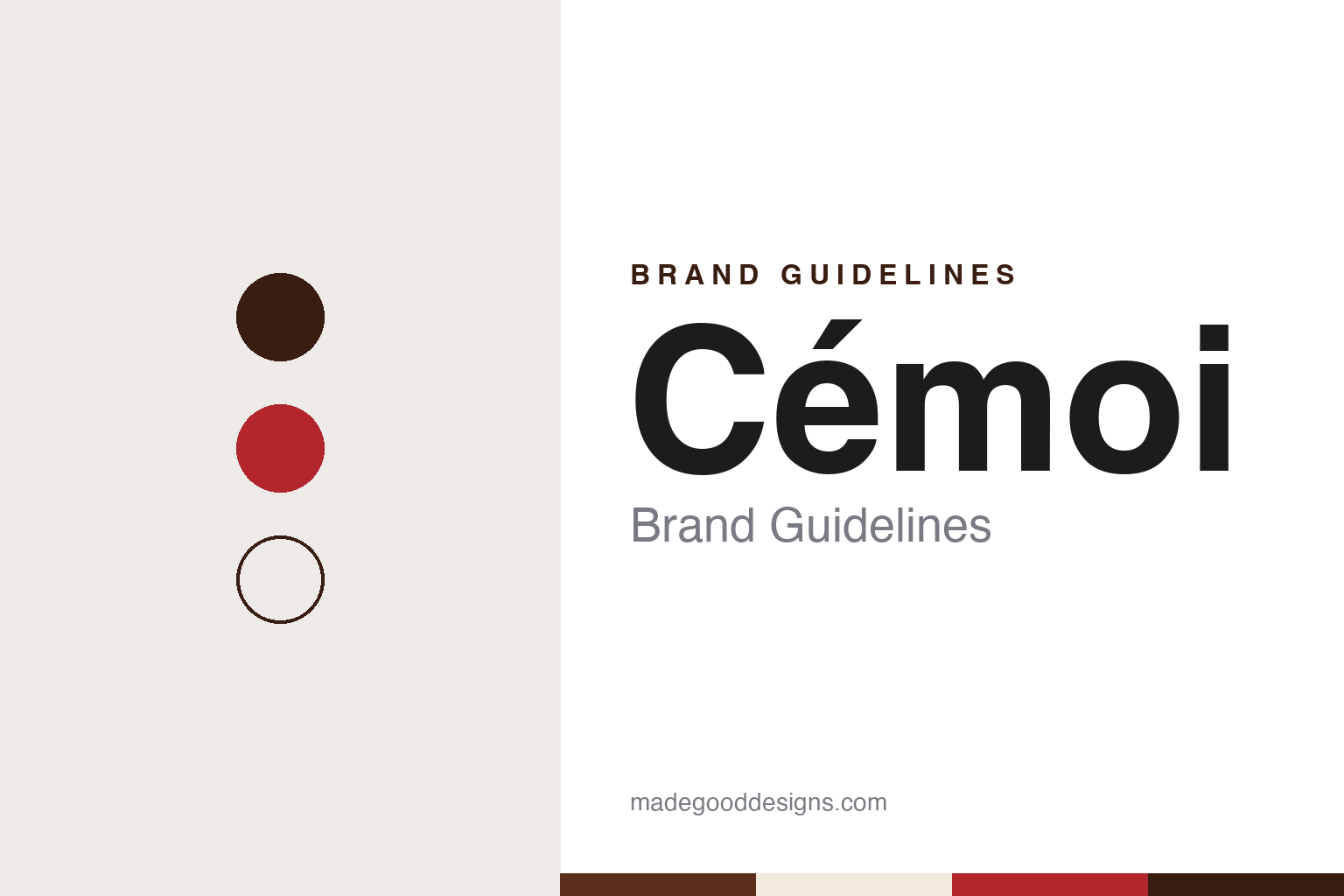
Cémoi Brand Guidelines
The Perpignan chocolate maker that took a Grenoble name.
Aa
Two constants: a Cémoi brown, cream and red palette and a warm serif register. Abstract homage — not a Cémoi product or mark; no bar, wrapper or logo is reproduced.
Cantaloup-Catala
A chocolate works near the Spanish border.
The group that sells chocolate as Cémoi traces itself to 1814. French Wikipedia, citing a 2009 article in La Croix, says the chocolatier Jules Pares built one of France’s first chocolate factories that year at Arles-sur-Tech, in the Pyrénées-Orientales; the company itself says that “the group’s first chocolate factory” opened in 1814 in the Pyrénées-Orientales. In 1887 the business took the names of its two directors, Joseph Cantaloup and Émile Catala, and became Cantaloup-Catala, according to a 2011 article in the Perpignan newspaper L’Indépendant cited by French Wikipedia.
The works did not stay in the mountains. After flood damage in the Aiguat of 1940, the October flood in the Roussillon, the business settled in Perpignan, where its head office has been since 1940, according to the group’s history page as cited by French Wikipedia.
In 1962 the businessman Georges Poirrier bought the chocolate maker and renamed it Cantalou. In that period, Libération reported in 1995, it specialised in chocolate bars made under supermarkets’ own labels for France’s new hypermarket chains. It then began buying competitors: Frankonia of Würzburg in Germany in 1977, and in 1979 the breakfast-drinks maker Phoscao and the Ollé chocolate works at Vallirana, near Barcelona, French Wikipedia says.
Colour
A Grenoble brand, revived after liquidation.
The name itself came from Grenoble. French Wikipedia’s article on the original company says Félix Cartier-Millon, one of the sons of the founder of the pasta brand Lustucru, bought the struggling Chocolats Dauphin there in 1920 and renamed it Cémoi in 1922. The story told by the city magazine Grenoble Mag is that he had first chosen “Chocolats Marquise,” and when his wife asked whose idea that was, he answered “c’est moi” — “it’s me.” By 1955, the same source says, Cémoi was one of France’s four big chocolate brands, making 4,000 tonnes a year with about 500 employees.
That company did not survive. It filed for protection in 1970 after a rise in cocoa prices, passed to the American group DiGiorgio and then, in September 1973, to the businessman Gaston Maulin, and on 21 July 1976 it was put into compulsory liquidation, Le Monde reported that month. The city of Grenoble bought the factory site in 1979; it is now offices in the Bouchayer-Viallet district, still known as the Cémoi site.
In 1981 Cantalou took the name for itself. Les Echos reported in 2018 that Georges Poirrier renamed his company Cémoi that year, and French Wikipedia says the group bought six chocolate makers in Europe between 1981 and 1984, including Aiguebelle, Pupier and the Cémoi brand, which has been used across its production since 1989. The Quadro wafer followed in 1986. In 2003 Cémoi bought the Bouquet d’Or factory at Villeneuve-d’Ascq from Cadbury, Les Echos reported, and with it the Petit Ourson marshmallow bear; in 2007 it took control of Jacquot of Troyes and bought the Gryf plant in Poland, and in 2017 it acquired Chris Candies of Pittsburgh.
Typography
Chocolate and documentation.
The seven brands in this group all sell chocolate, and they come from three countries: Cémoi, Jeff de Bruges, Monbana and À la Mère de Famille from France, Summerbird and Peter Beier from Denmark, and Puccini Bomboni from the Netherlands. They sit at different points in the chocolate trade, from names found on supermarket shelves and in shopping-centre chains to single shops known mainly to the people who walk past their windows.
Some of these businesses are manufacturers, buying cocoa or chocolate in bulk and turning it into bars, drinks and seasonal shapes sold far from where they are made. Others are chocolatiers, who buy finished chocolate from a supplier and use it to make bonbons, truffles and filled pieces by hand, and whose identity rests on a shop, a recipe and a family name as much as on any wrapper. Many sit somewhere between the two, running workshops and shops at once.
Each guide separates what independent sources record from what the company says about itself — who founded it, who owns it now, where its cocoa comes from and where its chocolate is made — and marks plainly what rests only on the company’s own word.
Aa
A warm serif for a heritage chocolate name. (Specimen set in Fraunces, a serif STAND-IN; NOT the Cémoi logo.)
Cémoi
A French chocolate maker under Belgian ownership.
The Poirrier era ended in 2021. In May that year Le Figaro reported that the Belgian family-owned group Sweet Products, parent of Baronie, was set to buy Cémoi, then a business with about €750 million in sales and 3,200 employees; the purchase was completed in July 2021 for around €500 million, about ten times 2020 EBITDA, according to Les Echos’ Capital Finance, as cited by French Wikipedia. L’Agefi wrote that the combined group would have about 5,000 staff and €1.2 billion in sales and become the world’s largest maker of private-label chocolate. Baronie’s own brands include Jacques, Sarotti and Alpia, and in October 2011 it bought Stollwerck of Cologne from Barry Callebaut, English Wikipedia says.
Cémoi is still run from Perpignan. Its consumer website says it has seven chocolate factories in France — at Perpignan, Tinchebray, Bourbourg, Bègles, Villeneuve-d’Ascq, Troyes and Chambéry — and more than 2,350 employees in the country, and it presents its bars under a “made in France” commitment; French Wikipedia counts 15 factories worldwide for the group. Its consumer brands are Cémoi, L’Authentique Petit Ourson Guimauve and Quadro. The group opened a new chocolate factory in Perpignan in 2008, its history page says, and in 2009 L’Usine Nouvelle reported a range of six organic, fair-trade bars, each made with cocoa from a single producing country.
On cocoa, the group built a bean-processing plant in Côte d’Ivoire in 1996, La Tribune reported in 2009, and in 2015 it launched Transparence Cacao, a programme meant to control the chain “from the planter to the consumer,” in the group’s words. The programme’s website says it works with 32 partner cooperatives and nearly 23,000 farmers across six sourcing regions in Africa and Latin America, and that its cocoa is fully traceable; those are the company’s figures. Cémoi says it buys cocoa directly from farming cooperatives and roasts it close to where it is harvested.
For a design guide, Cémoi shows how a regional maker can borrow a stronger name: a chocolate works from the Spanish border that adopted a Grenoble brand. Compare Stollwerck, now in the same Baronie group, and Valrhona, another long-established French chocolate maker. For this guide we use cocoa brown, cream and a wrapper red with a serif, an unofficial interpretation; no product or logo is reproduced.
Explore & save
Keep Cémoi’s identity on hand — save it to a board in the Made Good inspiration library.
Cémoi identity set
Pin the Cémoi brown, cream and red palette and the warm serif register to your own board.