Peter Beier Brand Guidelines
The Danish chocolatier who bought his own cocoa plantation.
Aa
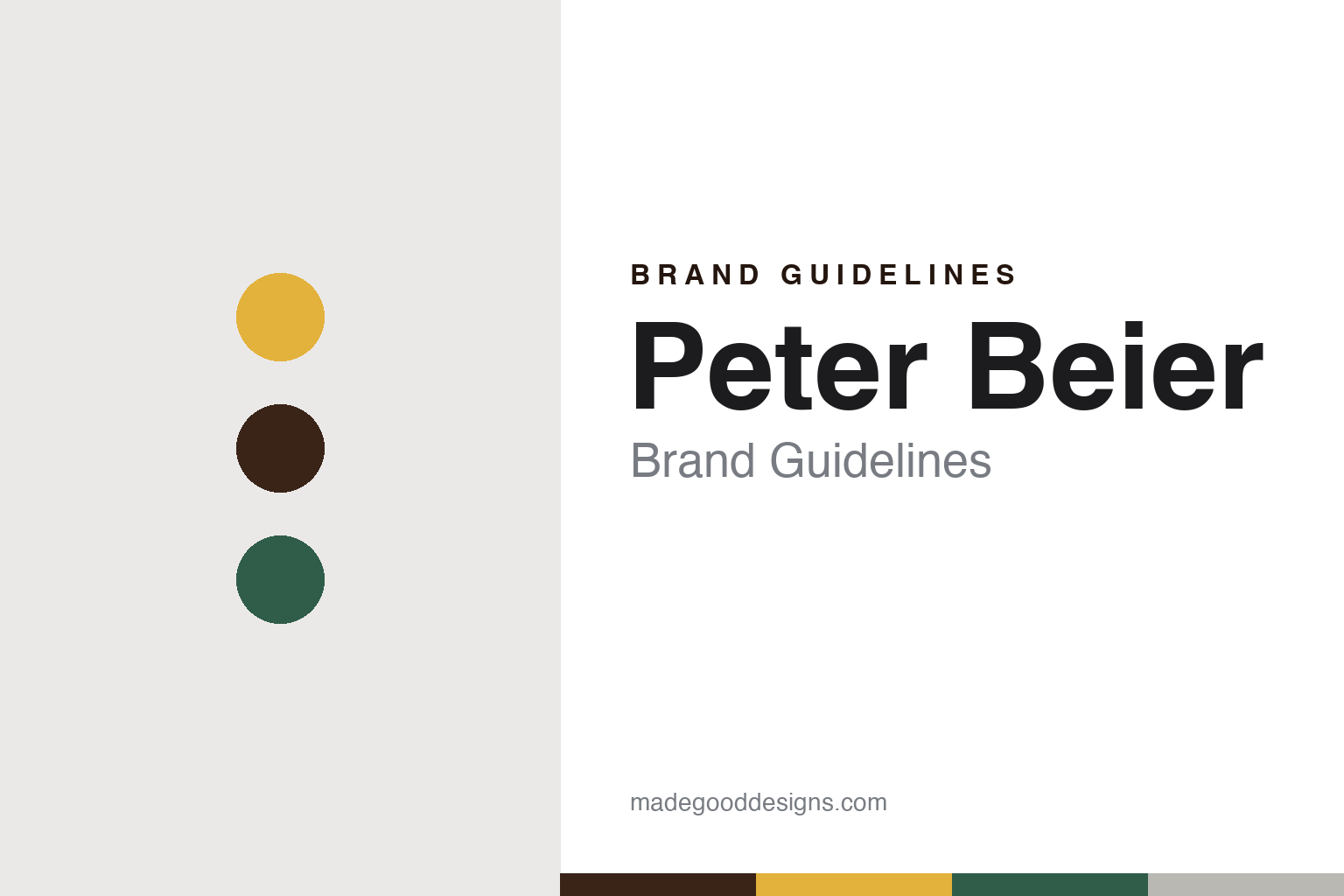
Two constants: a Peter Beier cocoa, yellow and green palette and a Classic display serif register. Abstract homage — not a Peter Beier product or mark; no box, logo or chocolate is reproduced.
From Magasin to his own name
A pastry apprentice who ran a department store’s chocolate factory.
Peter Beier Chokolade was founded in 1996 by the chocolatier Peter Beier, Danish Wikipedia and the company both say. The company says he trained in Denmark, England, France, Belgium and Spain. Jyllands-Posten, profiling him in June 2015, traced the start to a summer job with a pastry maker in Stubbekøbing that became an apprenticeship; the paper says he was named pastry chef of the year at 22.
That led to Magasin du Nord, the Copenhagen department store, whose chocolate production he joined at 22 and soon ran, according to the company and to Jyllands-Posten. In a separate Jyllands-Posten interview in May 2015 he said he had headed the store’s chocolate factory for seven years, and the June profile reported that sales nearly quintupled in six years. He left to work for himself. Jyllands-Posten reported that a non-compete clause kept him from making his own chocolate for a year, that he worked in a shop in Lyngby in the meantime, and that his chocolate was served at the 1995 wedding of Prince Joachim and Alexandra; it adds that he was then one of the driving forces behind the chocolate firm Amokka.
In 1996 he set up his own production of handmade chocolate. The company calls itself a family business, started together in 1996. Its first shop, Jyllands-Posten reported, was on Falkoner Allé in Copenhagen, and the chain grew around Greater Copenhagen: the paper counted 15 of its own shops in 2015, and the tabloid BT reported 16 that spring, including two in Sweden and one in Jutland.
Colour
A plantation in the Caribbean and an estate in North Zealand.
The defining move came in 2002, when Peter Beier bought a cocoa plantation in the Dominican Republic, as both the company and Jyllands-Posten report. The company says the plantation is organic and that he bought it to secure the quality of his raw material and decent working conditions, and to avoid child labour. BT reported in 2015 that the plantation covers 16 hectares and, together with neighbouring plantations, supplies the beans for the Danish production. On its plantation page the company says the cocoa trees grow among banana, papaya, coconut, mango, lime and grapefruit trees, that pods are harvested by machete every two weeks with a peak in April and May, and that the beans are fermented, roasted and conched before the chocolate is shipped to Denmark. It also shows film of a visit in October 2017 to assess damage from Hurricane Irma.
The other half of the story is Ørsholt Gods, an estate at Gurre near Helsingør in North Zealand, which Danish Wikipedia gives as the company’s headquarters and production site. Jyllands-Posten reported in 2015 that Peter Beier had invested in the estate about seven years earlier. The company says the estate covers 130 hectares of lakes, woods and fields, where it grows apples, pears, cherries, plums, berries, almonds, walnuts and hazelnuts for its fillings, and that it keeps an orangery of cacao trees from the plantation, used for staff training and chocolate courses. It sums this up as a “from soil to table” concept and says the chocolate is 100 per cent handmade.
In May 2015 Helsingør Dagblad reported that Peter Beier was among seven people honoured that year with diplomas from the Danish Gastronomic Academy, citing his cocoa growing and his renewal of the classic confectionery tradition.
Typography
Danish chocolate, from department stores to estates.
The seven brands in this group all sell chocolate, and they come from three countries: Cémoi, Jeff de Bruges, Monbana and À la Mère de Famille from France, Summerbird and Peter Beier from Denmark, and Puccini Bomboni from the Netherlands. They sit at different points in the chocolate trade, from names found on supermarket shelves and in shopping-centre chains to single shops known mainly to the people who walk past their windows.
Some of these businesses are manufacturers, buying cocoa or chocolate in bulk and turning it into bars, drinks and seasonal shapes sold far from where they are made. Others are chocolatiers, who buy finished chocolate from a supplier and use it to make bonbons, truffles and filled pieces by hand, and whose identity rests on a shop, a recipe and a family name as much as on any wrapper. Many sit somewhere between the two, running workshops and shops at once.
Each guide separates what independent sources record from what the company says about itself — who founded it, who owns it now, where its cocoa comes from and where its chocolate is made — and marks plainly what rests only on the company’s own word.
Aa
A classic display serif — a nod to the estate and the gift box. (Specimen set in Playfair Display, a serif STAND-IN; NOT the Peter Beier logo.)
Peter Beier
Chocolate, ice cream and cafés.
The products are recognisable more by shape than by packaging. BT wrote in 2015 that the pyramid-shaped chocolates and the flødeboller — the Danish chocolate-coated marshmallow treats — had become Peter Beier’s trademark, and described staff pressing marzipan eggs by hand and brushing away flaws before boxing. The current shop groups the range into signature boxes, a Silver Collection, a Plantage series, seasonal chocolate, gourmet flødeboller and bars, alongside the ice cream it sells as World of Icecream.
The business has also changed shape. In 2015 the company, then trading as Peter Beier Chokolade A/S, told Berlingske it planned to add 50 to 100 selected outside retailers to its own shops. Today the website, run as Peter Beier Danmark from Ørsholt Gods, presents a chain of cafés selling chocolate, ice cream and crêpes, from Helsingør and Hillerød to Roskilde and central Copenhagen, together with tastings, events and gift cards. Danish Wikipedia describes it as a café, ice-cream and chocolate chain with 18 branches in the capital region and about 200 employees in 2024, and says it is owned by Peter Beier; the company describes it as a family business in which the whole family is involved. We found no record of an outside owner in the sources we checked.
Where the chocolate is made is clear from the company’s own account: the chocolates are made by hand at Ørsholt Gods, and the company says the chocolate itself comes from beans grown, fermented, roasted and conched in the Dominican Republic, from its own plantation and, BT reported, from neighbouring farms.
For a design guide, Peter Beier shows a brand built on a place rather than a pack: a plantation in the Caribbean and an estate in North Zealand, told as one “from soil to table” story. Compare Summerbird, another Danish chocolatier with its own shops, and Friis-Holm, the Danish bean-to-bar maker. For this guide we use cocoa brown, an estate yellow and a plantation green with a serif, an unofficial interpretation; no product or logo is reproduced.
Explore & save
Keep Peter Beier’s identity on hand — save it to a board in the Made Good inspiration library.
Peter Beier identity set
Pin the Peter Beier cocoa, yellow and green palette and the Classic display serif register to your own board.