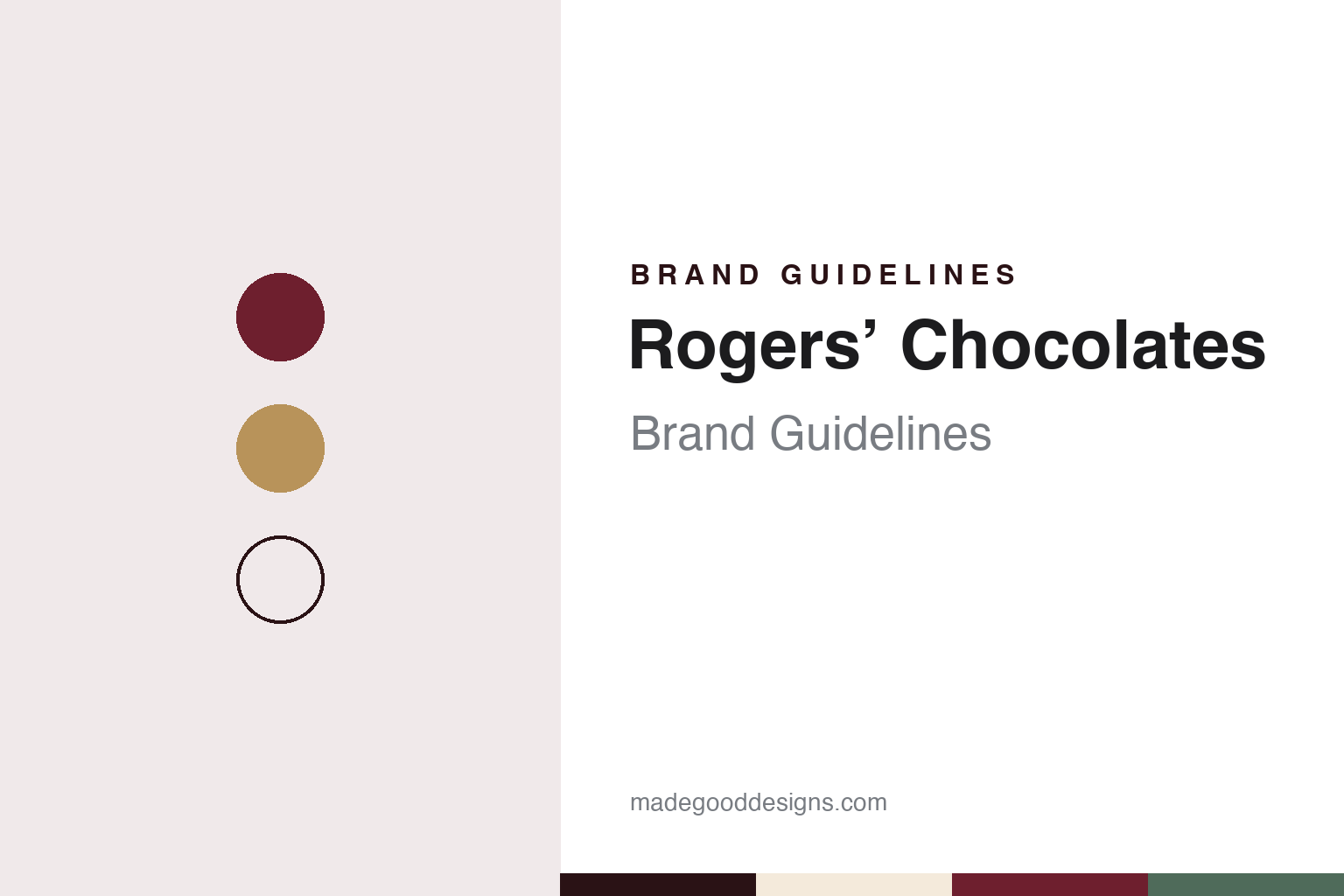
Rogers’ Chocolates Brand Guidelines
Victoria’s Government Street chocolatier since 1885.
Aa
Two constants: a Rogers’ burgundy, gilt and cream palette and a Victorian serif register. Abstract homage — not a Rogers’ Chocolates product or mark; no box, tin, logo or photograph is reproduced.
Candy Rogers
A grocer who started making his own.
Rogers’ Chocolates traces itself to 1885, when Charles “Candy” Rogers moved to Victoria, British Columbia. The company describes him as the son of a Massachusetts farmer; English Wikipedia gives his dates as 1854 to 1927 and calls him a grocer. He opened what the company calls a “green grocery” on the west side of Government Street, the main shopping street of the provincial capital, and, the company says, sold chocolates there that he imported from San Francisco before deciding to make his own.
He did not work alone. He married Leah Morrison — in 1888, according to a history by Geoffrey Castle of the British Columbia Historical Federation that the company once reprinted on its website — and, in the company’s account, she ran the shop while he cooked in the back room. The first Rogers’ chocolates, the company’s website said as early as 1998, “were made in 1885 by Charles W. (Candy) Rogers in the back of his grocery shop.”
His first creation, the company says, was the Victoria Cream, a large, flavoured cream centre covered in chocolate, and it still sells the line under that name, made, it says, to his original recipe. The company now calls him “Canada’s original chocolatier,” a description we give as its own.
Colour
A shop that became a historic site.
The shop moved more than once along the same street. A heritage-inventory text that the company also reprinted says Rogers’ first shop was torn down in 1891 to make way for the B.C. Land and Investment Agency building, and that he reopened inside the new building, on the west side of Government Street. In 1903, as an investment, he had a two-storey brick block built across the street by the Victoria architects Hooper and Watkins, one of a row of three buildings designed to look like a single front. English Wikipedia gives the same architects and year.
He did not move in straight away. The same inventory says he let the building to a fish and fruit merchant and then to two jewellers, and moved his own business in only in 1917; Castle gives 1916. The shop has traded there since. The Times Colonist, Victoria’s daily newspaper, has dated the company’s Government Street location to 1891, which matches the earlier shop across the road rather than the present one.
In 1991 the building was designated the Rogers Building National Historic Site of Canada. The federal listing, citing the Historic Sites and Monuments Board’s minutes of November 1990, calls the shop “a delectable adaptation of the Queen Anne Revival style applied to small commercial buildings,” and lists its leaded-light canopy over the recessed entrance, its marble and tile floor, and inside its glass-fronted cabinets, curve-topped counters and tall mirrors.
That interior became a dispute. In February 2009 the City of Victoria designated it as heritage after the company planned to enlarge its 950-square-foot shop by moving the rear wall. In February 2010 an arbitrator ruled the company should be compensated, and its lawyer put the total at about $600,000, the Times Colonist reported; he said it was the first such decision he knew of on a building’s interior.
Typography
The R850 brands.
The seven brands in this group all sell chocolate, and they come from three countries: Haigh’s, Darrell Lea and Koko Black from Australia, Whittaker’s from New Zealand, and Laura Secord, Purdys and Rogers’ Chocolates from Canada. They are grouped here because they share a market position more than a style: each is a home-grown name in a country whose chocolate shelves are also stocked by international groups.
They reach shoppers in different ways. Some are known mainly through their own shops, where the window, the counter and the box do much of the work of a brand; others are known mainly through supermarket shelves, where a wrapper has a few seconds to be recognised. Many sit between the two, and the line between a chocolatier, a confectioner and a chocolate maker is not always drawn the same way from one company to the next.
Each guide separates what independent sources record from what the company says about itself — who founded it, who owns it now, where its cocoa comes from and where its chocolate is made — and marks plainly what rests only on the company’s own word.
Aa
A Victorian serif — a shop with a Queen Anne front. (Specimen set in Playfair Display, a serif STAND-IN; NOT the Rogers’ Chocolates logo.)
Rogers’ Chocolates
Shareholders, burgundy and a factory up the road.
The Rogers family did not keep the business. After Charles Rogers died in 1927, Castle wrote, Leah Rogers sold it to William A. Lamb of Los Angeles, and ownership “eventually” passed to a British Columbian he did not name; we found no dated record of those later sales. By the 2010s the company was owned by shareholders and run by a board: in July 2013 the Times Colonist called it “an independent company, owned by shareholders and operated by directors.” Today its website says it is “privately owned and locally operated by Canadian families.” We found no sale to a larger confectionery group.
Its colour is part of that story. In February 2013 the new chief executive, Larry Sullivan, who had succeeded Steve Parkhill, told the Times Colonist that a move away from the company’s traditional burgundy had upset customers and that it was bringing the colour back; its Victoria Creams are still sold in what it calls its “traditional burgundy box.” He also sold the company’s delicatessen and soda shop to focus on making chocolate. That July the paper reported that Rogers’ made its chocolates in a 20,000-square-foot factory in Saanich, next to Victoria, and was opening a ninth shop; the company now names eight shops in British Columbia and gives its factory and head office as Victoria. Sullivan said much of the work was done by hand. Alongside the creams it sells Empress Squares, art tins and bars.
The company does not say who makes the chocolate it uses. It says its cocoa comes through a programme it calls Cultivate Better Cocoa, from farms certified by Fairtrade International, Fair Trade USA or Rainforest Alliance, with projects in Côte d’Ivoire and Ghana and audits by SCS Global Services; Cultivate Better is also the name of the cocoa programme of the Californian maker Guittard.
For a design guide, Rogers’ Chocolates shows how one shop interior and one box colour can carry a brand through changes of owner. Compare Laura Secord, another Canadian chocolate shop brand, and See’s Candies, a West Coast confectioner built on old recipes and its own shops. For this guide we use burgundy, gilt and cream with a serif, an unofficial interpretation; no product or logo is reproduced.
Explore & save
Keep Rogers’ Chocolates’s identity on hand — save it to a board in the Made Good inspiration library.
Rogers’ Chocolates identity set
Pin the Rogers’ burgundy, gilt and cream palette and the Victorian serif register to your own board.