Werther’s Original Brand Guidelines
Storck’s caramel, named after the Westphalian town where the company began.
Aa
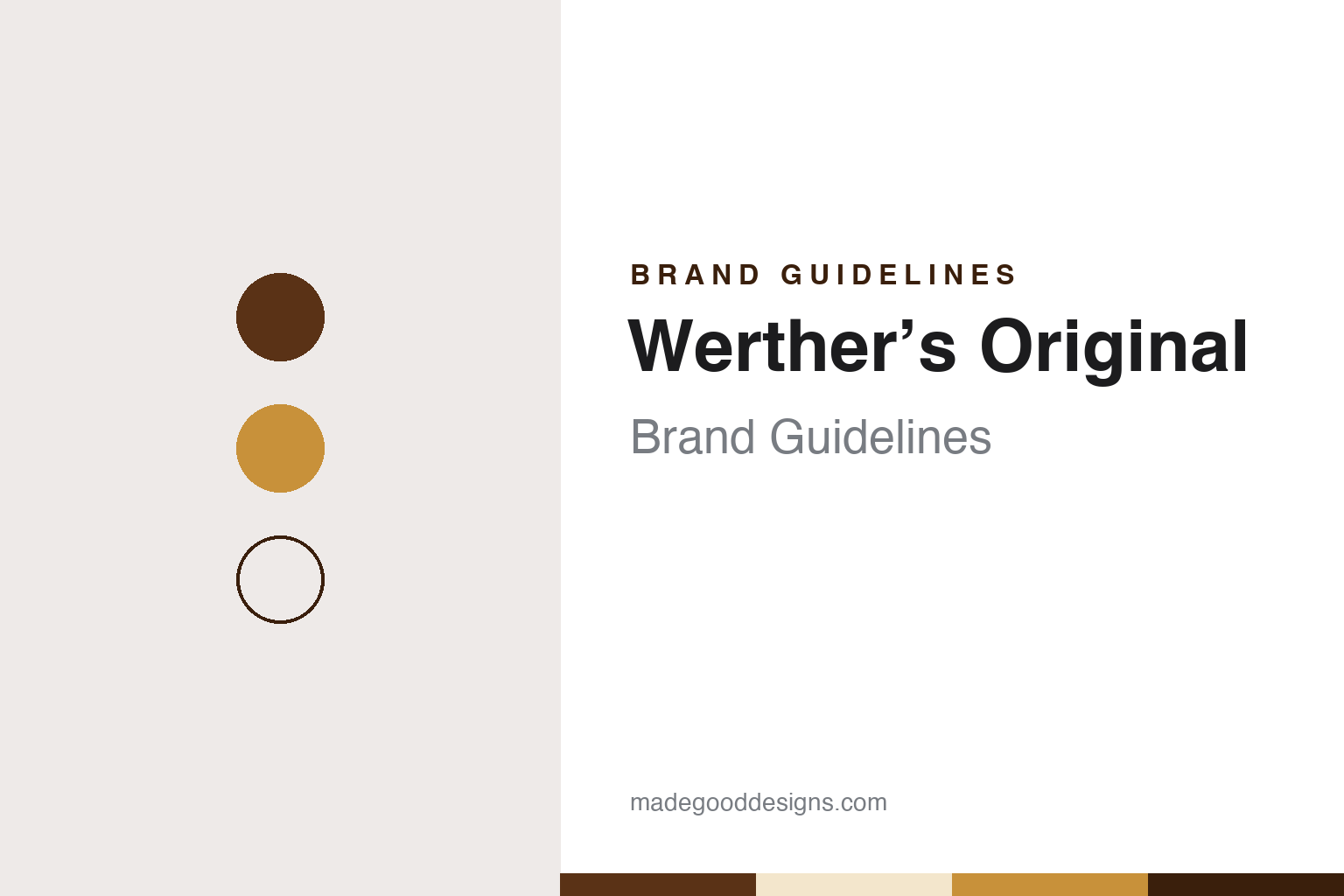
Two constants: a caramel brown, butter gold and cream palette and a traditional serif register. Abstract homage — not a Werther’s Original product or mark; no pack, logo or sweet is reproduced.
The Werther factory
A sugar-confectionery works in a small Westphalian town.
Werther’s Original takes its name from a place. Werther is a small town in East Westphalia, and it was there in 1903 that August Storck — also known as August Oberwelland, the owner of the Oberwelland farm — founded the Werther’sche Zuckerwarenfabrik, the Werther sugar-confectionery factory. Storck’s own history says he began with three employees, a cooking kettle and a panning kettle, and was soon supplying sweets across East Westphalia; by 1909 the company employed about a dozen people.
Storck’s origin story for the caramel belongs to that same year. The company says that in Werther in 1909 the confectioner Gustav Nebel took fresh cream, real butter, white sugar, brown rock sugar, a pinch of salt and plenty of time, and made his best sweet. The wording appears on the brand’s websites and, German Wikipedia says, was printed on the packs in 2011. German Wikipedia, citing the regional cultural body LWL, adds that older residents of Werther confirm Nebel was one of the factory’s first employees.
For decades the company’s sweets were sold without a brand of their own. Storck says the factory was making more than 200 varieties of unbranded sweets by 1921, when the founder’s youngest son, Hugo Oberwelland, took over. In 1934 it cleared them away for a single product, the Storck 1 Pfennig RIESEN, each piece wrapped with its name, the company name and its price; Storck calls it the first branded sweet in Germany. A second plant opened at Schötmar in 1938.
After the Second World War the company moved its production to the neighbouring town of Halle (Westfalen). Storck dates the new factory to 1945; German Wikipedia says the move took place between 1945 and 1949. Storck describes a factory set in open countryside, with a 100-metre caramel hall and its own railway siding. German Wikipedia says the company no longer makes anything in Werther itself.
Colour
Werthers Echte, a new name and a grandfather.
The brand itself arrived late. In 1969 Storck launched Werthers Echte — “the genuine ones from Werther” — in Germany, one of a run of brands the company introduced in quick succession. German Wikipedia lists nimm2 in 1962, merci in 1965, Campino in 1966 and Toffifee in 1973. Storck’s history says the 1969 caramel combined fine butter and fresh cream and drew on nearly 70 years of experience making caramels.
The English name came with international growth. Storck’s company history places the change from Werthers Echte to Werther’s Original in the 1990s, and an archived version of the same history, from 2013, dates the international renaming to 1998. German Wikipedia says the sweets have carried the English name in Germany, too, since 1998. Storck’s management moved to Berlin the same year, and the company is still based there, German Wikipedia says, while its main plant remains in Halle.
The brand is best remembered for its advertising. Storck’s archived history says the brand “brought generations together” through the story of a grandfather and grandson. The two brand websites date the campaign differently: the English site places it under 1985, the German site under 1998. The BBC, in its 2013 obituary of the actor Arnold Peters, best known for The Archers, reported that he appeared as a grandfather in television advertisements for Werther’s Original in the 1990s. German Wikipedia says the German television spots were set to the song “Everything I Own” by David Gates of Bread, citing the Hannoversche Allgemeine Zeitung in 2010.
German Wikipedia also notes how little the brand now has to do with its namesake. The advertising draws on small-town motifs, it says, but does not use footage from Werther, and the town presents itself as the town of the painter Peter August Böckstiegel rather than of the sweets.
Typography
Design and documentation.
The seven brands in this group all make sweets and gummies, and they come from Germany, Sweden, Britain and the United States: Katjes, Trolli, Werther’s Original, Cloetta, Maynards Bassetts, Swizzels and Jelly Belly. Sweet and gummy brands in general sit at many different points in the trade, from family firms that still carry a founder’s surname to names that now belong to much larger confectionery groups, and a single brand can be sold everywhere from a corner shop to a supermarket aisle.
A sweet brand’s identity is usually carried less by a single product than by a pack, a name and the treat it promises, because the company behind the name may have changed hands, moved its factory or grown far beyond the town where it started. That makes the questions behind each name worth asking plainly: who started it, who owns it now, and where its sweets are actually made and packed.
Each guide separates what independent sources record from what the company says about itself — its founding story, its owners over time, where its sweets are made and how its packaging has changed — and marks plainly what rests only on the company’s own word.
Aa
A traditional serif for a brand built on a story about the old days. (Specimen set in Playfair Display, a serif STAND-IN; NOT the Werther’s Original logo.)
Werther’s Original
From one hard caramel to a family of products.
Werther’s Original is still owned by the family company that created it. August Storck KG is run by the founder’s descendants: Klaus Oberwelland took over in 1971 and Axel Oberwelland has chaired the management since 2003, German Wikipedia and Storck say. For its centenary in 2003 Storck adopted a new logo and the slogan “Part of Your World,” and since then, German Wikipedia says, the Storck name has appeared on every one of its brand packs. Storck calls Werther’s Original its most international brand and says it is sold in more than 100 countries.
The range has grown well beyond the original hard caramel. The German brand site lists a sugar-free version in 2005, Werther’s Original Eclair and Caramel & Crème in 2008, chocolate-and-caramel specialities including Caramelts the same year, caramel popcorn in Germany from August 2018, soft caramels in 2019 and Caramel Bites in 2023. The English site adds that a Karamell-Küche presented by Werther’s Original opened at Epcot, at Walt Disney World, in 2010.
Storck does not say on its brand pages which plant makes which product. It has three German factories: the main plant in Halle, a Berlin plant opened in 1967 for chocolate, and a plant at Ohrdruf, in Thuringia, opened in 1993, which Storck says makes chocolate specialities and caramel. English Wikipedia says Werther’s Original is made in Halle.
For a design guide, Werther’s Original shows how a sweet can be sold on a story of origin and family as much as on its pack. Compare Katjes and Trolli, two other German sweet makers. For this guide we use a caramel brown, a butter gold and a warm cream with a serif, an unofficial interpretation; no product or logo is reproduced.
Explore & save
Keep Werther’s Original’s identity on hand — save it to a board in the Made Good inspiration library.
Werther’s Original identity set
Pin the Werther’s Original caramel brown, butter gold and cream palette and the traditional serif register to your own board.