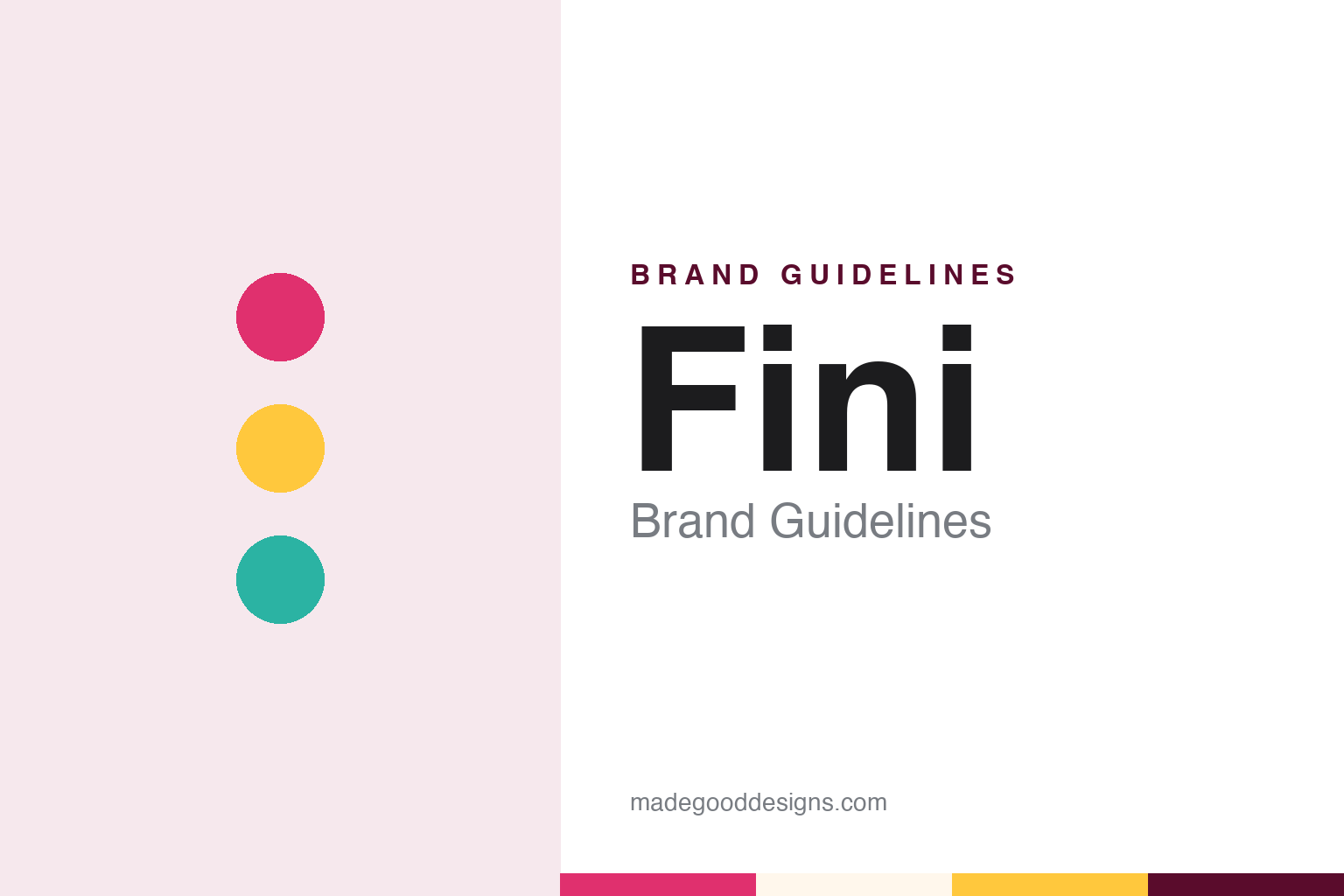
Fini Brand Guidelines
The Molina de Segura gummy maker that grew up in Brazil.
Aa
Two constants: a gummy pink, sherbet yellow and mint green palette and a bouncy rounded sans register. Abstract homage — not a Fini product or mark; no pack, logo or sweet is reproduced.
Chewing gum in Molina de Segura
A kitchen, a family and a town outside Murcia.
Fini is a family business from Molina de Segura, a town just north of Murcia in south-eastern Spain. The company says its history began there in May 1971 as a small, artisan chewing-gum factory run by Manuel Sánchez Cano, and it dates the birth of the Fini brand to the same year. Spanish Wikipedia, citing José Luis Munuera Alemán’s 2010 book Casos de éxito de las empresas murcianas, puts the start a little earlier: it says Sánchez Cano founded a small chewing-gum factory in Murcia in 1953 and widened production to other sweets in 1971, the year Fini was officially founded. English Wikipedia also records the 1953 gum factory, citing the Brazilian site Dr. Curioso.
The company tells the early years as a family story. Its history page describes Sánchez Cano as the son of farmers who started work at the age of 12 and was over 40 when he founded the business with his wife and children. It says the recipes were first worked out in the family kitchen, while the children packed the sweets and delivered them by bicycle through the streets of Murcia. Chewing gum, jelly sweets, marshmallows and liquorice followed one another, and the company says the first products were tutti-frutti flavoured. Its Spanish history page describes the journey from handmade gum in the 1970s to wrapping machines that turn out 1,200 pieces a minute.
Growth began early. The company says its sweets were being distributed in Europe from 1980, and Spanish Wikipedia, citing El País, says that in the 1980s Fini opened distribution centres in Portugal and Spain. By March 2024 El País was describing the company, in the headline of a profile, as the business that had turned Molina de Segura into the world capital of “chuches,” the Spanish word for sweets. The sweets are sold as Fini, and Spanish business press such as Europa Press and Murcia Economía refers to the Spanish company as Fini Golosinas.
Colour
Dentures, worms and a second home in Brazil.
Fini’s largest market is not Spain but Brazil. The company’s timeline says Brazil received its first Fini sweets in 1998 — sweets shaped as dentures and worms — and that the company opened its second factory, in the state of São Paulo, in 2001. English and Spanish Wikipedia place that factory at Jundiaí and describe it as the company’s only production site outside Europe; Europa Press, reporting a company statement in August 2021, gave 2002 as the date the Brazilian factory began. The company says it started making marshmallows in Brazil in 2003. English Wikipedia, citing the Brazilian marketing magazine Propmark in 2014 and Revista Economia S/A in 2018, describes Fini as the confectionery market leader in Brazil, and the company today calls Brazil its second production country.
The range has grown well beyond gum. The company’s timeline lists the launch of a sweet called Fini Boom in 2000, its own shops from 2012 and a new chewy-candy category in 2020. In 2018, it says, Fini ran a Spanish television spot built around the question “Hey you, stop and think, do you think you had fun today?” Spanish Wikipedia, citing El País, says Fini moved into ice cream in Brazil in 2019 in partnership with Froneri, and into lip balm in 2023 with the Brazilian company Cimed; UOL reported the ice-cream launch in October 2019.
Partnerships have become part of the brand’s image. Forbes Spain reported an alliance with the Inditex fashion chain Lefties to sell Fini products through its stores, and Murcia Economía reported in October 2024 that Fini Golosinas had been named in the Pioneer category of the Kantar Outstanding Innovation Awards 2024. The paper said the jury singled out the company’s collaborations with brands outside confectionery, among them Harry Potter, Havaianas and Lefties, and quoted the global marketing director of The Fini Company, Pablo Moreno, on opening new lines of business in a creative way.
The company has also put its colours into its own buildings. Spanish Wikipedia, citing the architecture firm IDEA TSG, says the company’s corporate offices were refurbished with themed spaces inspired by Fini’s characteristic colours and shapes, planting and low-impact materials, in a project designed to give staff a bright and creative place to work.
Typography
Design and documentation.
The seven brands in this group all make sweets or chocolate, and they come from four European countries — Germany, Britain, Spain and Finland: Maoam, Barratt, Walker’s Nonsuch, Toffifee, Merci, Fini and Panda. European confectionery brands in general sit at many different points in the trade, from family firms that still carry a founder’s surname to names that now belong to much larger food groups, and a single brand can be sold everywhere from a corner kiosk to a supermarket shelf.
A confectionery brand’s identity is usually carried less by a single sweet than by a pack, a name and the treat it promises, because the company behind the name may have changed hands, moved its factory or grown far beyond the town where it started. That makes the questions behind each name worth asking plainly: who started it, who owns it now, and where its sweets are actually made and packed.
Each guide separates what independent sources record from what the company says about itself — its founding story, its owners over time, where its sweets are made and how its packaging has changed — and marks plainly what rests only on the company’s own word.
Aa
A bouncy rounded sans for a brand built on gummies. (Specimen set in Baloo 2, a sans STAND-IN; NOT the Fini logo.)
Fini
A family company with a new corporate name.
Fini has stayed in the hands of the family that founded it. English Wikipedia, citing Propmark, and Spanish Wikipedia both give the owner as Grupo Sánchez Cano, and the company’s history pages describe a family business started by Manuel Sánchez Cano and continued with his son Antonio Andrés. In an interview with the Spanish trade magazine Sweet Press in April 2020, Antonio Andrés Sánchez Bernal spoke as the company’s chief executive; in August 2021 Europa Press quoted Manuel Sánchez Cobian as chief executive of Fini Golosinas.
In 2021 the group adopted a new umbrella name. The company says The Fini Company is a global corporate brand launched that year to connect its commercial brands, Fini and the supplement brand Dr. Good. Europa Press reported the change in August 2021, alongside a company statement that sales had risen 45% in the first half of the year to €146 million and that it had made a record 40 million kilos of sweets in those six months, in the year Fini Golosinas marked 50 years in Spain and 20 years in Brazil. Sweet Press had reported turnover of €224 million for 2019, with exports accounting for 77% of production, and later reported that the company reached €260 million in 2021.
Production is split between two countries. The company says it has two factories, one in Spain and one in Brazil, which together supply around 111 million kilos of sweets a year to their home markets, to its international subsidiaries and to the more than 100 countries where the brand is sold. Its site lists subsidiaries in Chile, Colombia, Ecuador, France, Italy, Morocco, Peru, Portugal and the United Kingdom, and says the group employs more than 3,600 people. Europa Press reported in 2021 that the products were sold through more than 300,000 points of sale.
For a design guide, Fini shows how a family gum maker from a small Spanish town can build a bright, playful brand that travels — strong enough to become a market leader in Brazil and flexible enough to appear on lip balm and in fashion stores. Compare Trolli, the German gummy maker, and Katjes, the liquorice and fruit-gum brand from Emmerich. For this guide we use a gummy pink, a sherbet yellow and a mint green with a rounded sans, an unofficial interpretation; no product or logo is reproduced.
Explore & save
Keep Fini’s identity on hand — save it to a board in the Made Good inspiration library.
Fini identity set
Pin the Fini gummy pink, sherbet yellow and mint green palette and the bouncy rounded sans register to your own board.