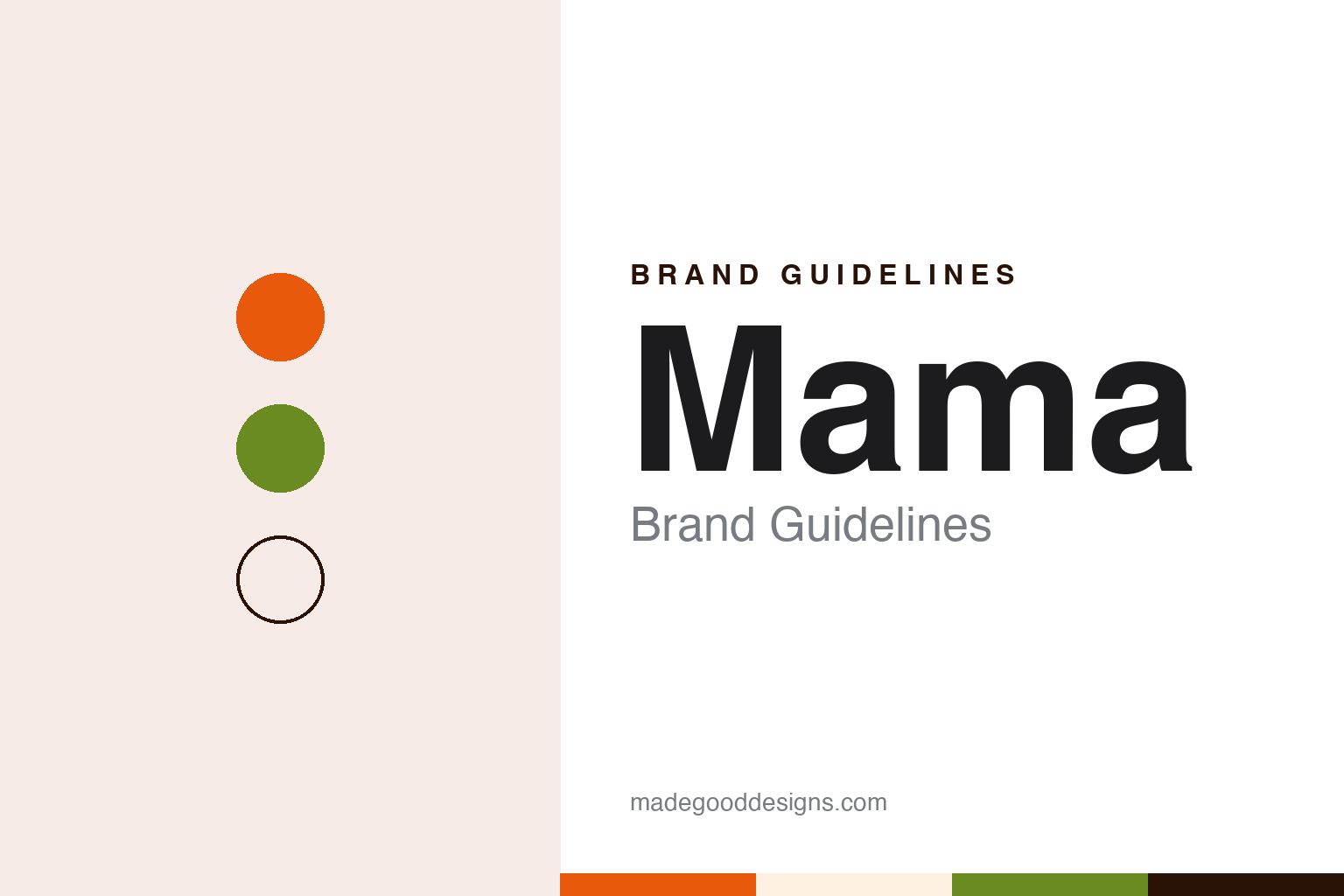
Mama Brand Guidelines
Thai President Foods’ instant noodle since 1972.
Aa
Two constants: a Mama tom yum orange and lemongrass palette and a Rounded sans register. Abstract homage — not a Mama product or mark; no pack, logo or label is reproduced.
A Thai–Taiwanese venture
Technology from Taiwan, sales from Saha.
Mama is the instant-noodle brand of Thai President Foods, a Bangkok company that says it was “established on 15 February 1972” as a joint venture between President Enterprise Co., Ltd. of Taiwan and Saha Pathanapibul, the Thai consumer-goods distributor; English Wikipedia gives a different date, 18 April 1972. Thai Wikipedia describes the division of roles: the Taiwanese partner brought instant-noodle production technology, while Saha Pathanapibul handled marketing and sales in Thailand. Thai Wikipedia says Saha Pathanapibul distributes the brand to this day, and that the company began with registered capital of six million baht.
The first head office, Thai Wikipedia says, was on New Phetchaburi Road, and the first factory was in Nong Khaem, a district of Bangkok — the company also names Nong Khaem as its original plant. According to the company, full production of chicken-soup flavoured instant noodles under the “MAMA” brand name began in 1973. The brand is written in capitals, MAMA, in the company’s English material, and as มาม่า in Thai.
The venture soon became a Thai-run business. Thai Wikipedia says that in 1973 the Taiwanese shareholders transferred their shares to the major Thai shareholders, who have managed the company since. In 1975, it adds, the company set up President Commercial to distribute its products, and in 1976 it opened a second factory at Si Racha, in Chonburi province, on the eastern seaboard.
In 1978 Thai President Foods listed on the Stock Exchange of Thailand, according to both the company and English Wikipedia. The same year, the company says, Nissin Confectionery of Japan transferred biscuit-making technology to it, and Thai Wikipedia says a biscuit factory was built at the Si Racha site. In 1986, with Si Racha running at full capacity, the Nong Khaem plant was closed, and in June 1992 the head office moved to Srinakarin Road, where it remains, Thai Wikipedia says.
Colour
Partners, flavours and a market lead.
Thai President Foods grew through partnerships. Thai Wikipedia lists a joint venture with Myojo Foods in 1984 to make premium noodles under the Myojo name; a fresh-bread venture, President Bakery, in 1985, under the Farmhouse brand; and, in 1990, President Danish Foods, formed with Denmark’s Danish Fancy Food Group to make cookies under the Kjeldsens name, a stake it raised to almost the whole company in 2000. On 16 May 1994 Thai President Foods became a public company and, the same year, invested in Nissin Foods (Thailand), Thai Wikipedia says. In August 1999 its biscuit brand was renamed from Nissin to Bissin.
The Japanese link is reflected in the shareholder register. English Wikipedia, citing figures for October 2017, gives Saha Pathana Inter-Holding 25 per cent and Nissin Holdings 16 per cent, with the rest held by families including the Chokwatana, Tatiyakawee, Poonsakudomsin and Paniangvait families. It names Pipat Paniangvait as chief executive.
Mama’s flavours track Thai cooking. Thai Wikipedia dates a moo nam tok flavour, after the grilled-pork dish, to 2000; tom yum pork and a pho taek seafood flavour to 2001; and a creamy tom yum kung to 2002. In 2007 came Oriental Kitchen, a premium Korean-style noodle, and Ruski, a line for Muslim consumers; in 2008, the premium Super Bowl range with retort-packed meat; and in 2009 the original chicken-soup flavour returned, Thai Wikipedia says.
The brand leads its home market. English Wikipedia says Thai President Foods was the largest instant-noodle maker in Thailand as of 2020, with a market share of more than 50 per cent, and that in 2019 Mama remained ahead of its rivals Wai Wai and Yum Yum. The company also makes biscuits, wafers and other instant foods, and sells further noodle brands, among them Mendake at home and Thai Chef, Greenmate and Kelly for export.
Typography
Design and documentation.
The seven brands in this group all make instant noodles, and they come from Japan, Indonesia, Thailand, Britain, South Korea and Singapore: Nissin, Maruchan, Indomie, Mama, Pot Noodle, Nongshim and Koka. Instant noodle brands in general sit at many different points in the trade, from family firms that still carry a founder’s name to names that now belong to much larger food groups, and a single brand can be sold everywhere from a corner shop to a supermarket shelf on another continent.
An instant noodle brand’s identity is usually carried less by a single product than by a pack, a name and the quick meal it promises, because the company behind the name may have changed hands, opened factories abroad or grown far beyond the city where it started. That makes the questions behind each name worth asking plainly: who started it, who owns it now, and where its noodles are actually made and packed.
Each guide separates what independent sources record from what the company says about itself — its founding story, its owners over time, where its noodles are made and how its packaging has changed — and marks plainly what rests only on the company’s own word.
Aa
A rounded sans — MAMA in capitals. (Specimen set in Baloo 2, a sans STAND-IN; NOT the Mama logo.)
Mama
Made in Thailand and beyond.
Most Mama noodles come from Thailand. The company lists five factories there: Si Racha in Chonburi, Lamphun in the north, Rayong on the eastern seaboard, and two at Ratchaburi, west of Bangkok. It dates the Lamphun plant to 1995; Thai Wikipedia says that factory was built on a site of 37 rai with investment-promotion privileges, and that in 2008 the company moved all its biscuit, wafer and cookie production from Si Racha to Rayong, using the space at Si Racha to make more cup noodles.
It also manufactures abroad. The company names three foreign production subsidiaries: Thai President Foods (Hungary), at Esztergom; President Foods (Cambodia), in Phnom Penh, in which Thai Wikipedia says it took a 30 per cent stake in 2001; and Kallol Thai President Foods, in Dhaka, Bangladesh. English Wikipedia also lists a plant in Yangon, Myanmar. Thai Wikipedia adds a 1992 joint venture in Kunming to make noodles for the Chinese market.
The company says its products are “available in over 60 countries around the world for more than 40 years,” and that it makes private-label noodles for leading companies in Europe, the United States and Australia; those are its own descriptions.
For a design guide, Mama shows a brand built on its home cuisine and a long partnership between a Thai distributor and Japanese and Taiwanese food makers. Compare Indomie, Indonesia’s noodle of the same year, 1972, and Nissin, the Japanese noodle maker that is now one of Thai President Foods’ shareholders. For this guide we use a tom yum orange and a lemongrass green with a rounded sans, an unofficial interpretation; no product or logo is reproduced.
Explore & save
Keep Mama’s identity on hand — save it to a board in the Made Good inspiration library.
Mama identity set
Pin the Mama tom yum orange and lemongrass palette and the Rounded sans register to your own board.