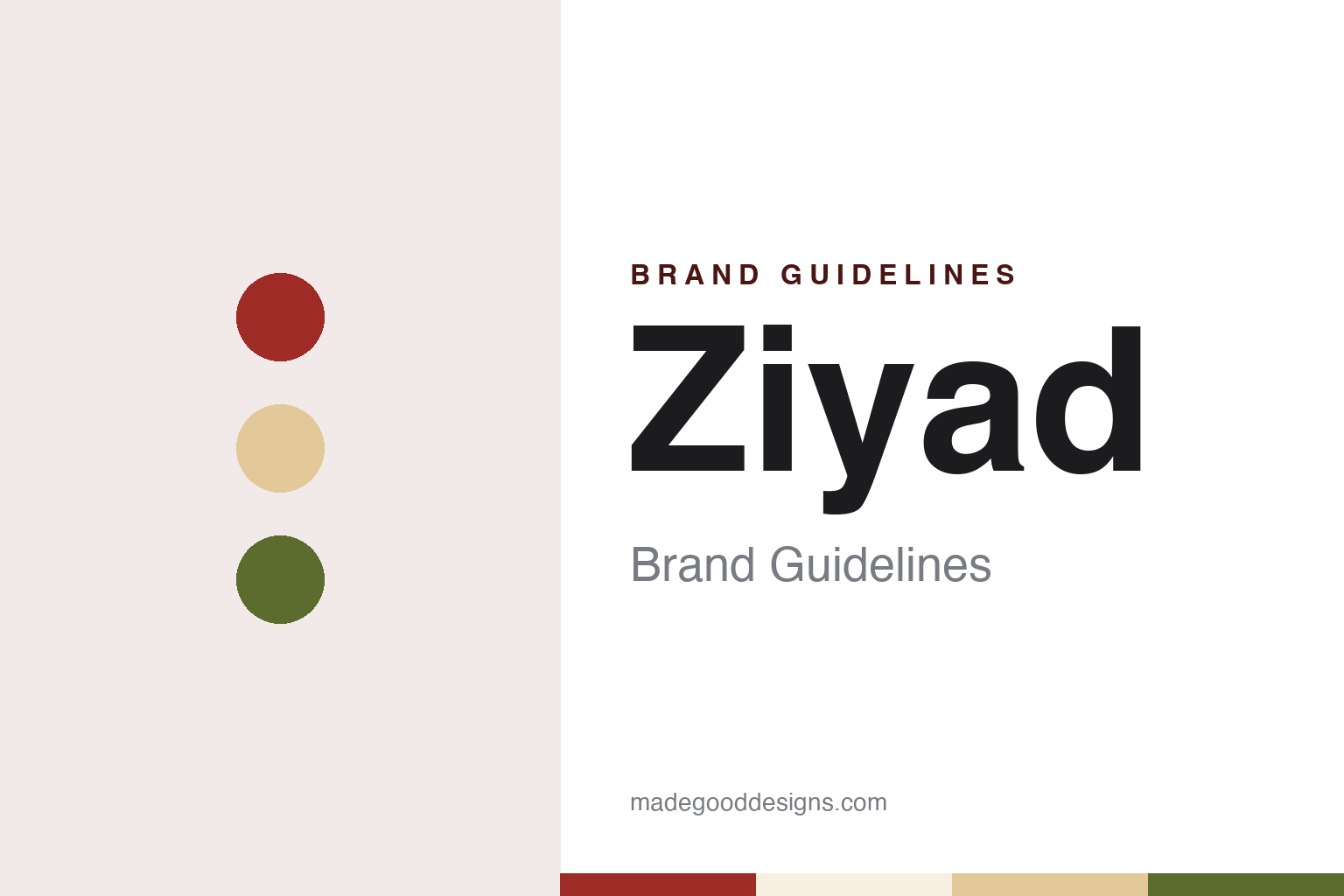
Ziyad Brand Guidelines
The Chicago pita bakery that became a Middle Eastern pantry.
Aa
Two constants: a sumac red, tahini sand and olive palette and a warm bookish serif register. Abstract homage — not a Ziyad product or mark; no pack, logo or food is reproduced.
A bakery on the South Side
Two brothers, a pita oven and a grocery shelf.
Ziyad began as a bakery. The company says that in 1966 the brothers Ahmad and Ibrahim Ziyad set up Syrian Bakery & Grocery, Inc. on the South Side of Chicago, making hand-made pita bread and importing foods from the Middle East to sell alongside it. The company describes that shop as the first pita bakery in Chicago. Its later press releases, issued through the private investment firm Peak Rock Capital in 2022 and 2023, repeat the same origin in brief: Ziyad was “founded as a small bakery in 1966 in Chicago.”
The bread drove the early growth. In the 1970s and 1980s, the company says, the brothers moved into a warehouse at 21st Street and Western Avenue and built what it calls the region’s first automated pita production line. That let them sell beyond their own counter to the big Chicago-area supermarket chains, and the company names Jewel and Dominick’s among the early customers. By the 1980s, it says, Ziyad was distributing in about 20 states and had become known as a main source of Middle Eastern foods for American shops.
The name on the door changed along the way. The business that began as a bakery and grocery trades today as Ziyad Brothers Importing, and the family name became the brand on its own packs, sold as the Ziyad brand. The consumer website frames the brand around the family rather than a single product: for generations, the company says, the Ziyad family has travelled to find the foods of the Middle East and the Mediterranean and bring them home to American kitchens.
Colour
An importer’s brand, built on supplier relationships.
Ziyad is an importer first, so the question of where its foods are made has a different answer from that of a factory brand. The company does not present itself as a manufacturer of most of what carries its name. Instead it says it has long-standing relationships with leading growers and suppliers of traditional products in the regions they come from, and that it brings those foods to North America. Its consumer site puts tahini, yoghurt and labneh, sumac, cardamom and pita bread at the front of the range, and its trade site adds dates, za’atar, honey, rice, tomato paste and coffee.
Alongside its own label, Ziyad sells other companies’ brands. Peak Rock’s 2022 release said Ziyad partners with dozens of companies on an exclusive basis to bring their brands to the North American market. Ziyad’s trade website names partner brands including Al Ameed coffee, Sultan olive oil and frozen vegetables, and Egypt’s Best rice, and lists American grocery chains it supplies, from Kroger, Albertsons and Meijer to Whole Foods, Walmart, Jewel-Osco and Mariano’s, as well as independent grocers.
The size of the range depends on who is counting and what. Peak Rock’s release of February 2022 described a portfolio of more than 800 products, or SKUs. The company’s trade site speaks of more than 1,500 products, while the story page on its consumer site says Ziyad imports and distributes more than 3,000 items across North America, Central America and the Caribbean. What all three describe is the same model: one family brand on the front of the shelf, and a distribution business behind it that carries both Ziyad-branded foods and the brands of its partners.
Typography
Design and documentation.
The seven brands in this group all make food, and they come from Saudi Arabia, Kuwait, Lebanon, the United States and Turkey: Almarai, Americana, Al Wadi Al Akhdar, Cortas, Ziyad, Tamek and Eti. Middle Eastern and Turkish food brands in general sit at many different points in the trade, from family firms that still carry a founder’s name to names that now belong to much larger food groups, and a single brand can be sold everywhere from a neighbourhood grocer to a supermarket shelf abroad.
A food brand’s identity is usually carried less by a single product than by a pack, a name and the meal or snack it promises, because the company behind the name may have changed hands, moved its factory or grown far beyond the town where it started. That makes the questions behind each name worth asking plainly: who started it, who owns it now, and where its food is actually made and packed.
Each guide separates what independent sources record from what the company says about itself — its founding story, its owners over time, where its products are made and how its packaging has changed — and marks plainly what rests only on the company’s own word.
Aa
A warm bookish serif for a family name that became a pantry label. (Specimen set in Lora, a serif STAND-IN; NOT the Ziyad logo.)
Ziyad
Cicero, a second generation and a private-equity partner.
In 1995, the company says, Ziyad bought a 150,000-square-foot building in Cicero, Illinois, just west of Chicago, which has been its headquarters and main base since. The second generation of the family then led the business, and the company says it went on to open distribution centres in New Jersey and in the Los Angeles area. Peak Rock’s 2022 release describes the same footprint: a company headquartered in Chicago with additional facilities in New Jersey and California, selling to specialty grocers, supermarkets, national accounts and e-commerce platforms.
The ownership changed in 2022. On 11 February 2022 Peak Rock Capital, a private investment firm based in Austin, Texas, announced that one of its affiliates had completed the acquisition of Ziyad Brothers “in partnership with” the company’s management team and the Ziyad family. The release called Ziyad a business with a 50-year track record and said Nassem Ziyad had been named chief executive in connection with the deal; it was Peak Rock’s thirteenth investment in food, drink and consumer companies, the firm said. By March 2023 Ziyad’s own release named Jim Wagner as chief executive and Nassem Ziyad as executive chairman.
That March 2023 release announced Ziyad’s first acquisition under the new owner. On 20 March 2023 Ziyad said it had bought Vintage Food Corp., a distributor of Turkish, Middle Eastern and Eastern European food and drink brands, headquartered in Kearny, New Jersey, and founded as a small distribution business in Brooklyn in 1992. Vintage supplied more than 2,000 products, the release said, and its president, Levent Demirgil, joined Ziyad to keep running the Vintage business. Ziyad described the two companies’ brand portfolios and geographic reach as complementary, and its consumer site now presents the purchase as a widening of its Turkish, Middle Eastern and Eastern European range.
For a design guide, Ziyad shows how an immigrant family’s bakery name can become the label on an importer’s whole shelf of foods. Compare Goya, another American importer built on a family-run grocery trade, and Cortas, the Lebanese pantry brand. For this guide we use a sumac red, a tahini sand and an olive green with a warm serif, an unofficial interpretation; no product or logo is reproduced.
Explore & save
Keep Ziyad’s identity on hand — save it to a board in the Made Good inspiration library.
Ziyad identity set
Pin the Ziyad sumac red, tahini sand and olive palette and the warm bookish serif register to your own board.