Lantic Brand Guidelines
The Montréal sugar refiner that joined Rogers of Vancouver.
Aa
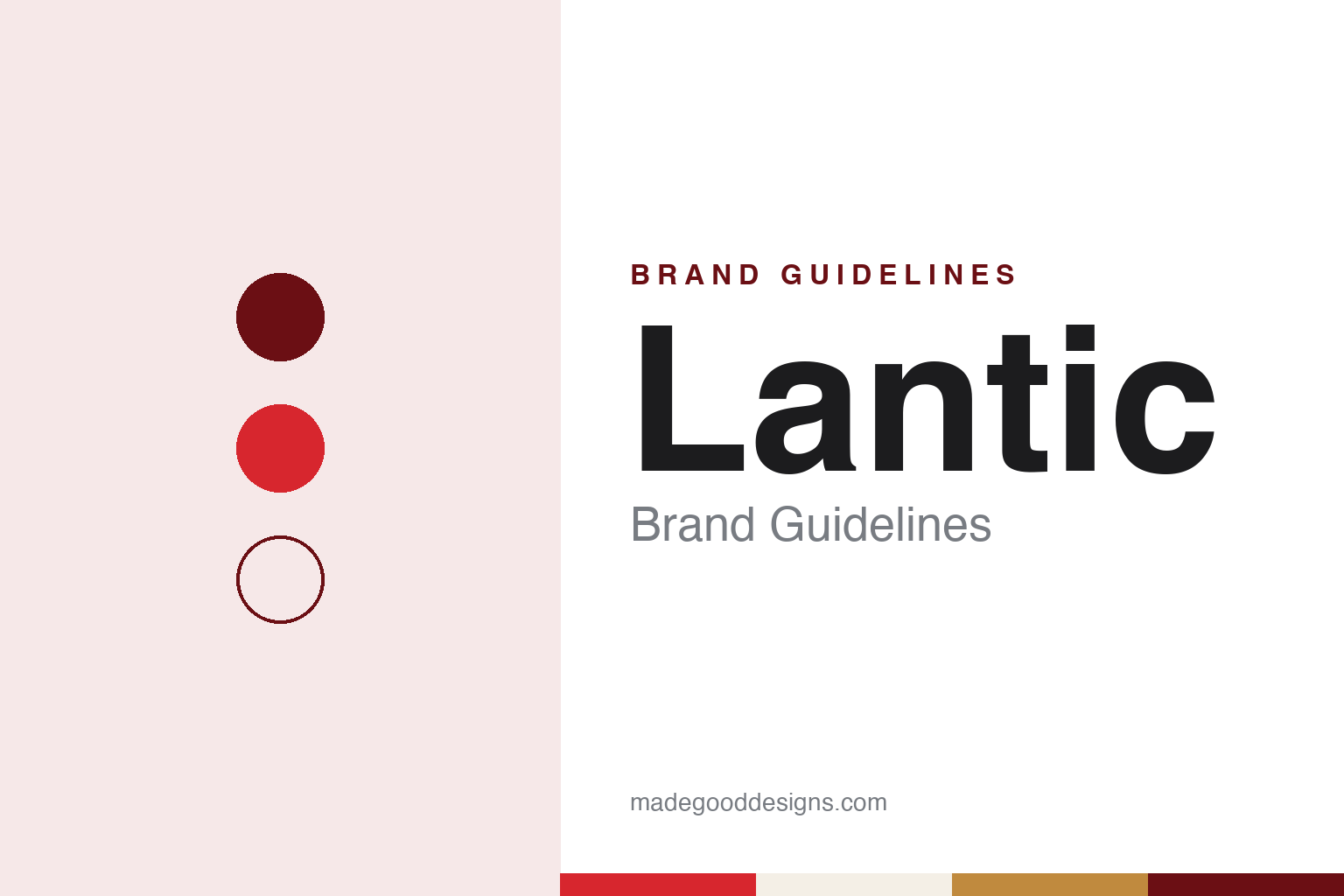
Two constants: a refinery red, granulated white and golden-syrup palette and a warm heritage serif register. Abstract homage — not a Lantic product or mark; no bag, logo or wordmark is reproduced.
Two Eastern refineries
A Montréal riverside plant and a Saint John refiner.
Lantic is the sugar brand of Lantic Inc., a Montréal company that says it has been part of the Canadian food industry since 1888. That date belongs to its Montréal refinery: the company says St. Lawrence Sugar built its original cane refinery on the shores of the St. Lawrence River that year, and the plant, much upgraded since, still stands in the city’s Notre-Dame district, where Lantic has its head office.
The Lantic name comes from a different company. Lantic Sugar, the company says, has its roots in the Acadia Sugar Refining Co., a Scottish corporation formed from three refinery operations in Nova Scotia, which was succeeded in 1912 by Atlantic Sugar Refineries when that firm built a cane-sugar refinery in Saint John, New Brunswick. Wikipedia, citing the Canadian Sugar Institute, describes Atlantic Sugar Refineries as formed in 1912 from the merger of three refineries, including Acadia, established in Halifax in 1893, and says the company was later renamed Lantic Sugar Limited.
The two Eastern businesses came together in the 1980s. From 1981 to 1990 Lantic Sugar was owned by Steinberg’s, the Québec supermarket chain, Wikipedia says. In 1981 Lantic began what the company calls a programme of diversification and rationalisation, and in 1984 it bought St. Lawrence Sugar in Montréal. In 2000 Lantic consolidated its refining in Montréal and closed the Saint John plant, reinvesting in the Montréal refinery in an expansion and upgrade that the company says doubled its capacity; Wikipedia, citing the company, says the work was completed in December 2000.
Colour
B.T. Rogers, the railway and a golden syrup.
The other half of today’s company began on the Pacific. Benjamin Tingley Rogers, born in Philadelphia in 1865 into a family of American sugar refiners, learned sugar boiling at the Havemeyers and Elder refinery in Brooklyn, according to the Dictionary of Canadian Biography. In 1889 he was in Montréal installing a filtering process at George Drummond’s Canada Sugar Refinery when he heard about Vancouver, the new western terminus of the Canadian Pacific Railway, and saw an untapped market. The company says Rogers recognised the high cost of shipping refined sugar by rail from Montréal.
The railway backed him. CPR president William Van Horne and other CPR directors bought shares in the British Columbia Sugar Refining Company, the Dictionary says; on 15 March 1890 Vancouver’s electors approved a bylaw granting the venture a site, tax exemptions and free water, and the company was incorporated on 27 March. The first raw sugar was melted on 16 January 1891. Rogers became president in 1897; he died in Vancouver in 1918. The company calls the refinery Vancouver’s first major industry not based on logging or fishing.
One product from those years is still on shelves. In 1913, the Dictionary says, Rogers’s chief chemist, Robert Boyd, recruited from the University of Toronto, developed Rogers’ Golden Syrup from the syrupy by-product of refining, and it became a highly successful product. The company still sells Rogers Golden Syrup today.
Rogers also moved into sugar beet. The company says its involvement began in the 1930s with factories at Raymond and Picture Butte in Alberta; a Winnipeg plant ran from 1940 until 1997, and a beet factory at Taber, Alberta, built in 1950, still operates. Lantic describes it as Canada’s only sugar-beet factory.
Typography
Design and documentation.
The seven brands in this group are all food brands, and all of them are Canadian: President’s Choice, Clover Leaf, Maple Leaf, Lantic, Christie, Neilson and Old Dutch. Canadian food brands in general sit at many different points in the trade, from family firms that still carry a founder’s name to names that now belong to much larger food groups, and a single brand can be sold everywhere from a corner store to a national supermarket chain.
A food brand’s identity is usually carried less by a single product than by a pack, a name and the meal or snack it promises, because the company behind the name may have changed hands, moved its factory or grown far beyond the town where it started. That makes the questions behind each name worth asking plainly: who started it, who owns it now, and where its food is actually made and packed.
Each guide separates what independent sources record from what the company says about itself — its founding story, its owners over time, where its food is made and how its packaging has changed — and marks plainly what rests only on the company’s own word.
Aa
A warm heritage serif for a refiner whose roots reach back to 1888. (Specimen set in Fraunces, a serif STAND-IN; NOT the Lantic logo.)
Lantic and Rogers
One company, two regional names and a maple arm.
The Eastern and Western refiners were joined in the 2000s. Rogers Sugar Income Fund was set up in October 1997 and converted into a regular corporation, Rogers Sugar Inc., in January 2011, Wikipedia says. On 30 June 2008 Lantic Sugar Limited and Rogers Sugar Ltd. merged to form Lantic Inc., which Rogers Sugar Inc., listed on the Toronto Stock Exchange, holds in full. The company describes Lantic as Canadian-owned.
The merger kept both names in use. Lantic’s sugar is marketed mainly under the Lantic trademark in Eastern Canada and the Rogers trademark in Western Canada, the company said in April 2026, covering granulated, icing, cube, yellow and brown sugars, liquid sugars and speciality syrups. The company’s press releases carry the Lantic name as a red script wordmark beside a red ROGERS wordmark. It operates cane refineries in Montréal and Vancouver, the Taber beet factory and a distribution centre in Toronto, and in 2023 it began what it calls the largest investment in its history, an expansion and modernisation of the Montréal refinery it names Project Leap.
Maple is the newest line. In 2017 the company bought L.B. Maple Treat and Decacer, and the maple division it formed brought together four family bottlers in Granby, Dégelis and St-Honoré-de-Shenley in Québec and in Vermont, the company says. In April 2026 that business, The Maple Treat Corporation, announced its new name, Lantic Maple Inc.; Rogers and Lantic chief executive Mike Walton said that carrying the Lantic name aligned the division with a trusted brand.
For a design guide, Lantic shows how one company can keep two regional names for the same staple, each with its own wordmark, across a country. Compare Tate & Lyle, the British cane-sugar name, and Lyle’s, whose golden syrup sits beside Rogers’. For this guide we use a refinery red, a granulated white and a golden-syrup amber with a serif, an unofficial interpretation; no product or logo is reproduced.
Explore & save
Keep Lantic’s identity on hand — save it to a board in the Made Good inspiration library.
Lantic identity set
Pin the Lantic refinery red, granulated white and golden-syrup palette and the warm heritage serif register to your own board.