ROM Brand Guidelines
The Romanian rum bar of 1964, wrapped in the national tricolour.
Aa
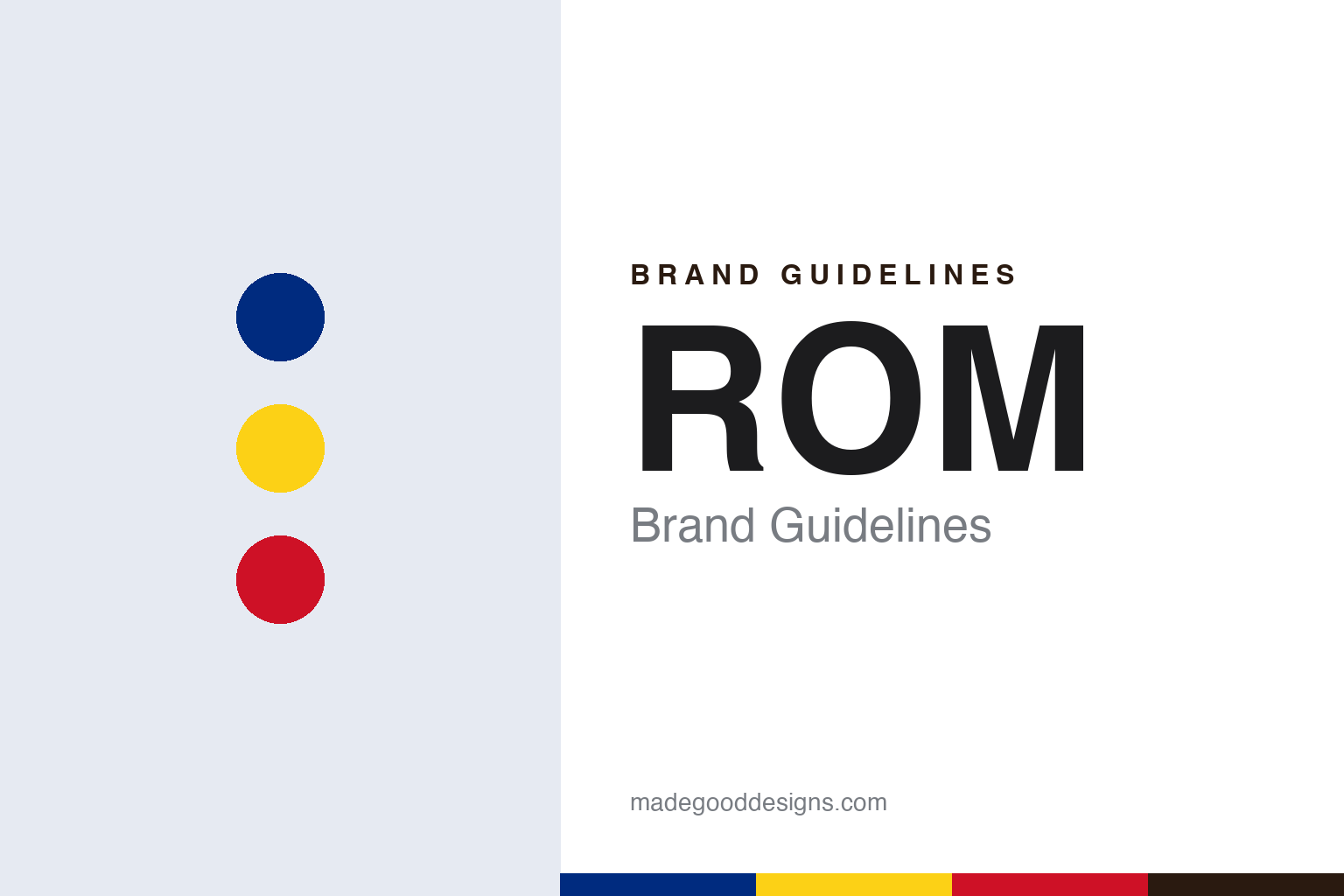
Two constants: a blue, yellow and red tricolour palette with dark chocolate brown and a condensed sans register. Abstract homage — not a ROM product or mark; no wrapper, logo or bar is reproduced.
A rum bar of 1964
A small dark bar with the capital’s name on top.
ROM is a Romanian chocolate bar created in 1964, according to Romanian Wikipedia, citing the newspaper Jurnalul Național; its maker, Kandia Dulce, says the brand has kept its authenticity “since 1964,” together with its “authentic rum taste.” Rom is the Romanian word for rum, the bar’s flavour.
The original product, Romanian Wikipedia says, is a small dark-chocolate bar with rum flavouring, its top engraved with the name of the Romanian capital, “București.” Its wrapper uses the colours of the Romanian flag — blue, yellow and red. Forbes România, in a 2018 profile of the brand, noted that the bar had kept both its original recipe and the “București” engraving, and called ROM the strongest chocolate bar in Romania.
The bar belongs to the lineage of Bucharest’s state confectionery industry. Kandia Dulce says that in 1948 several chocolate and sweets factories were brought together in the Întreprinderea de Produse Zaharoase București, the Bucharest confectionery enterprise. In February 1991, Forbes România reported, the Bucharest enterprise was transformed into the company Excelent București, which held ROM in its portfolio alongside the Kandia, Laura and Măgura marks, and which is today Kandia Dulce.
After 1989 the brand grew beyond the single bar. Romanian Wikipedia, citing Forbes România, says the range widened from small dark bars to other chocolate formats — among them a larger “double” ROM — and to caramels, biscuits and ice cream; Forbes named ROM ice cream, ROM biscuits and ROMToff coated caramels among them.
Colour
From Excelent to Kandia Dulce.
ROM’s owner is a Bucharest company with a second, older name attached. Kandia itself was a confectionery factory in Timișoara, in western Romania, established before 1890, Romanian Wikipedia says. Kandia Dulce tells the story through its own lineage: a small sweets workshop of 1890 that grew into a sweets factory, which in 1917 took the name Kandia, after Candia, the name Crete bore under Venetian rule, the company says.
The two businesses came together in the 2000s. In 2003, Romanian Wikipedia says, the investment fund Rivta sold Kandia to Excelent, a Bucharest company controlled by an investment vehicle of the Austrian Julius Meinl group. From 2004, the company says, Excelent București and Kandia Timișoara were merged as Kandia-Excelent, and from 2005 it invested in modernising its production lines and recipes.
Ownership then changed twice in three years. In 2007 Kandia-Excelent was sold to Cadbury and became Cadbury România, Romanian Wikipedia says. When Kraft bought Cadbury in 2010, the European Commission required it to sell the Romanian business. Here the sources differ on the buyer: Romanian Wikipedia says Julius Meinl bought it back in July 2010, while Kandia Dulce says it was sold to the investment fund Oryxa Capital. Both agree on what followed: in October 2010, according to Romanian Wikipedia, the company returned to an old name and became Kandia Dulce.
Today Kandia Dulce describes itself as a maker of Romanian sweets — chocolate, cakes, caramels, gummies, biscuits and wafers — and its managing director, Dragoș Militaru, has described it to Ziarul Financiar as the largest chocolate producer on the local market, with brands including ROM, Măgura and Făgăraș. Romanian Wikipedia says the company employs about 400 people and operates two factories in Bucharest.
Typography
Design and documentation.
The seven brands in this group all make food or drink, and all of them come from Romania or Bulgaria: Ursus, Timișoreana, Borsec, Dorna, Napolact, ROM and Zagorka. Food and drink brands from these two countries in general sit at many different points in the trade, from names that still carry a town or a region to names that now belong to much larger international groups, and a single brand can be sold everywhere from a village shop to a supermarket shelf.
A food or drink brand’s identity is usually carried less by a single product than by a pack, a name and the taste or occasion it promises, because the company behind the name may have changed hands, moved its production or grown far beyond the place where it started. That makes the questions behind each name worth asking plainly: who started it, who owns it now, and where its products are actually made and packed.
Each guide separates what independent sources record from what the company says about itself — its founding story, its owners over time, where its products are made and how its packaging has changed — and marks plainly what rests only on the company’s own word.
Aa
A tall, condensed sans with a poster voice. (Specimen set in Oswald, a sans STAND-IN; NOT the ROM logo.)
ROM
A flag on a wrapper, and the campaign that swapped it.
ROM’s best-known piece of design is its wrapper, and its best-known campaign turned on changing it. In 2010, Forbes România reported, the advertising agency McCann Erickson created the campaign “American ROM” to reach younger buyers: the bar’s packaging swapped the Romanian flag for the American one, with heavy media coverage. The change set off a public debate about national values, Forbes wrote, and within a few days the bar returned to its original identity. The campaign won the agency two Grand Prix at the Cannes advertising festival in 2011, Forbes România reported — the first time, it said, that Romania had won such a distinction at the festival.
The brand’s voice since has played on national pride and on its own age. Kandia Dulce uses the line “Senzații tari. Românești.” — “strong sensations, Romanian” — and Romanian Wikipedia gives a variant, “senzații tari din 1964,” strong sensations since 1964. Romanian Wikipedia also lists “ROM Autentic” advertisements that parody the communist period. In 2018, the centenary year of modern Romania, ROM removed the lettering from its bar wrapper and kept only the colours of the flag, Forbes România reported.
For a design guide, ROM shows how a pack can carry a whole identity — a flavour, a capital’s name on the bar and a national flag on the wrapper — and how a brand can test that identity in public and keep it. Compare Kalev, Estonia’s long-established confectioner, and Wawel, Kraków’s chocolate maker. For this guide we use tricolour blue, yellow and red with dark chocolate brown and a condensed sans, an unofficial interpretation; no product or logo is reproduced.
Explore & save
Keep ROM’s identity on hand — save it to a board in the Made Good inspiration library.
ROM identity set
Pin the ROM tricolour and dark chocolate palette and the condensed sans register to your own board.